


US urged to fully implement consensus reached by two countries' leaders as China stresses firm opposition to Section 301 tariffs
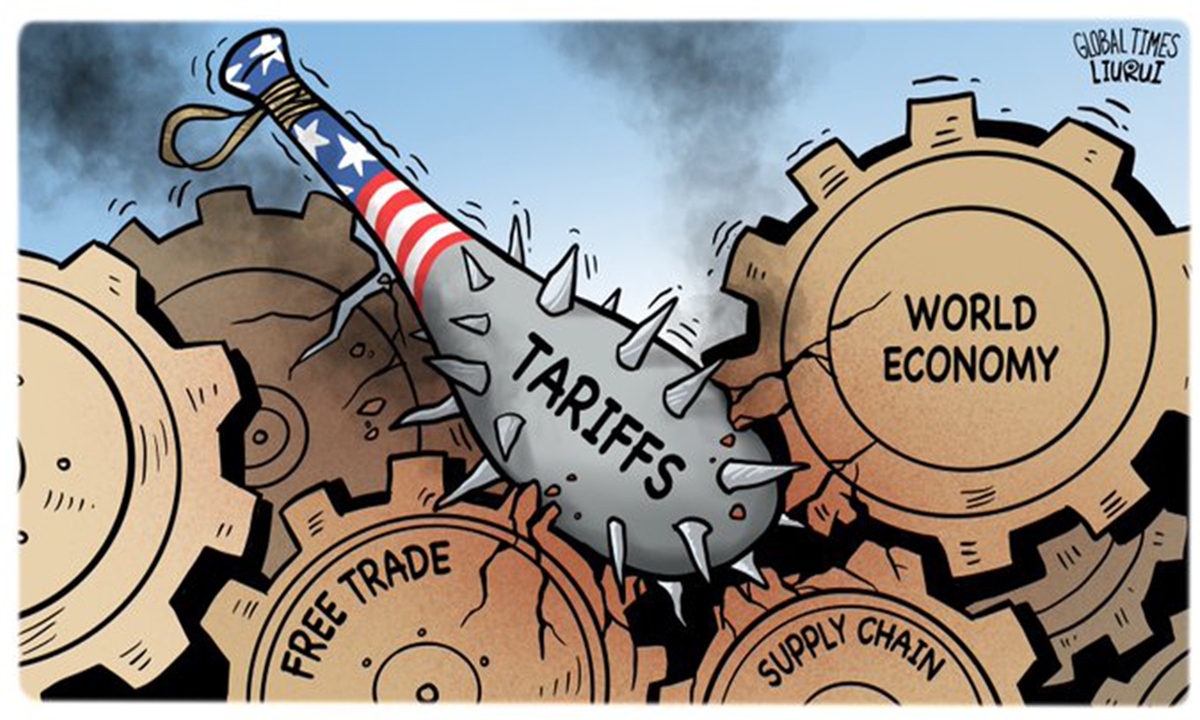
US tariff (Illustration: GT)
Two Chinese government agencies on Thursday reiterated firm opposition to the US' Section 301 tariffs targeting 14 economies, including China, vowing "necessary measures" to safeguard the country's legitimate rights and interests. The coordinated remarks came as the US administration's threatened new tariffs triggered a broader backlash: even the EU and Japan, among Washington's traditional allies, have both objected, with the EU blasting the report from the Office of the US Trade Representative (USTR) as "absurd."
Chinese experts said that the current US administration seems to be sending a signal that it maintains policy tools to build bargaining leverage with major trading partners after the US Supreme Court struck down most of the US administration's tariffs in February and a Republican loss in the midterm elections. However, they are doubtful of the material impact a new round of US tariffs can produce, given that previous US tariffs have already fallen short of their claimed objectives, in addition to the fact that the US' trade partners may not be so accommodating to the US this time.
The China-US relationship is one of the most important bilateral relations in the world today, and the US should fully implement the important consensus reached by the countries' two heads of state, experts said. They urged the US to uphold equality and mutual benefit in economic and trade exchanges, respect others' stage of development and national conditions, while refraining from taking unilateral actions that would pose long-term risks to global economic growth.
Broader backlash"Tariffs and trade wars serve neither side's interests, and China and the US should resolve relevant issues through consultations based on equality, respect, and mutual benefit," Chinese Foreign Ministry spokesperson Guo Jiakun stressed at a regular press conference on Thursday.
"The so-called 'overcapacity' claim is a false proposition, and China opposes using it as a pretext for political manipulation. The two sides should work together to deliver on the important common understandings between the two heads of state and maintain the steady growth momentum of China-US economic and trade relations," Guo said, stressing China will continue to take necessary measures to safeguard its legitimate rights and interests.
China's Ministry of Commerce (MOFCOM) spokesperson He Yadong on Thursday also strongly criticized the US Section 301 investigation as a typical act of unilateralism that seriously undermines the international economic order and violates WTO rules, stressing China's firm opposition.
He urged the US to correct its wrongdoing and return to the right track of resolving disputes through dialogue and consultations. China will closely monitor developments and reserves the right to take necessary measures to resolutely safeguard its legitimate rights and interests, He said.
The USTR claimed on Wednesday (US time) that the acts, policies, and practices of 14 economies relating to structural excess capacity and production in manufacturing sectors are unreasonable and burden or restrict US commerce and are thus actionable under Section 301(b) of the Trade Act. In a statement on the USTR website, the proposed rate for China is 20 percent, 15 percent for the EU, 15 percent for Japan, and 25 percent for India, among other economies.
"By imposing those unilateral tariffs, the US gravely violates WTO rules and seriously damages the rules-based multilateral trading system and the international economic and trade order," Huo Jianguo, former president of the Chinese Academy of International Trade and Economic Cooperation under the Ministry of Commerce, told the Global Times on Thursday.
It's unrealistic for the US to bend the global trading system to benefit itself alone, Huo said. The current US administration's so-called "reciprocal tariffs" imposed in April 2025 have proven to be a failure, as inflation continues to rise at home while global trade carries on much as before, he said, noting that new tariffs will be unlikely to produce much effect globally but only show how capricious Washington is.
As of Thursday, multiple countries, including the US' allies, have harshly slammed the US' fresh tariff threats. The chair of the European Parliament's trade committee, Bernd Lange, lambasted the conclusions of the USTR report as "absurd," Politico reported on Wednesday (EU time).
"Neither the [US] Supreme Court ruling nor the verdict of the voters has swayed Donald Trump. When a court strikes down the legal basis for his tariffs, he looks for another. His aim remains the same. He uses tariffs to put pressure on trading partners and wring ever more concessions out of them," Lange said, per the Politico report.
Japan has protested to the US over its plans to impose new tariffs, Bloomberg reported on Thursday.
Brazilian President Luiz Inacio Lula da Silva has voiced outrage over new tariffs proposed by the Trump administration on Brazilian aircraft and sugar, Al Jazeera reported. Brazil was not ruling out "reciprocal measures," Lula's office said in a statement on Wednesday.
Washington urged to deliver"The reactions from these countries reflect just how unpopular US tariffs have become, and some are bound to respond with reciprocal measures of their own," Li Haidong, a professor at China Foreign Affairs University, told the Global Times on Thursday, urging the US to fully implement the important consensus reached by the two heads of state and maintain healthy development of China-US trade to inject more certainty into the global economy.
"In a major year for China-US relations, stability is the top priority on both sides — and with Washington hosting the G20 and to invite Beijing, the groundwork for a good meeting between the two heads of state needs to be laid before the summit," Li said.
That shared imperative had already begun to move from atmosphere into arrangements before the US' abrupt announcement of new tariffs. On November 19, the two sides agreed to map out an action plan for building a constructive China-US relationship of strategic stability, the Xinhua News Agency reported.
"As the world's two largest economies, their relationship has consequences well beyond their respective borders. Greater predictability in bilateral relations would benefit not only businesses and investors in both countries but also the wider Asia-Pacific region and the global economy," John Quelch, executive vice chancellor, American president, and distinguished professor of social science at Duke Kunshan University, told the Global Times in a recent interview.
"I think China will keep to its established course and stay focused on its own priorities. Strategic stability remains the basic point of reference for its next steps," Zhou Mi, a senior research fellow at the Chinese Academy of International Trade and Economic Cooperation, told the Global Times on Thursday.
In July, a MOFCOM document titled "China's Position on the So-called Excess Capacity Issue" pointed out that the notion that "China's insufficient domestic demand causes excess capacity" does not accord with the facts — China is not only a manufacturing powerhouse but also a major consumer, and not only the "world factory" but also a "world market."
By rebutting the so-called 'overcapacity' narrative, the paper underscores China's active attitude in expanding opening-up, pursuing industrial and supply-chain cooperation, and building mutually beneficial trade ties. China has always been a mainstay of the multilateral trading system and an anchor of global economic stability, Zhou said.