


The 'Doctor Yak' family: three PhDs, two generations on the plateau
Qumalai county in Yushu Tibetan Autonomous Prefecture, northwest China's Qinghai Province, sits at an average altitude of more than 4,500 meters. Song Rende stood on a hillside north of the county seat, watching more than 100 female yaks graze below.
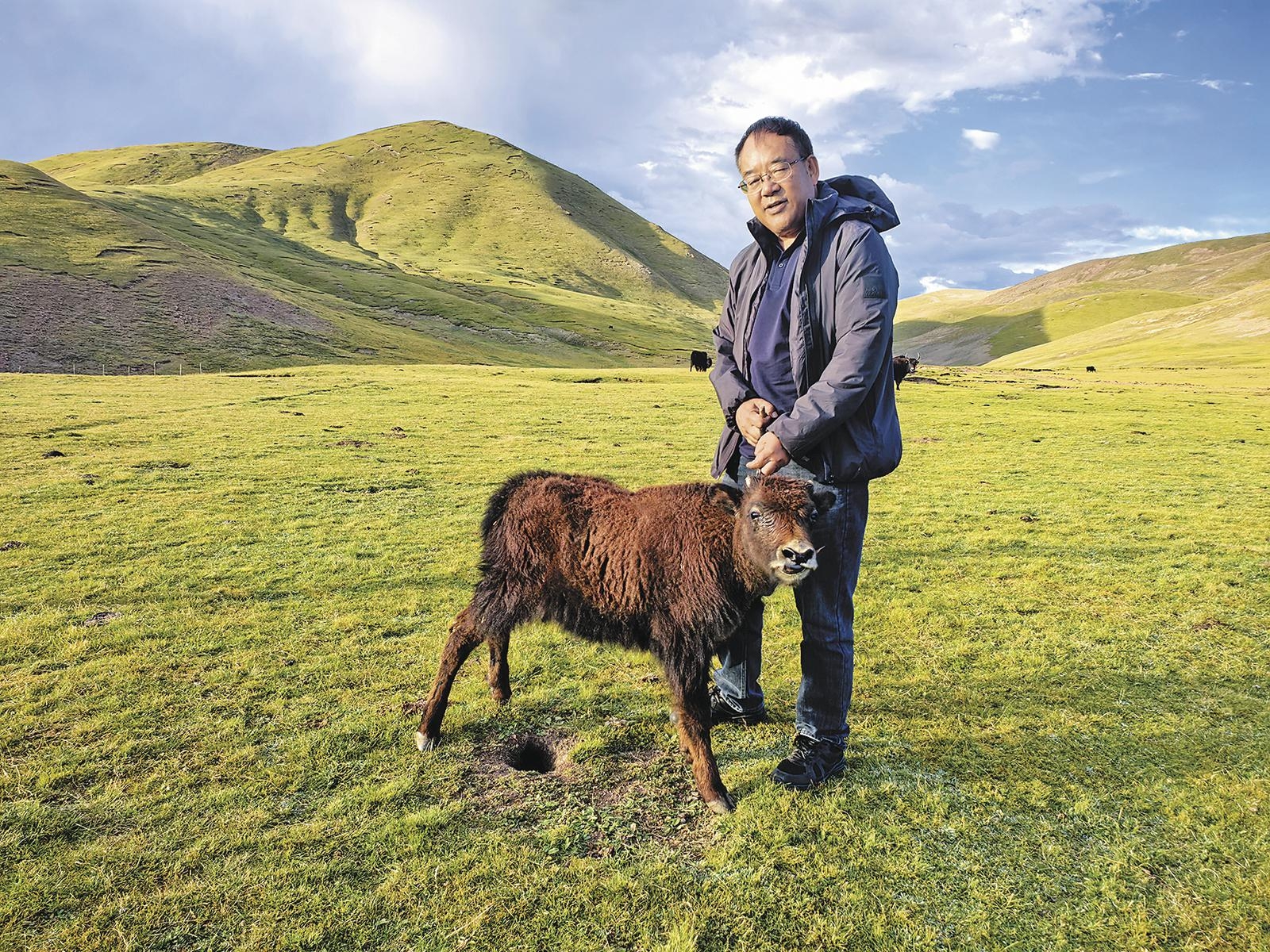
Song Rende. (Qinghai Daily/courtesy of the interviewee)
Song, 60, is the former director of the Yushu Prefecture Animal Disease Control and Prevention Center. Local herders call him "Doctor Yak" for his decades of work on a single problem: how to ease pressure on the grasslands by shrinking herds while raising the productivity of the animals that remain.
This year, he was named one of China's "most beautiful sci-tech workers," becoming the first recipient of the honor in Qinghai.
Song first came to Yushu in 1986. Fresh out of university, he could have stayed on at his university or gone home — he chose Yushu instead. "Someone has to do the work. If everyone says no, who will?" he said.
He met his wife, Li Guomei, in Yushu. At his encouragement, she continued her studies. From 1997, the couple went abroad one after the other, earning doctorates in animal science and grassland science respectively. They returned to the plateau in 2007, turning down offers from a Shanghai university that included housing.
In 2010, they planned to transfer to Xining, the provincial capital. Shortly before the move, a devastating earthquake struck Yushu on April 14. "People came from all over the country for disaster relief. We could not be deserters," Song said, and the plan was dropped.
Their daughter Song Weiru grew up in Xining and later studied overseas. She rarely saw her parents as a child, and did not understand their commitment until she earned a doctorate of her own, in resource and environmental science. She applied for a post at the prefecture's animal husbandry and veterinary station and made her home on the plateau. Now 36, she heads the veterinary public health department at the Yushu Prefecture Animal Disease Control and Prevention Center.
Song's early field trips, made on horseback, revealed a pattern: severely degraded grassland was spreading because of overgrazing. Herders saw large herds as a sign of wealth, but the grass could not support them, and mortality among yaks in some parts of Yushu reached 5 percent in normal years.
Song knew that simply urging herders to reduce their herds would not work, as yaks were their livelihood. He aimed to improve people's livelihoods while protecting the environment, settling on two approaches: improving livestock breeds and planting forage.
Li helped herders pick the right grasses and learn to grow them.
Around that time, Song and his wife often traveled to rural areas together to assess herders' grasslands and show them how to grow forage. To improve livestock breeds, Song began working with hybrids of wild and domestic yaks, along with a local sheep breed.
But Song found that herds were still turning over slowly, because yaks were slaughtered too late. A nine-year-old yak eats 12 times as much forage as a three-year-old. So Song began promoting a system that combines grazing with supplementary feeding, centered on early weaning.
Calves fed grass and supplements reach an average of 128 kilograms within a year — twice the weight of calves left to nurse. And freed from nursing, female yaks recover faster and can calve every year instead of every other year.
"Earlier weaning and slaughter of calves can help reduce herd sizes. Only when herds shrink can grasslands recover," Song said.
Herders were skeptical at first. Some fed the supplements to their dogs and other livestock instead. Song ran controlled trials, giving calves 400, 800 and 1,200 grams a day. After a year, the 800-gram group had grown fastest and fallen ill least.
Cailage, a herder in the prefecture, recorded his sales in an account book. One January entry reads: "On Jan. 13, I sold two three-year-old yaks, earning 18,000 yuan (about $2,700). On Jan. 30, I sold 10 yaks, earning 90,000 yuan."
The entries show more than Cailage's rising income: they are evidence that reducing herd sizes can work.
Caiwen, a herder from a village in Xiewu town, Chindu county, began working with Song and his wife years ago. His family had more than 200 yaks, but the pasture could not support them all. In 2011, the couple helped him grow forage and adopt supplementary feeding, which saved the herd. He later followed their advice to wean calves early and completely, and to cut his herd size.
Over 30 years, Li has expanded her vegetation monitoring sites from 32 to 772. Pointing to a slope she had surveyed two decades earlier, she said that fewer than 20 stalks of a native grass grew per square meter at the time. Now, various species of grass grow so densely that their stalks are impossible to count.
The results are now visible. Cailage has raised his offtake rate from 11 percent to over 23 percent, and his annual income now exceeds 600,000 yuan (about $90,000).
In Qumalai county, Gyatso's family yak-breeding business has grown into a substantial operation. Gyatso, 44, is now a leading figure in the local yak industry, and the company supplies more than 600 high-quality breeding bulls a year.
Across Yushu, average calf birth weights have risen 30 percent. Female yaks now give birth for the first time two years earlier, their annual calving rate has risen 78 percent, and yaks reach slaughter weight more than two years sooner. Net income per yak is up by over 2,000 yuan (about $300). In under a decade, the number of yaks in Yushu has fallen by 255,200 — while grassland vegetation coverage has recovered from 57 percent to 62.4 percent.
Song's health has never suited the altitude. He has diabetes and high blood pressure, and at 4,500 meters his heart rate and blood pressure climb further, raising the risk of cerebral hemorrhage and heart damage. Every morning begins with an injection and medication.
Song retired this year but still works in pastoral areas almost every day. He has compiled bilingual Chinese-Tibetan manuals on yak breeding, and more than 10,000 copies have been printed. Over the past five years he has held 72 training sessions for herders, with more than 8,300 attendances in total.