


China’s first complete southern mammoth skull fossil discovered in Qinghai, filling a gap in record for this species
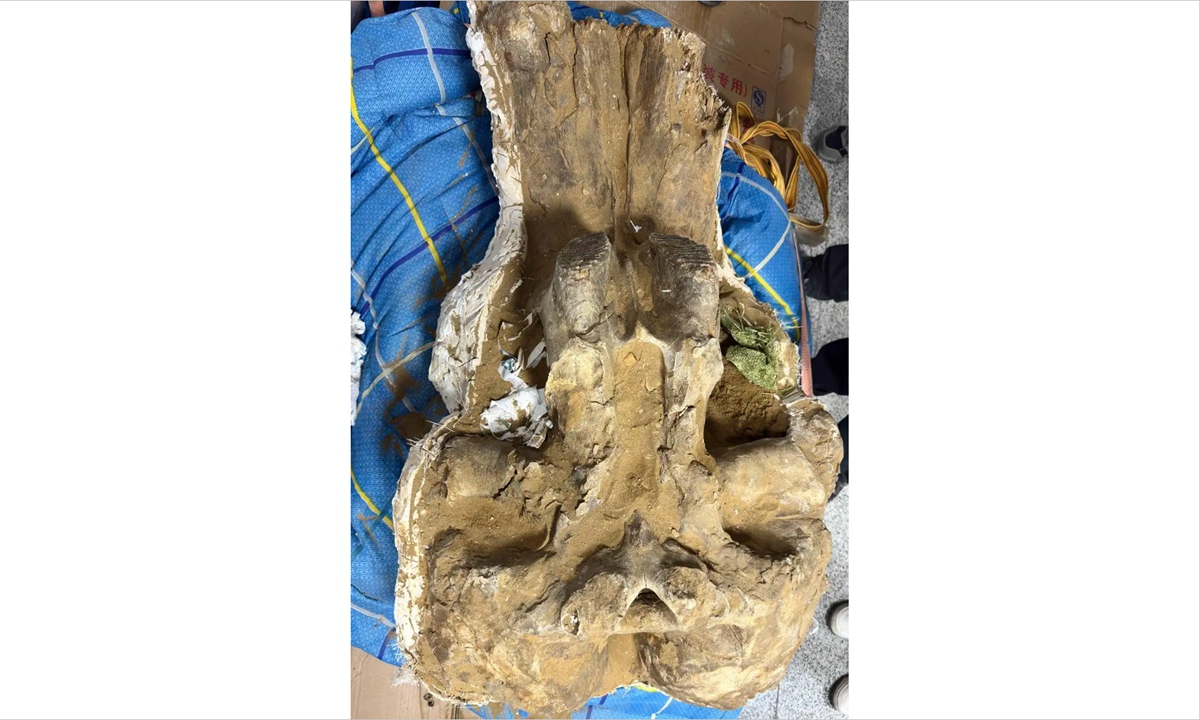
The southern mammoth skull fossil currently housed at the Museum of Natural Resources of Qinghai Province Photo: Xinhua
Chinese researchers have discovered the country's first complete fossilized skull of a southern mammoth in the Gonghe Basin, located on the northeastern edge of the Qinghai-Xizang Plateau, filling a gap in China's skull fossil record for this species and providing key evidence for tracing mammoth migration across the Eurasian continent and studying their evolutionary history.
The fossil, discovered in August by a team from the Qinghai provincial geological survey institute in Gonghe County meets China's standards for first-class protected paleontological fossils, the Xinhua News Agency reported, citing the Department of Natural Resources of Qinghai Province.
On August 7, the research team spotted a 15-centimeter bone fragment on a cliff while tracing paleontological clues in the Gonghe Basin. Following on-site excavation and cleaning, the researchers confirmed the fossil as an elephant skull measuring 75 centimeters long and 70 centimeters wide, with 175-centimeter-long tusks. The main structure of the skull is well preserved, with limited cracking and a high degree of structural integrity.
The Institute of Vertebrate Paleontology and Paleoanthropology under the Chinese Academy of Sciences confirmed the specimen as a southern mammoth dating back approximately 2 million to 1.3 million years.
According to Pan Tong, chief scientist at the Bureau of Geology and Mineral Exploration and Development of Qinghai Province, the southern mammoth was one of the most representative large proboscidean species in Eurasia during the Early Pleistocene Epoch and was larger than the woolly mammoth that lived during the Late Pleistocene.
The southern mammoth lacked cold-adaptation features such as a thick coat of hair and preferred warm, humid environments, including woodlands, grasslands and lakeshores. Its habitat range extended from southern Europe to East Asia, Pan noted.
Previously, southern mammoth fossils found in China were limited mainly to isolated teeth and jaw fragments. This latest discovery makes it possible, for the first time, to conduct a direct comparison between skull specimens of comparable completeness from East Asia and Western Europe, providing key evidence to trace the species' eastward migration and determine when it reached the northeastern edge of the Qinghai-Xizang Plateau.
The fossil's clearly identified geological layer and well-established age also provide a crucial chronological marker for dating tectonic activity associated with the Gonghe Movement on the northeastern edge of the Qinghai-Xizang Plateau.
Li Wufu, a senior engineer at the Qinghai provincial geological survey institute, said the discovery of the southern mammoth fossil provides crucial vertebrate evidence for reconstructing the biological communities and climatic conditions along the northeastern edge of the Qinghai-Xizang Plateau between 2 million and 1.3 million years ago, while supporting geological heritage conservation and protected-area designation in the Gonghe Basin, according to the People's Daily.
Next, the team will conduct meticulous specimen restoration, 3D scanning, and multidisciplinary testing to deepen research into the paleoecological evolution of the plateau, according to Zhang Hailong, head of the research team.