


Political changes on Taiwan island cannot stop trend of reunification: spokesperson
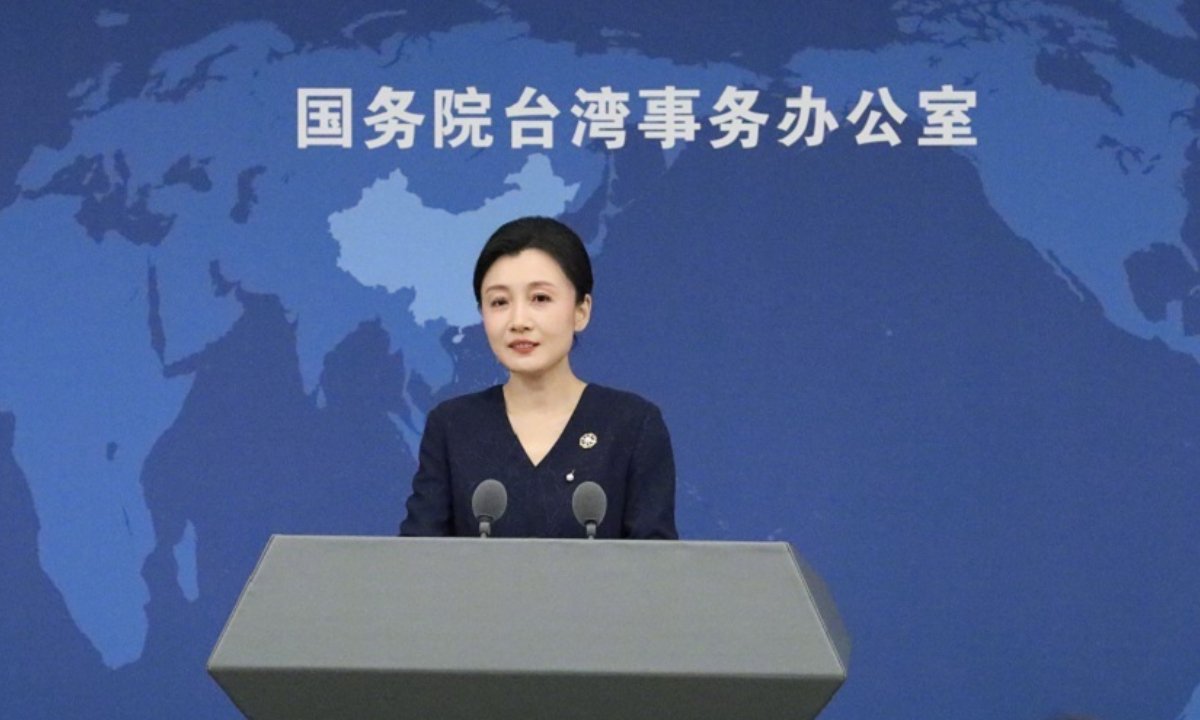
The Taiwan Affairs Office of the State Council spokesperson Zhang Han holds a press conference in Beijing on October 21, 2026. (Photo: People's Daily)
No matter how the political landscape on the Taiwan island changes, it cannot alter the direction or trend of cross-Straits relations as they move forward, still less stop the historical trend that China must and will be reunified, a spokesperson for the Taiwan Affairs Office of the State Council said on Sunday.
Spokesperson Zhang Han made the remarks in response to a question about the results of Saturday's "nine-in-one" local elections on Taiwan island.
The conclusion of voting brought the island's local election campaign to an end, with the results showing changes in the local political strength of the Kuomintang (KMT) and the Democratic Progressive Party (DPP).
Experts on cross-Straits affairs said the outcome should be understood in the context of local governance and competition between the parties, rather than as a change in the direction of cross-Straits relations.
They also expressed concern over chilling effect caused by the DPP authorities during the campaign, including making false allegations of interference from the Chinese mainland and the use of public power to suppress opponents of "Taiwan independence." Such practices undermine the political environment on the island and deserve attention beyond the distribution of elected posts, they said.
Shape local policy prioritiesHeld every four years, Taiwan island's "nine-in-one" elections allow voters to choose nine categories of local public officials on the same day. According to media reports, 19,695 candidates competed for 11,051 positions this year. Among them, 81 sought the top posts in the island's 22 counties and cities, while 1,492 qualified to contest municipal, county and city council seats.
The elections have a direct bearing on daily life. Local governments oversee transport, education, social welfare and other public services, meaning the results will shape local policy priorities over the next four years. With local leaders and representatives elected across all 22 counties and cities, the outcome also provides an important measure of the parties' local support and shifting political influence.
Saturday's results showed the KMT winning 11 county- and city-level posts, a decline from its previous total, while the DPP increased its tally to 10, according to media reports. Independent candidate Kao Hung-an won the remaining post in Hsinchu.
The results broadly reflect changes in the relative political strength of the blue and green camps, Wang Jianmin, a senior cross-Straits expert at Minnan Normal University in East China's Fujian Province, told the Global Times on Sunday.
The DPP now controls more local governments, Wang said. As the party that governs the Taiwan authorities, it has access to a range of administrative resources and has sought to expand its presence across the island's political and social landscape, further squeezing the KMT's room to operate, he added.
However, the significance of local elections needs to be assessed within their scope, Wang said. Policy conditions, the work local politicians have done to build support and residents' concerns about local affairs all influence the results. These factors matter more directly to voters choosing their local leaders than many broader political questions, he noted.
Although the elections are important for local governance, they do not change the political relationship between the two sides of the Taiwan Straits, while national reunification remains the overarching historical trend on both sides of the Straits, Wang said.
Peace and developmentResponding to the results, spokesperson Zhang said the office had taken note of the situation. The desire for peace, development, exchanges and cooperation represents mainstream public opinion on the island, she said, adding that compatriots on both sides of the Taiwan Straits share aspirations for stronger cross-Straits exchanges and cooperation, as well as peace and stability in the Taiwan Straits.
The results offer indications of those public priorities, Zheng Jian, a professor at the Taiwan Research Institute of Xiamen University, told the Global Times on Sunday. He pointed in particular to the defeat of DPP candidate Shen Pao-yang in the Taipei mayoral race, saying Shen had failed to break through the party's established electoral ceiling in the city.
Shen, an advocate of "Taiwan independence" who has repeatedly made separatist remarks, was put on the list of obstinate "Taiwan independence" separatists by the Taiwan Affairs Office of China's State Council on October 2024. He challenged KMT incumbent Chiang Wan-an for the Taipei mayoralty. During the campaign, observers noted that Shen had toned down or avoided discussion of his positions on "Taiwan independence."
"Shen had sought to build electoral momentum around his personal appeal, accompanied by misleading opinion polls, but ultimately failed to achieve his goal," Zheng said,
"During the campaign, Shen sought to conceal his extreme 'Taiwan independence' separatist stance and used online communications and cognitive warfare tactics to cultivate a public image that differed from his actual stance," Zheng said, adding that "the need for such an approach itself showed that ordinary voters did not accept those extreme positions."
For the local election, the public cares more about governance capabilities than about radical political ideas, Zheng noted. Residents were concerned about how their city would be run and did not want to serve Shen's "Taiwan independence" separatist ideologies, he added.
This focus on local affairs, rather than confrontation, reinforces the assessment that peace, development and stability are what people on the island want, Zheng added.
The KMT's loss of some county and city leadership posts should be examined against the wider campaign environment, he said. Zheng argued that cognitive warfare, misleading polls and the DPP authorities' use of judicial proceedings against political opponents had affected the contest.
A series of judicial cases against political opponents can create an intimidating atmosphere and influence voting behavior, Zheng said. As the DPP now runs the island's authorities, people living under such conditions may develop concerns and fears, he added, noting that some Taiwan residents visiting the mainland for exchanges had also spoken of these pressures.
Similar concerns were raised by the KMT following the vote. In remarks delivered at around 9:30 pm on Saturday, KMT Chairperson Cheng Li-wun described judicial intervention in this year's elections as the most heavy-handed and extensive, Taiwan media outlet "China Times" reported.
Cheng identified Yilan, Changhua and Hsinchu as the areas most affected, alleging that the deployment of "state power" had created a severe chilling effect during the local election, according to the report.
Looking beyond the election results, Zhang said the office will continue to uphold the one-China principle and the 1992 Consensus, unite Taiwan compatriots, and deepen cross-Straits exchanges, cooperation and integrated development.
It will resolutely combat "Taiwan independence" separatist forces, oppose interference by external forces, firmly promote the peaceful development of cross-Straits relations and advance the cause of national reunification, she said.