


Tang Yanwei, a student at the Communication University of China, made her foray into livestreaming last year after a video of her taking the national college entrance examination for art students she posted online got over 35 million views.
She saw the attention as a starting point to seize on the vast opportunities for profit, future employment and personal growth through livestreaming.

Tang shares her daily life in a short video. (Photo provided to the People's Daily)
This year, she has emerged as a livestreamer and content creator with a total of 247,000 followers on several platforms, including China's microblogging platform Sina Weibo.
"Livestreaming will be one of my career choices," Tang said, echoing an expanding group of university students in the country.
Shifting view on employment
According to the survey "What young people are looking for in employment" released on Sina Weibo in July, 61.6 percent of the nearly 10,000 college graduates who responded would consider emerging jobs such as livestreaming.
The booming industry brings hope to college graduates struggling to find a job.
According to Zhou Xiaopu, a professor at the School of Journalism and Communication, the Renmin University of China in Beijing, the growing numbers of young livestreamers and content creators represent a noticeable change in how young people approach employment.
She told Singaporean newspaper Lianhe Zaobao that Chinese college students have more diverse career choices than previous generations.
"It's beneficial for them to explore these new industries, as they can acquire experience, find their career paths and even start their own businesses in the process," Zhou said.
Catching the spotlight
In her short videos, Tang shares scenes from her life on and off campus. From taking classes and attending competitions to hanging out with friends, her college life seems both busy and exciting.
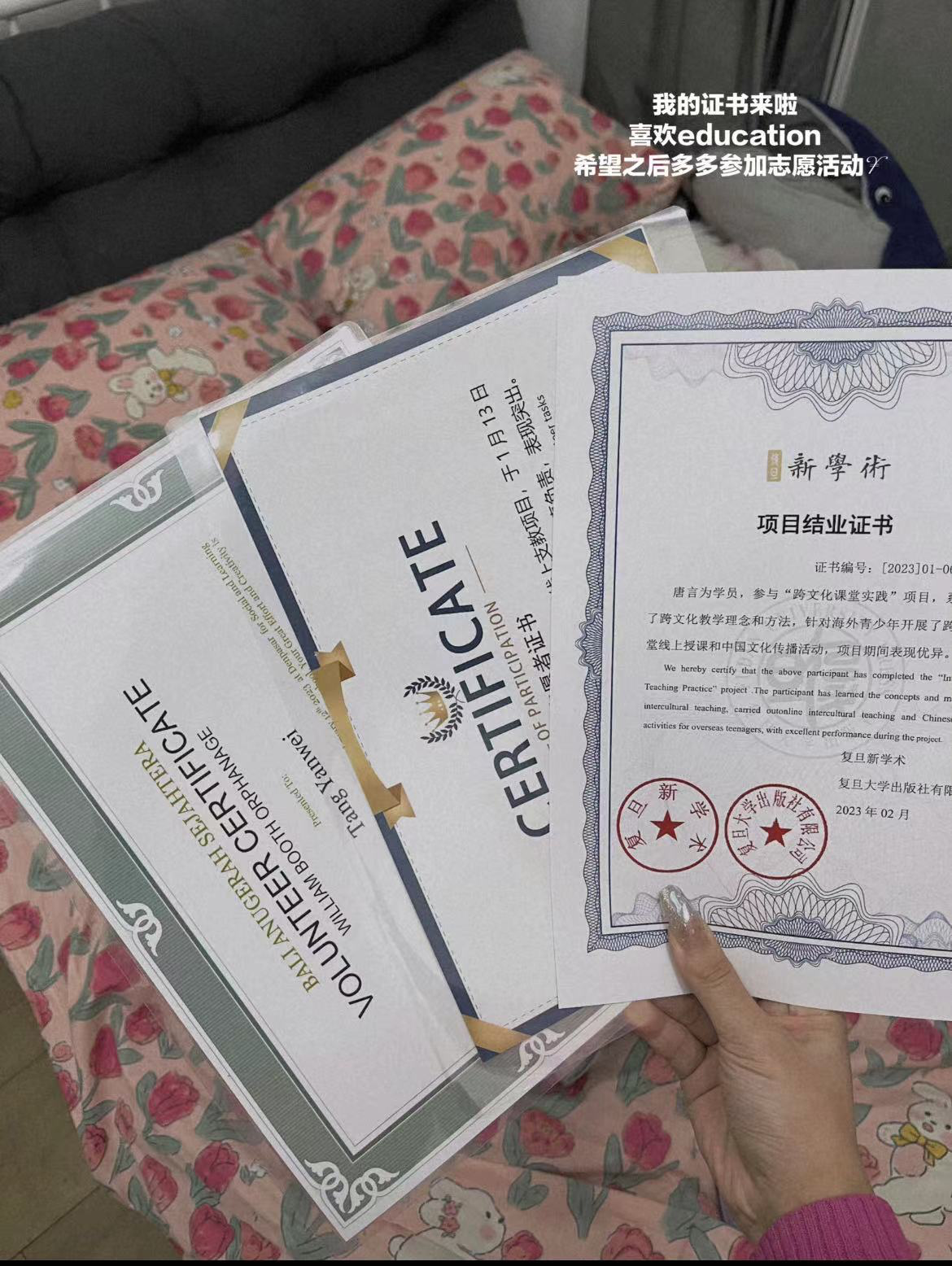
Tang shares certificates she received from internships and volunteer programs on Sina Weibo. (Photo provided to People's Daily)
"I record my life as a college student who keeps improving herself," she said. "I hope in this way I can inspire young viewers to grow and progress together with me."
To attract viewers, Tang also uses buzzwords and spotlights the latest lifestyle trends in her videos. "I hope my posts demonstrate the ethos and thoughts of young people," she said.
Despite Tang's carefree online profile, juggling roles as a student and content creator is not as easy as she makes it look.
"It takes me five hours to make one post," said Tang, adding this becomes extra challenging when her study load gets heavy.
"But it isn't easy to excel at anything, is it?" Tang said. "I find it worth my time and energy, given the benefits it has brought to me."
One major benefit is financial independence.
In addition, Tang said it helps her to keep improving. "Now I'm more capable of handling pressure and managing time," she said.
But she cherishes the sense of achievement of cultivating a fan base most. "I hope this feeling continues in my future career," she said.
Leveraging advantages
Short video platforms are popular vehicles for the spread of knowledge and experience, and university students are making unique contributions.
Those in their 20s with an associate degree or higher make up the core of the short video and live-streaming industry, according to a special report released by Chinese live broadcast and short video research institution New Broadcast in March.
This demographic quickly picks up new skills, which enables them to provide high-quality content, Zhou explained.
"College students are eager to ride new trends, and always have a nose for trends to come," Tang said. "That helps us create viral content."

Tang sits on a motorcycle in a photo posted to her Sina Weibo account. (Photo provided to People's Daily)
She said young people like her become influencers on livestreaming platforms because of their capability and courage. Unlike older generations, who are more likely to label this career choice as "loafing around" and "drifting," Gen Z is defining it in their own ways.
Many young livestreamers have mobilized their fan bases for noble causes. In doing such things as imparting knowledge, introducing cultural heritages and promoting produce for farmers, they reshape the public image of influencers and short video platforms.
Tang believes that livestreaming is open to anyone with something meaningful to share, "If you're gold, you'll eventually have your moment to shine," she said.
Enjoying support
Kwai, a major short video platform in China, announced in February that it would offer financial assistance and boost traffic for college students or recent graduates on the platform.
Meanwhile, it has developed training courses for young people seeking to be professional livestreamers.
Chinese short video and livestream platform Kwai has created 34.63 million jobs and lifted college graduates out of unemployment, according to a special report by the Renmin University of China School of Labor and Human Resources in Beijing.
Apart from livestreaming platforms, local governments, Party committees and higher education institutions are also providing support to college students and graduates in the industry.
For graduates seeking flexible jobs such as livestreaming, the government offers a two-year subsidy that covers up to two-thirds of their social insurance fees.
Hundreds of universities and colleges nationwide have set up majors related to e-commerce to cultivate future livestreamers.
Many universities, with the support of local governments and party committees, organize student volunteers to sell agricultural products for farmers through livestreaming. The campaign has not only helped promote local produce and specialties, but also offered a platform for students to hone their livestreaming skills.
However, experts warn college students not to idealize the livestreaming industry.
Chen Xiaoxia, a senior consultant on talent development, told newspaper the Workers' Daily that 20 percent of livestreamers make 80 percent of the industry's total revenue.