


March 15 marks the third anniversary of the China-proposed Global Civilization Initiative (GCI). Alaa Mamdouh Akef, an Egyptian sinologist engaged in research and teaching at Peking University, shared his views on the initiative.
"The GCI is a vivid expression of the values of respect and sincerity toward others," Akef said in an interview with People's Daily Online.
He noted that the wisdom deeply rooted in traditional Chinese culture enables China to promote exchanges and cooperation among different civilizations on the basis of equality.
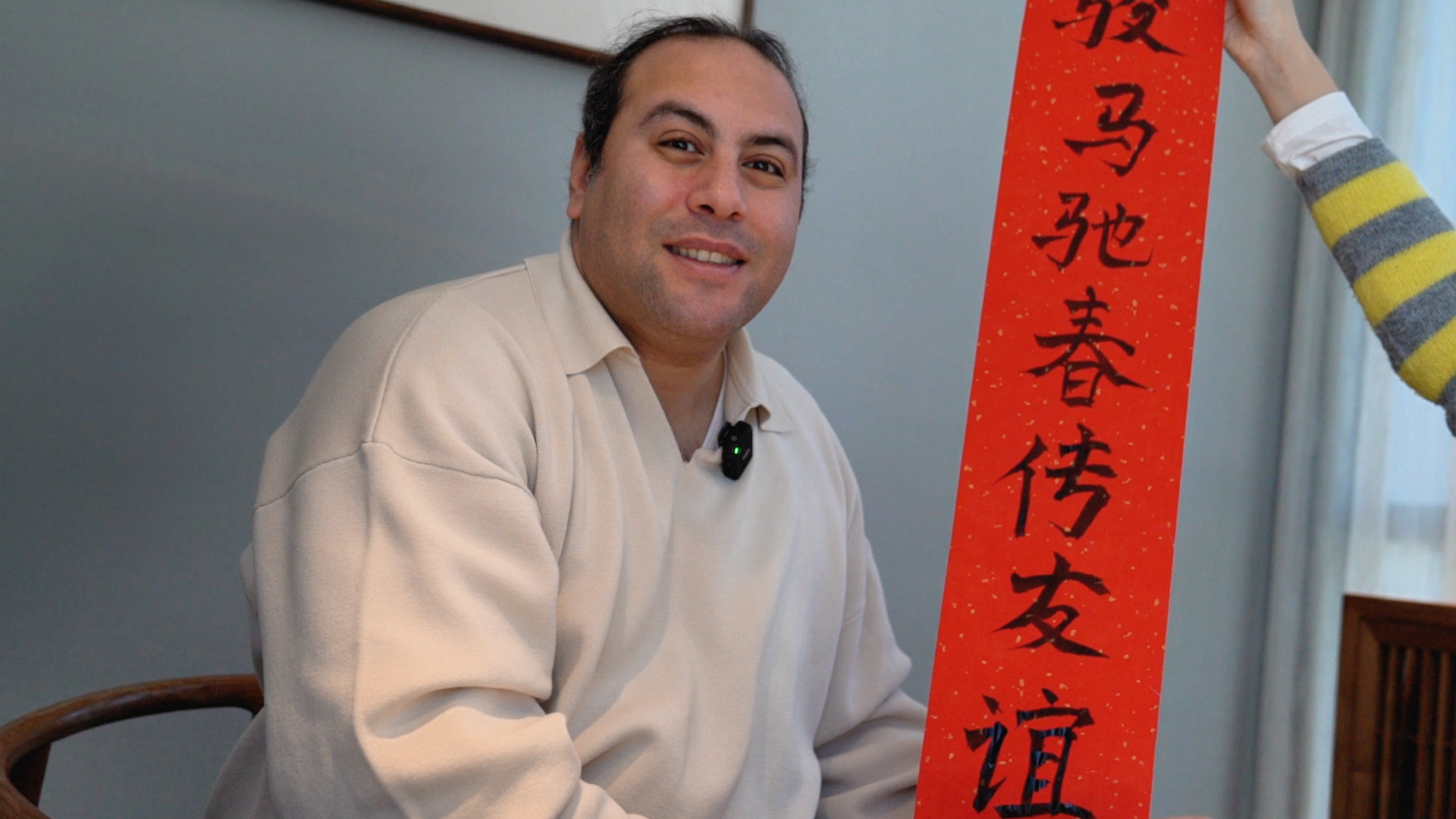
Alaa Mamdouh Akef displays a Spring Festival couplet. (People's Daily Online/Wang Yuheng)
At the 2025 World Chinese Language Conference held in Beijing in November 2025, 61 young sinologists from 51 countries invited to participate in the event wrote a letter to Chinese President Xi Jinping, sharing their experiences gained through studying China. They expressed their commitment to deepening their research on China and serving as bridges for communication among civilizations.
Akef was among the sinologists who initiated the letter. Soon afterward, they received a reply from Xi encouraging them to serve as envoys who help connect Chinese civilization with others around the world.
The reply letter left Akef deeply encouraged. "It is not only a source of encouragement, but also a recognition of our community of sinologists. For those of us engaged in China studies, it marks a milestone moment," he said.
Akef said he will continue to devote himself to the study of China and play an active role in promoting exchanges and mutual learning between Chinese and Arab civilizations.
Looking back to 2004, when Akef was among the first cohort of students in the Department of Chinese Language at Cairo University, his knowledge of China was still largely confined to books. Chinese, with its distinct phonetic system, writing structure, and modes of expression, was entirely different from the languages he knew. Though learning Chinese was challenging, Chinese culture deeply fascinated him. The few translated Chinese novels he could find in bookstores became his window into the country.
Several years later, Akef came to China to pursue a master's degree, setting foot for the first time in the country he had long wanted to see. What he found amazed him. "China preserves a rich historical and cultural heritage, yet it is also filled with modern skyscrapers and vibrant commercial centers. The speed of its modernization far exceeded my expectations," he said.
After earning his PhD, Akef chose to stay in China. He continues his research in Sinology while teaching Arabic at Peking University, working to cultivate internationally minded talents capable of telling China's stories well in Arabic.
Now, after more than a decade of living and working in China, his understanding of the country has become increasingly nuanced.
"In the past, much of the Arab world's understanding of China came through Western media. That made me realize how important it is to present a real and multidimensional picture of China from different perspectives. I see my role as serving as a bridge between Chinese and Arab cultures," he said.
Today, Akef is not only a sinologist, but also a witness to and participant in China-Arab cultural exchanges. He hopes more young people from the Arab world will come to China, engage in open dialogue, break down misconceptions, and discover the real China for themselves.