



A guest displays a Chinese calligraphy work he has completed at the UN Chinese Language Day event hosted by the Mission of China to the African Union (AU), together with the United Nations Economic Commission for Africa (UNECA), the UNESCO Liaison Office to the AU and UNECA, and the African Union Committee. (Photo provided by the Mission of China to the African Union)
April 20 marked United Nations Chinese Language Day. At the University of Venda in South Africa, the Green Technology Confucius Institute -- the world's only Confucius Institute themed on green technology -- offers a vivid glimpse into the growing appeal of the Chinese language.
"Can learning Chinese help us take part in these scientific projects?"
"What links South Africa's astronomy programs with China's FAST (Five-hundred-meter Aperture Spherical Radio Telescope)?"
At the university's Chinese Language Day event, questions like these poured out from young students. Behind them was not only a strong admiration for China's scientific and technological progress, but also a firm belief in the value of learning Chinese.
In classrooms, terms such as "environmental protection" and "green development" appear frequently, as Chinese learning and scientific knowledge are absorbed side by side. On the bookshelves, Chinese-language science and technology books are neatly arranged, becoming an important window through which local students can better understand China. In the university's experimental fields, BeiDou satellite receivers precisely regulate agricultural irrigation, while mobile signal vehicles for smart transportation are preparing to go into service.
These real-world applications make one thing clear to local students: Chinese is far more than a communication tool -- it is a practical asset for pursuing opportunities and shaping the future.
This trend is not limited to one campus. Across Africa, 17 countries have incorporated Chinese into their national education systems. The results of Chinese-language education are becoming increasingly evident: at China-Africa cooperation project sites, Chinese and African researchers communicate smoothly and collaborate efficiently in Chinese; in recruitment advertisements from African companies, the phrase "Chinese language skills preferred" is becoming more and more prominent.
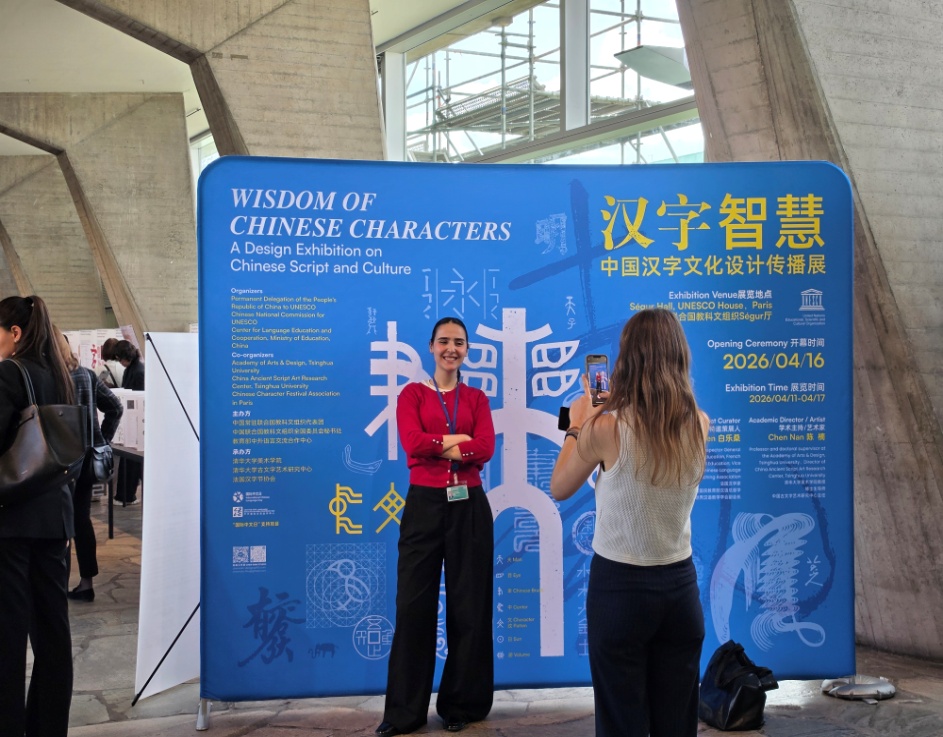
The UN Chinese Language Day is celebrated at the UNESCO headquarters in Paris, France, April 16. (Photo: People's Daily/Shang Kaiyuan)
A shared understanding is spreading among the young Africans: learning Chinese can open doors to the future. So why is Chinese gaining this reputation?
First, it reflects confidence in China's development.
Some say that the influence of a language is essentially the influence of a country. As China continues to make breakthroughs and lead globally in fields such as electric vehicles, artificial intelligence, clean energy, and e-commerce, and as it stands as the world's second-largest economy and a major force in global scientific and technological innovation, Chinese has become an indispensable key for those who want to learn advanced technologies and share development opportunities.
"Learn Chinese, and you can get on board China's fast train of development" -- this has become a common aspiration among African youth.
Eric Maruta, the foreign dean of the institute, put it plainly: "Chinese has opened a window for the Venda region. It allows us to achieve development through Chinese technology and strengthens South Africa-China cooperation."
Second, it is driven by China's openness to the world.
With the Belt and Road Initiative expanding across Africa, cooperation now spans not just infrastructure, but also science and technology, education, and culture.
In project after project, local builders who understand both Chinese and technical expertise have become vital connectors in these projects.
As China opens its doors ever wider and the momentum of China-Africa cooperation grows stronger, the scope for using Chinese also continues to expand. Its future value speaks for itself.
Third, it draws on the enduring appeal of Chinese civilization.
Chinese continues to attract the world not only because it is useful, but also because behind it stands a civilization that has lasted for thousands of years without interruption. Learning Chinese is, in essence, mastering a new way of understanding the world.
Chinese wisdom such as "harmony without uniformity" and "harmonious coexistence" is contributing solutions to global governance that are rooted in Chinese logic. Chinese is an important carrier for conveying this wisdom.
Chinese is a gift that travels across time and space. The closer one gets to China, and the deeper one engages with Chinese culture, the more one can feel its strength and warmth.
That Chinese is becoming "the language of the future" reflects not only China's development and the resonance of civilizations, but also the world's shared pursuit of openness, cooperation, and shared progress.