


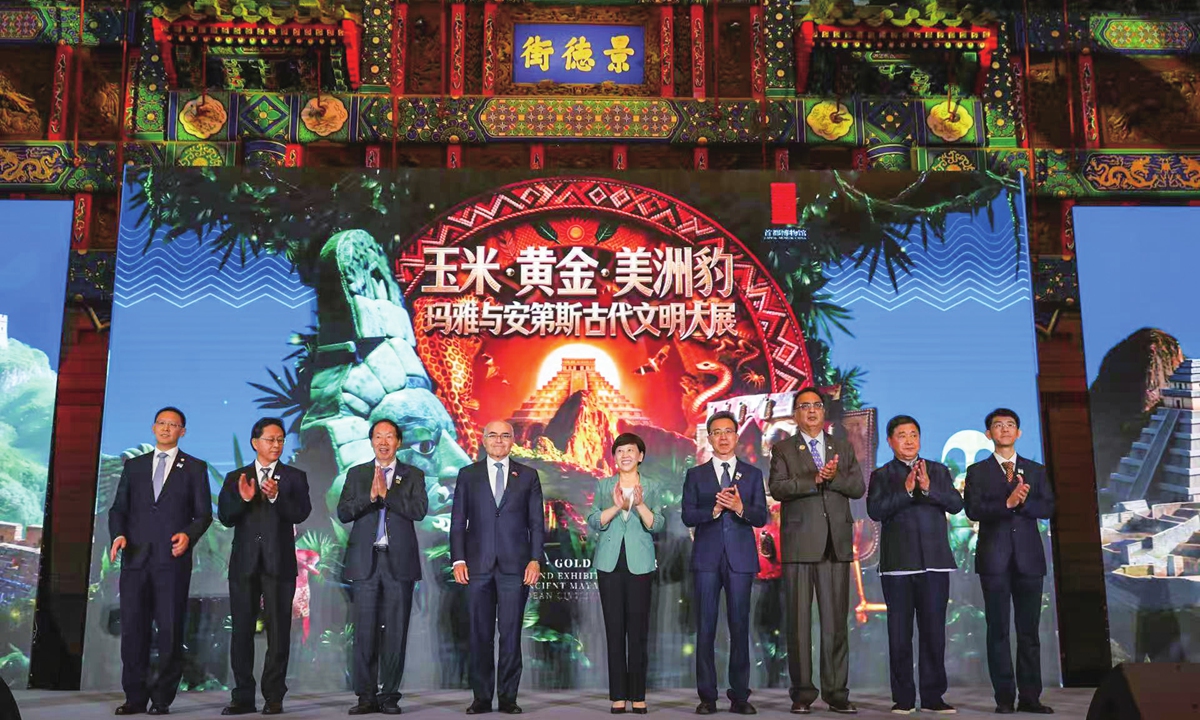
Ambassador of Peru to China Carlos Vasquez (4th from left) and Shahbaz Khan, Director of the UNESCO Multisectoral Regional Office for East Asia and Representative to China (3rd from right), and delegates pose for a group photo at an inauguration ceremony in Beijing on May 17, 2026. (Photo: Courtesy of the Embassy of the Republic of Peru in China)
The 2026 Beijing Museum Season officially kicked off on May 17 at the Capital Museum to celebrate the International Museum Day, which fall on May 18. Diplomats were invited to the inauguration ceremonies that features Maize, Gold, Jaguar: Ancient Maya and Andean Civilizations Exhibition - the latest installment in its "World Civilizations: Exchange and Mutual Learning" series initiated by the Capital Museum.
Featuring some 800 treasures from over 20 cultural institutions in Mexico and Peru, the exhibition is the largest exhibition since the Capital Museum was founded.
This year, the International Museum Day is marked under theme "Museums Uniting a Divided World."
Ambassador of Peru to China Carlos Vasquez said at the opening ceremony of the exhibition that each year, the commemoration, promoted by the International Council of Museums, reminds us that museums are much more than exhibition spaces. They are places where emotions, questions, and memories are preserved, helping us understand who we are as a society.
Therefore, the motto proposed this year by the International Council of Museums takes on a particularly significant force in the current international context, Vasquez said.
In times marked by increasing polarization, geopolitical tensions, and narratives that often emphasize what divides people rather than what unites them, cultural diplomacy reminds us of something essential: the most lasting bonds are those built on mutual recognition, respect, and admiration for our identities, he added.
From his view, this exhibition is not merely an artistic or archaeological display. It represents the reunion of two ancient civilizations that, although they arose in different geographical locations and despite their differences, share profound ways of understanding the world.
Meanwhile, this exhibition reflects the excellent state of cultural relations between Peru and China. In 2026, the two countries will celebrate 55 years of diplomatic relations. "We are convinced that cultural exchange will continue to be one of the strongest pillars of our friendship," said Vasquez, noting that culture continues to be one of the most powerful tools for strengthening mutual understanding between the two countries.
In his remarks, Shahbaz Khan, Director of the UNESCO Multisectoral Regional Office for East Asia and Representative to China said that "the exhibition unveiled today demonstrates how museums can build bridges between cultures and civilizations across regions and histories. Such exchanges embody the spirit of dialogue and mutual learning that UNESCO continues to promote globally."
Moreover, the very first program of China's "Museum Carnival" and the "Museum Night" this year was launched on May 17, which serves as a supporting activity of the exhibition.
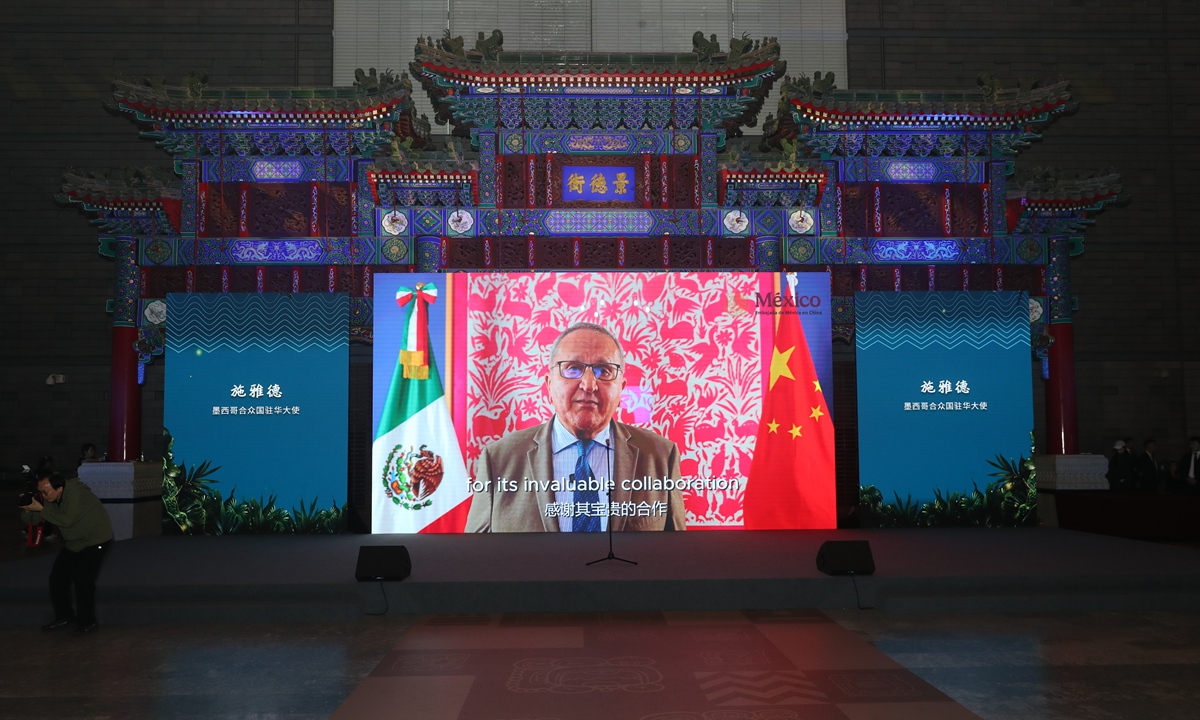
Ambassador to China Jesús Seade gives a video speech at the inauguration ceremony at the Capital Museum in Beijing on May 17, 2026. (Photo: Courtesy of the Embassy of the United Mexican States in China)
"This exhibition focuses on the Mayan civilization, but also explores the richness of other cultures that flourished in what is now Mexico. All of them, distinct yet deeply connected, built over millennia one of humanity's most complex cultural traditions, based on a holistic vision of the universe, time, and the relationship between humankind and nature," said Seade.
In this world, knowledge and worldview held a central place. The development of calendars, mathematics, and writing systems reflects a high level of thought, but also a profound understanding of the balance between the human, the natural, and the sacred. Elements such as corn, the jaguar, and gold symbolized for them not only sustenance or wealth, but also identity, transformation, and connection to the divine, he elaborated.
This legacy does not belong only to the past: it lives on in the communities of Mexico and finds resonance in China, another great ancient civilization, he added.
In his remarks, the Deputy Head of Mission of Embassy of the United Mexican States in China, Minister Enrique Escamilla, who is currently the Chargé d'affairs (CDA), said this exhibition represents a meeting between two significant civilizations.
"We live in an age marked by uncertainty and conflict. Against this, the worldview expressed through these works offers a quiet yet powerful truth: all life is interconnected. What we do to another, what we do to nature, we ultimately do to ourselves. The rejection of 'the other' is not strength - it is self-destruction," said Escamilla.
This exhibition therefore invites the visitors not only to admire extraordinary works of art and history, but also to reflect on values that remain deeply relevant today: harmony, balance, respect for nature, and recognition of our shared humanity, he added.
"Tonight, under the same sky once observed by ancient astronomers across continents, we celebrate not only the greatness of the past, but the promise of a shared future," Escamilla said.