


At the foot of Mount Wutai, a UNESCO World Cultural Heritage Site that has served as a center of Chinese Buddhism for nearly two millennia, the ancient and the virtual are converging.
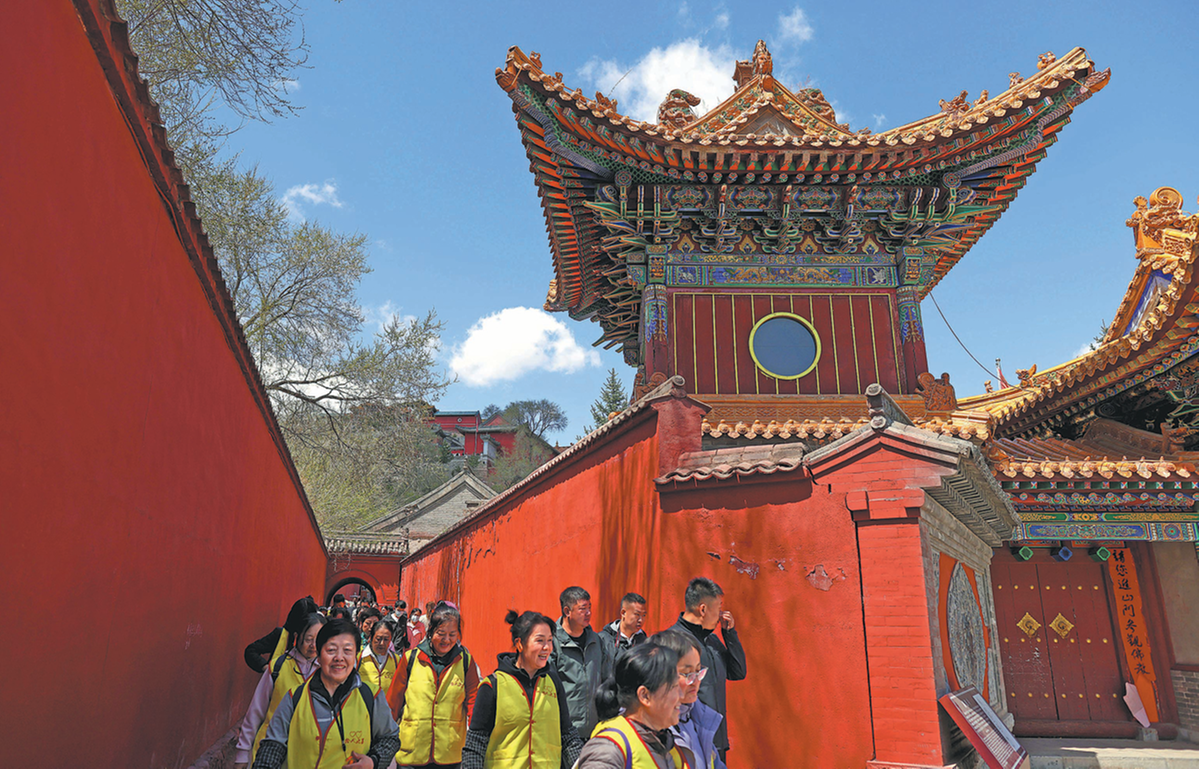
Tourists visit a temple on Mount Wutai in Shanxi province. (Photo via China Daily)
Inside a newly opened immersive experience hall, visitors don extended reality (XR) headsets to accomplish in 20 minutes what would normally take days of grueling physical travel. Through high-precision 3D modeling, users fly through seasonal seas of clouds, inspect the intricate timber joints of ancient temples, and virtually scale the sacred mountain's five distinct peaks.
The facility, which opened in April, is the brainchild of 40-year-old Xing Wei, a native of Yingfang village at the base of the mountain. Last year, Xing and fellow villagers Liu Yong and Guo Lijun pooled their capital to launch a tech startup aimed at digitizing local tourism. Partnering with a Shanghai-based virtual reality firm, their team spent seven months trekking through the rugged terrain to collect spatial data and film the mountain's major architectural relics.
"Instead of just looking at a static facade, visitors can now interact with the landscape," Xing said. The timing has proved lucrative: Mount Wutai drew a record 7.27 million tourists in 2025, a 5.22 percent increase year-on-year. So far, more than 10,000 visitors have paid to experience the XR simulation.
For many travelers, the digital experience functions as an interactive primer before they face the physical mountain. Wang Yanlin, a 54-year-old visitor from Tianjin, used the XR hall to study the layout of the temples before beginning his uphill climb.
"Seeing the architecture digitally first gave me an immediate, intuitive understanding of how these structures were engineered," Wang said. "When you later stand in front of the real thing, the scale of what ancient artisans built in this harsh mountain environment becomes much more profound."
The mountain boasts 121 immovable cultural relics, including four top-tier national protection units that encompass ancient architecture, painted sculptures and sprawling murals. Since its first temple was constructed in 68 AD during the Eastern Han Dynasty (25-220), Mount Wutai has stood as a living record of how Buddhism was localized in China and transmitted across East Asia.
Beyond consumer entertainment, digital technology has become a critical tool for structural preservation. Local authorities are currently accelerating a comprehensive data-collection initiative to safeguard historical structures vulnerable to weathering and natural wear.
At Luohou Temple, preservationists are deploying 3D laser scanning, oblique photography and close-range photogrammetry to map every square centimeter of the site.
"This is completely non-contact data collection," said Wang Chao, deputy general manager of Shanxi Cultural Tourism Digital Communication Co, the entity leading the digital mapping. "We are establishing a permanent digital database that logs exact structural dimensions, spatial relationships, and material textures. First and foremost, this is about preservation. If a disaster or severe degradation occurs, this immutable data provides the exact blueprint needed for restoration."
Wang's team has already completed full digital modeling for four of Mount Wutai's most critical national heritage sites, including the historic Tayuan and Xiantong temples.
Local heritage officials emphasize that keeping the site relevant to a modern, tech-literate public is essential to its long-term survival.
"True revitalization means thinking about how to better display these cultural relics to the public," said Han Ruijie, director of the Mount Wutai Cultural Relics and Heritage Protection Center. He noted that the scenic area plans to expand both static and dynamic digital displays to offer a deeper context to domestic and international travelers alike.
By shifting the preservation philosophy from isolation to digital engagement, management aims to reduce the physical foot-traffic pressure on fragile timber structures while expanding the site's global reach.
"The best protection is not to lock these relics away from the public, but to pass down the heritage through innovation," Liu Yuan, director of the Mount Wutai Scenic Area Management Committee, told Shanxi Daily."By deepening our digital protection and intelligent management projects, we ensure this millennium-old heritage survives scientifically for generations to come."