


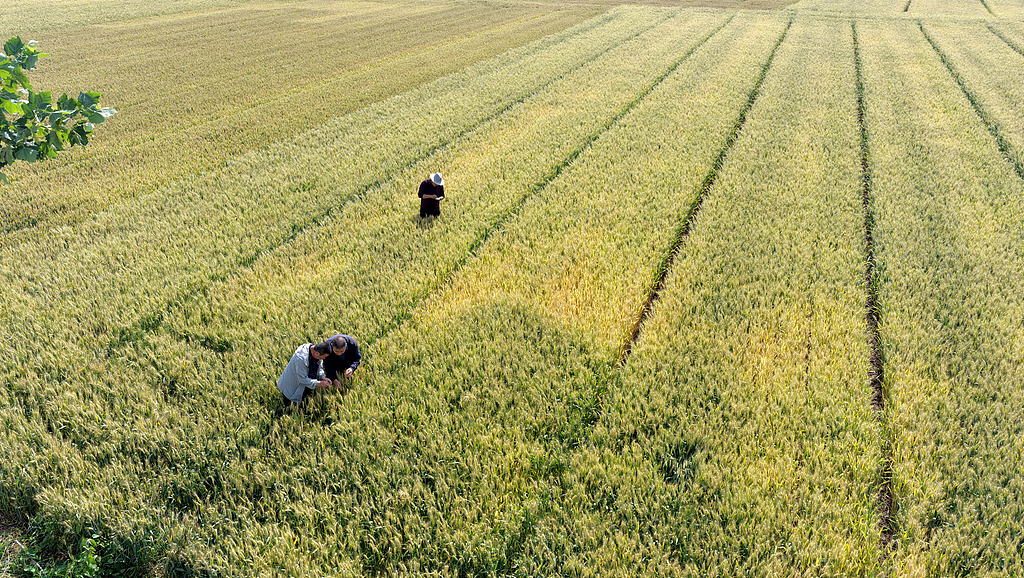
Villagers are checking the growth of wheat crops in a field, Handan City, north China's Hebei Province, May 21, 2026. (Photo: VCG)
China is accelerating its summer harvest and planting campaign while stepping up efforts to guard against floods and other weather-related risks, as heavy rainfall and the arrival of the country's main flood season pose challenges to grain production in several key agricultural regions.
During an inspection tour in north China's Hebei Province from June 1 to 2, Vice Premier Liu Guozhong called for all-out efforts to ensure a successful "Three Summer" campaign – summer harvesting, summer planting and summer field management – to lay a solid foundation for this year's grain production.
China is currently in a critical period for summer grain production. The country's summer wheat harvest, which accounts for more than 20% of annual grain output, is concentrated in major producing regions such as Henan, Shandong, Anhui and Jiangsu.
However, widespread heavy rainfall in May affected dozens of provinces, regions and municipalities across China. The prolonged precipitation coincided with critical crop growth and harvesting periods, complicating summer harvest operations. Meteorological authorities have forecast another round of extensive rainfall beginning June 3, bringing showers and localized severe convective weather to key grain-producing areas, including Henan and Shandong.
According to the Ministry of Agriculture and Rural Affairs, as of June 2, China had harvested 119 million mu (7.93 million hectares) of summer wheat, completing 35.09% of the nationwide harvest. Among major producing provinces, wheat harvesting is nearly 70% complete in Anhui, close to 50% complete in Henan, more than 20% complete in Jiangsu and over 10% complete in Shaanxi.
Liu stressed the need to maximize periods of fine weather to secure the summer grain harvest, strengthen meteorological monitoring and early warning, ensure smooth summer grain purchases, coordinate summer sowing and field management, and guarantee stable supply and prices of chemical fertilizers.
He also called for integrated development of agricultural education, science and technology, as well as talent training, so as to help bring more scientific and technological advances to farmers.
Extreme weather poses growing challenges
According to China's Ministry of Water Resources, since the country entered its flood season on April 1, conditions on major rivers have remained generally stable. However, localized extreme rainfall has triggered unusually early and severe flooding in small and medium-sized rivers as well as mountain torrents.
National average precipitation has reached 170 millimeters so far this year, about 5% above the historical average for the same period. Since April, 146 rivers in 18 provincial-level regions have recorded flood levels exceeding warning thresholds, roughly 50% higher than the average for the same period over the past five years.
Several major agricultural provinces, including Hubei, Anhui and Henan, have experienced significant rainfall events that have posed challenges to crop production.
Experts attribute the increasing frequency of extreme weather events partly to intensifying global climate change.
Zhang Jianyun, a hydrology expert of the Chinese Academy of Engineering, said the overall deviation in hydrological and meteorological conditions is likely linked to climate change.
A recent report jointly released by the Food and Agriculture Organization of the United Nations and the World Meteorological Organization found that the frequency, intensity and duration of extreme heat events have risen sharply over the past 50 years, reshaping agricultural production conditions worldwide and becoming a major threat to global food security.
Mu Yueying, a professor at China Agricultural University, said extreme weather is not merely a natural phenomenon but a systemic risk affecting farmland, crops, agricultural machinery, storage facilities, logistics networks, markets and farmers' incomes.
Resilience strengthened through infrastructure and insurance
Despite weather-related challenges, officials say overall farmland waterlogging conditions remain manageable.
According to Long Haiyou, an official with the Ministry of Water Resources, major irrigation districts nationwide are operating normally, with only isolated areas experiencing waterlogging and no widespread agricultural flooding reported so far. However, risks from mountain floods, geological disasters and flooding in smaller rivers are expected to increase as China fully enters its main flood season in June.
Mu noted that China possesses significant strengths in agricultural disaster prevention and mitigation, including strong organizational mobilization capabilities and steadily improving rural infrastructure.
"High-standard farmland, irrigation and drainage systems, field roads, grain drying facilities and storage infrastructure provide solid support for coping with extreme weather," she said.
Agricultural insurance has also played an increasingly important role in helping farmers recover from disasters and safeguarding food security.
According to industry data, China Life Property & Casualty Insurance has received more than 360,000 agricultural insurance claims nationwide in 2026, involving approximately 3.95 million mu (about 263,300 hectares) of farmland and major crops. The company has completed damage assessments worth nearly 3 billion yuan ($443.6 million) and paid out about 2.9 billion yuan in compensation.