


The Second World Conference of Classics, themed "Dialogue Between Ancient and Modern: Contemporary Inspirations from Classical Wisdom," is being held in Athens, Greece from Tuesday to Wednesday.
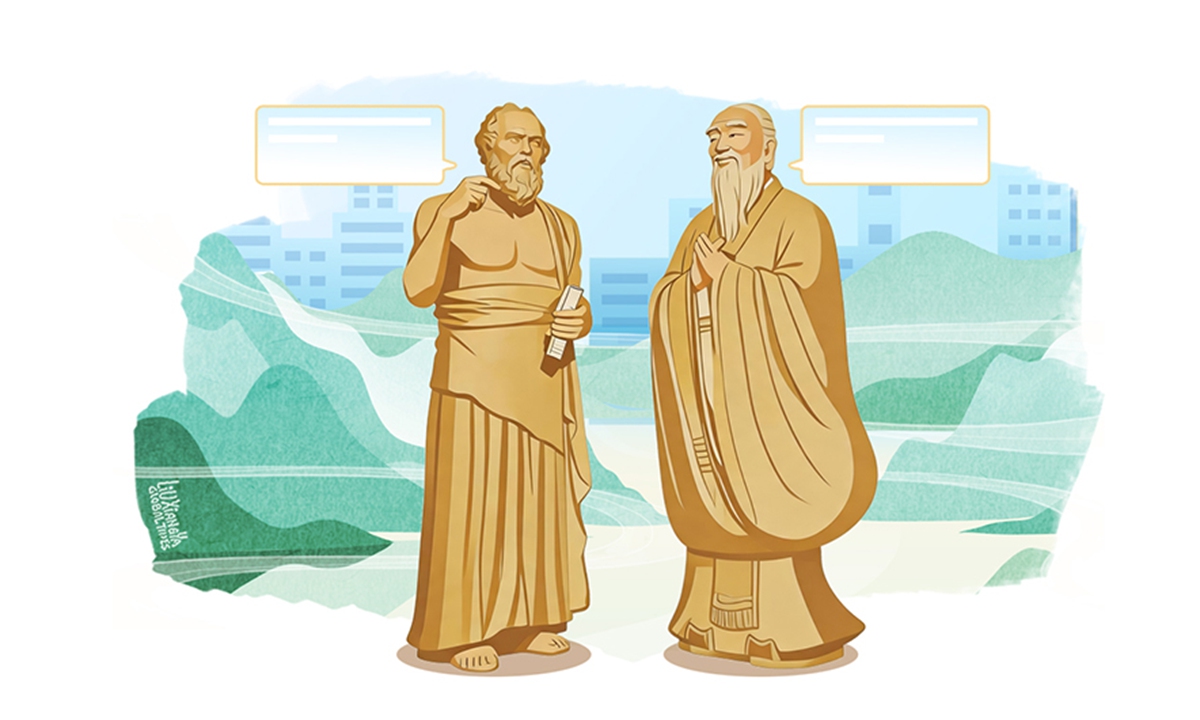
Illustration: Liu Xiangya/GT
Following the successful inaugural conference in Beijing, this grand gathering of civilizations has crossed mountains and seas to reach Greece. It serves as a vivid testament to the mutual understanding, exchanges, and learning between the ancient civilizations of China and Greece, while also providing an important platform for dialogue between Eastern and Western civilizations.
China and Greece are, respectively, the brilliant wellsprings of classical civilizations in the East and the West. With a history spanning more than 5,000 years, Chinese civilization has cultivated enduring wisdom embodied in the pursuit of harmony between humanity and nature, good-neighborly relations, and the balance between upholding tradition and embracing innovation. Ancient Greek civilization, meanwhile, laid the foundations of Western civilization through its emphasis on the rational inquiry, the pursuit of truth, openness, and inclusiveness.
Though separated by mountains and seas and shaped by different historical trajectories, these two great civilizations have both withstood the test of time and continued to thrive. Each embodies a spirit of harmony and the pursuit of the common good, offering insights that can inspire humanity and illuminate the future. This shared spirit forms a resonance that transcends time and space, as well as the foundation for deeper exchanges and mutual learning between the two civilizations.
Chinese President Xi Jinping once said, "Diversity spurs interaction among civilizations, which in turn promotes mutual learning and their further development."
This important proposition has provided the guidance for dialogue among civilizations between China and Greece, as well as across the world.
For many years, exchanges and mutual learning among civilizations have served as an important bond and a defining feature of China-Greece relations. Scholars from both countries have jointly explored the intellectual "dialogue" between Confucius and Socrates, examining the common ground between Confucian ethics and ancient Greek philosophy. They have also sought contemporary insights into governance and moral cultivation from classical works such as The Analects and The Republic.
Through joint archaeological initiatives and cultural heritage conservation projects, China and Greece have engaged in practical cooperation to safeguard humanity's shared cultural legacy. These exchanges have not only enriched the traditions of both civilizations but have also contributed Eastern and Western wisdom to the building of a community with a shared future for mankind.
At a time when the world is undergoing profound transformations, global challenges such as geopolitical conflicts, climate change, and the digital divide are becoming increasingly intertwined, while diverse civilizations interact and sometimes clash amid rapid change. In the face of deficits in peace, development, security, and governance, it is imperative to reject the prejudices of "civilizational superiority" and the "clash of civilizations" rhetoric, and instead uphold the principles of equality among civilizations, mutual learning, and shared prosperity. This is not only a need of the times but also the aspiration of people around the world.
Using classical heritage as a bond and academic exchanges as a bridge, China and Greece have continued to deepen dialogue between civilizations. Their efforts have not only breathed new vitality into two ancient civilizations through the integration of past and present, but have also set an example for harmonious coexistence, exchanges, and mutual learning among different civilizations.
The Second World Conference of Classics brings together leading scholars from around 20 countries and regions to explore the contemporary relevance of classical wisdom. By tracing the roots of civilizations and examining the pressing issues of our time, the conference serves not only as a tribute to and continuation of classical traditions, but also as a meaningful effort to draw on the wisdom of the ancients and build broader consensus for humanity amid profound changes unseen in a century.
In addition to the opening ceremony, plenary sessions, and closing ceremony, the conference is holding four parallel forums on topics including virtue and education, ethical communities in changing societies, civilization-based approaches to global order, and the role of humanistic values in the digital age.
Through dialogue and exchange, scholars from around the world will explore the enduring value of classical texts, pool insights for addressing contemporary global challenges, and contribute to the implementation of the Global Civilization Initiative.
Ancient civilizations are like towering trees: Only with deep roots and flourishing branches can they withstand the passage of time and the trials of history. The gathering in Athens is expected to foster deeper exchanges and mutual enrichment between Eastern and Western classical wisdom, further advancing China-Greece civilizational dialogue and yielding new outcomes in cultural exchanges and mutual learning.
Looking ahead, China and Greece will continue to strengthen their bond through civilization and deepen cooperation across a wide range of fields. By cultivating the rich soil of people-to-people exchanges and expanding cooperation in education, science and technology, culture, and tourism under the framework of the China-proposed Belt and Road Initiative, the two countries can unlock new opportunities for collaboration. Guided by the Global Civilization Initiative, they will also work together to address shared challenges and inject fresh momentum into the building of a community with a shared future for mankind.
Standing at a new historical starting point, China and Greece are using the World Conference of Classics as an opportunity not only to pay tribute to the wisdom of the ancients, but also to address the present and look toward the future. Through sustained dialogue, exchanges, and mutual learning, the two countries will continue to write a new chapter in civilizational interaction, drawing on classical wisdom to illuminate pathways for contemporary cooperation. In doing so, they will contribute their shared strength to fostering a flourishing garden of world civilizations and advancing the common development of humanity.
The author is the Chinese Ambassador to Greece. This was compiled and translated by the Global Times based on an article originally published on page 3 of the People's Daily on June 9, 2026.