


It started with the one thing every college student understands: the misery of finals week.
During one of four virtual dialogue sessions this spring between students from Georgetown University in Washington DC and Beijing's Tsinghua University, Georgetown student Aanik Veedon made a lighthearted joke about exam season. Students on both sides of the Pacific burst into laughter at the same moment, no translation needed.
"That moment broke the ice," Georgetown students Bennie Chang and Luke Hughes later wrote. "It reminded us that before we are students of geopolitics, we are just students."
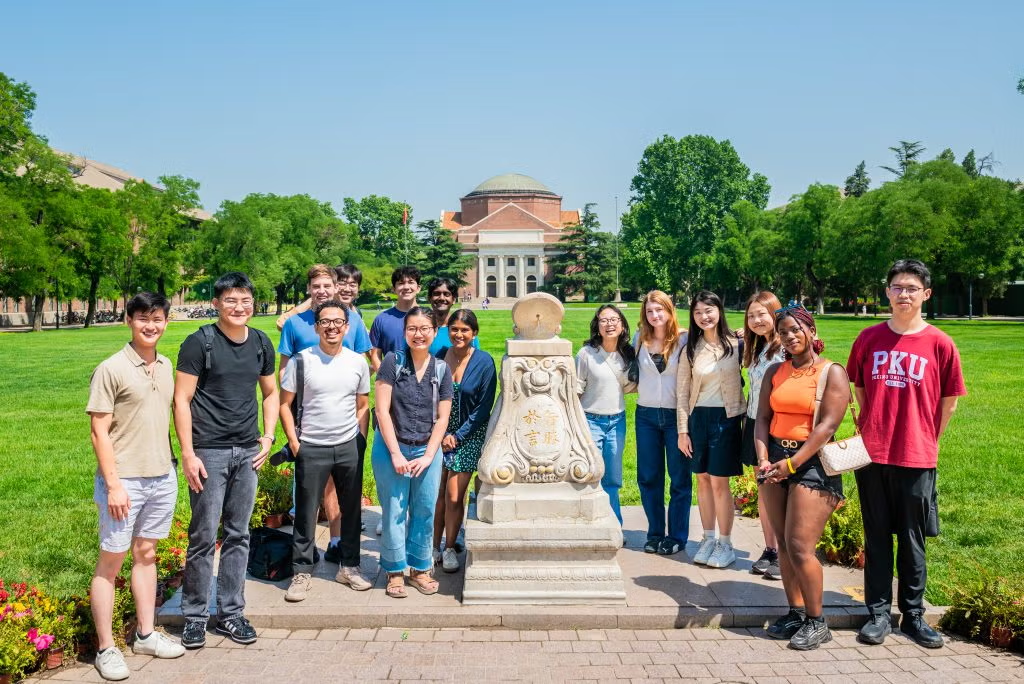
Georgetown and Tsinghua University students take a photo on Tsinghua University's campus in Beijing, China. (Photo: Georgetown University)
The Initiative on US-China Dialogue on Global Issues had brought students from both universities together for months of online discussions on artificial intelligence, climate change and global security. But over time, the conversations drifted beyond policy. Students began swapping stories about campus life, academic pressures and future plans.
The shift became unmistakable when the group met in person in Beijing. On Tsinghua's campus, students cycled between classes, shared meals in dining halls and exchanged stories about coursework and daily life. Chinese students patiently helped their American counterparts navigate everyday apps, from ride-hailing to other basics, turning simple tutorials into small windows into life in China.
Before arriving in Beijing, participants had been divided into working groups on topics ranging from climate cooperation to AI governance. For Chang, who joined the technology group, the discussions reinforced a conviction: even on technical issues, the real challenge is not policy but communication.
"If we don't work on interoperability now, we'll be talking past each other later," he wrote.
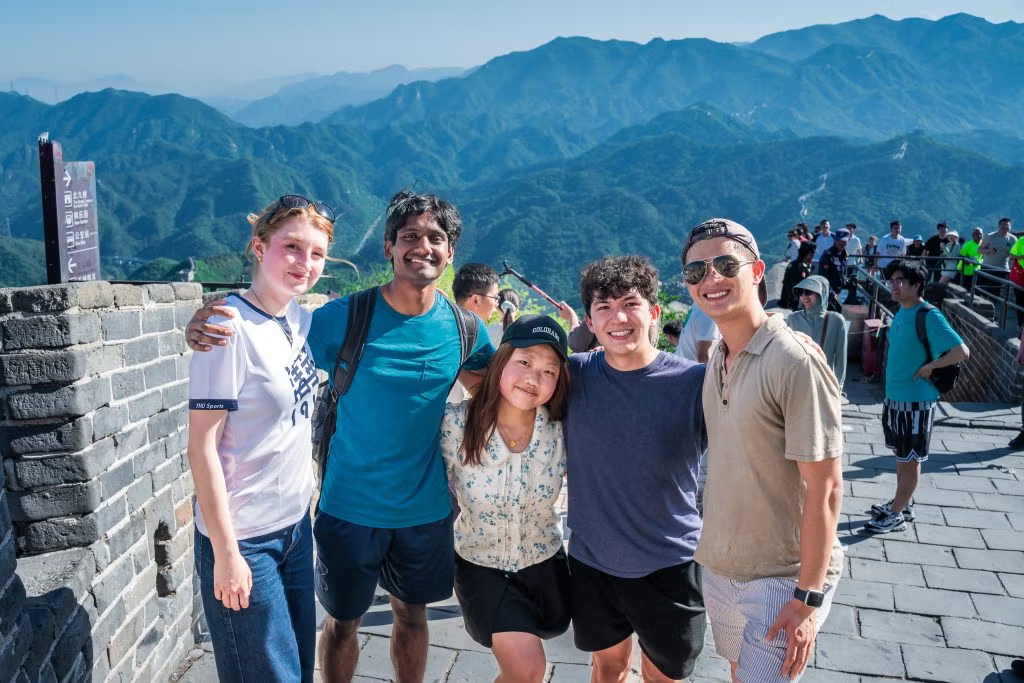
Georgetown and Tsinghua University students bonded while scaling the Great Wall of China. (Photo: Georgetown University)
Hughes found a parallel lesson in the environment group. Studying examples of climate diplomacy between Chinese and American researchers and local governments, he was struck by how much context is lost at a distance.
"Seeing firsthand how environmental issues here are part of everyday conversation. That kind of insight simply wouldn't have been possible without being on the ground," he reflected.
The presentations that followed were more than academic exercises. They became opportunities to test ideas, challenge assumptions and discover that meaningful dialogue often begins with listening.
By the alumni reception in Beijing, the atmosphere had changed completely. The Tsinghua students who had first appeared as faces on a screen were now friends sharing stories over Peking duck.
Conversations drifted from policy to everyday life. Chinese students were surprised to learn that Georgetown students typically take only five courses per semester; their American counterparts were equally surprised by the heavier course loads many Tsinghua students manage.
Curiosity ran both ways: Tsinghua students asked about American campus culture, while sharing tips on where to find the best street food near campus. What began as a structured dialogue had become genuine curiosity about one another's lives.
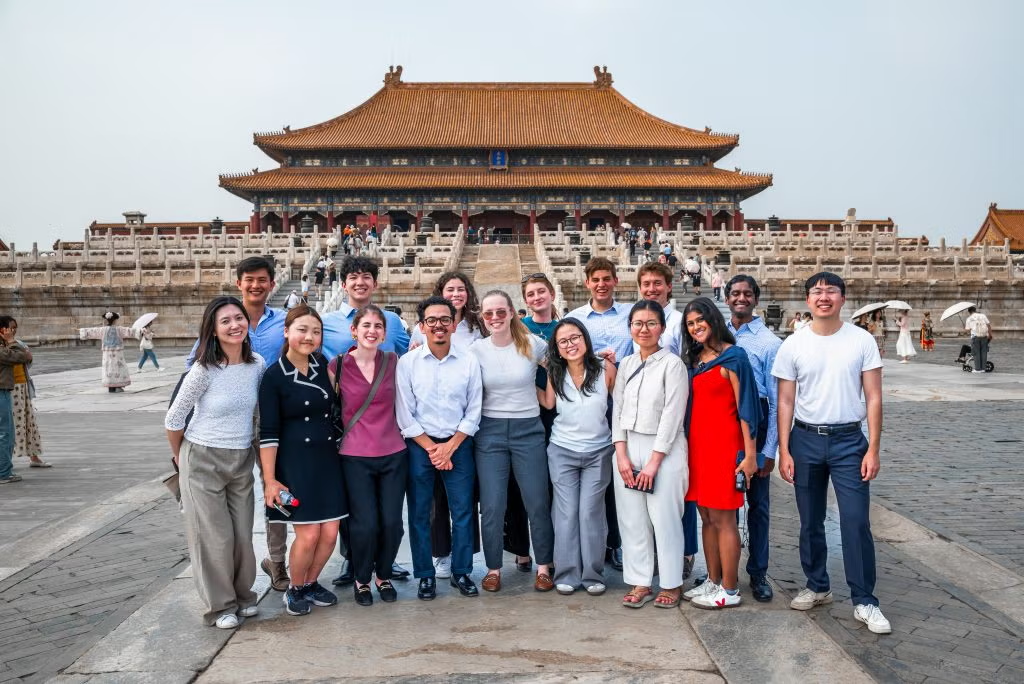
The Georgetown delegation visits the Forbidden Palace in Beijing, China. (Photo: Georgetown University)
The exchange extended to Hong Kong, where participants joined Georgetown alumni for another reception. For Hughes, one of the most memorable moments came after he stepped off stage following remarks alongside university officials: a group of local high school students surrounded him, asking questions about campus clubs, coursework and what it is really like to study in the United States.
"That reminded me that exchange isn't only about learning from others," he said. "It's also about sharing your own story."
Throughout the week, students debated technology, climate policy and the future of China-US relations. Yet some of the most lasting conversations were about simpler things: how they study, what they hope to do after graduation and how young people from very different backgrounds imagine their futures.
For Chang, the experience distilled into a single thought.
"We were lucky enough to discuss the role of the UN Security Council over Chinese pastries and snacks," he wrote.
"That's the kind of moment that stays with you."
(Edited by Zhao Zhengting, Zhao Yangyang, Ye Chenyang, Fu Xuan and Lu Dong)