


CAIRO, June 20 (Xinhua) -- An Egyptian archaeological mission has uncovered two tombs dating to the Early Dynastic Period (3100 BC-2686 BC) in Minya province, south of the Egyptian capital Cairo, the Ministry of Tourism and Antiquities said Saturday in a statement.
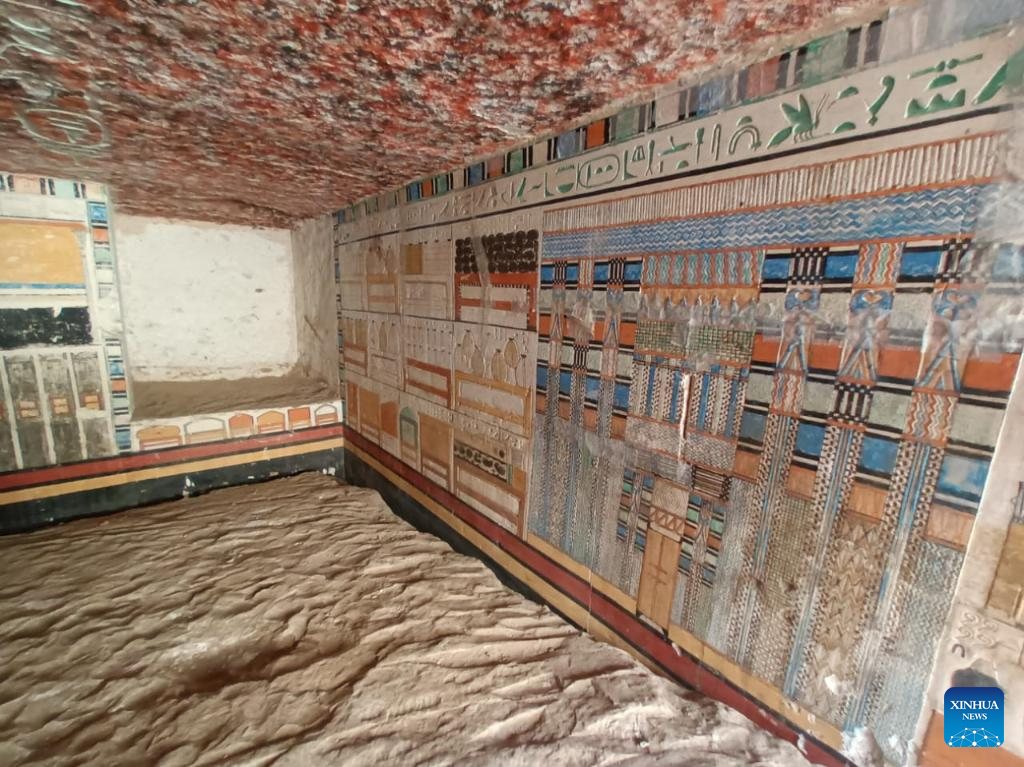
The undated photo shows colorful reliefs on walls of a mastaba discovered at the Saqqara archaeological site, south of Cairo, Egypt.
Hisham Elleithy, secretary-general of Egypt's Supreme Council of Antiquities, said the first tomb is considered a rare architectural discovery due to its unique geometric design, while the second closely resembles the first and is distinguished by its good state of preservation, read the statement.
Mohamed Abdel Badie, head of the Egyptian Antiquities Sector, explained that the first tomb features walls that gradually decrease in thickness from the base to the top, a design that may represent an early stage in the evolution of engineering concepts that eventually led to the construction of the Step Pyramid and later the true pyramid, read the statement.
Although the tomb was likely quarried in later periods for its stone blocks, the remaining sections revealed valuable details about ancient construction techniques, including guidelines used for precise stone cutting and large wooden supports that reinforced the walls, Abdel Badie said.
The second tomb, located south of the first, features a nearly identical design but is better preserved because it was not subjected to later quarrying activities, he added.
A number of burials from the Predynastic and Late Periods were also unearthed in the Jabal al-Tayr area, a historic mountain located about 25 km northeast of Minya city, read the statement.
According to Egyptian Minister of Tourism and Antiquities Sherif Fathy, the discoveries could help trace the development of funerary architecture in Ancient Egypt across different eras.