


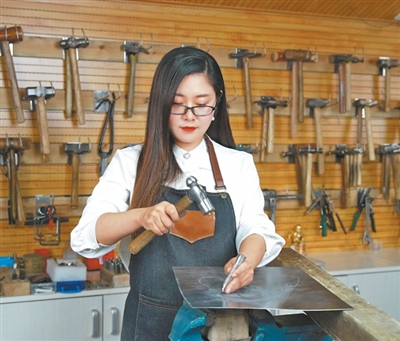
Guo Mohan works on an iron plate relief carving artwork. (Photo courtesy of the interviewee)
In the iron plate relief carving art museum at Hebei Vocational University of Industry and Technology in north China's Hebei Province, Guo Mohan carefully hammered a 1-millimeter-thick iron plate, transforming the cold metal into a vivid three-dimensional artwork.
Guo, a representative inheritor of the Guo family's iron plate relief carving, a provincial intangible cultural heritage in Hebei, is also a teacher at the university, a provincial-level arts and crafts master, and a recipient of the National March 8th Red-Banner Pacesetter, one of the highest honors given to the country's outstanding women by the All-China Women's Federation.
The craft traces its roots to China's centuries-old metal chasing technique. Unlike gold, silver or copper, iron cannot be softened by heating, making cold forging particularly challenging.
"Each iron plate is shaped directly on a wooden base without molds or welding. A single mistake can ruin the entire work," Guo said.
The craft involves 16 steps, from transferring the design and hammering the contours to rust removal, bluing, polishing, coloring and waxing. The most demanding stage is shaping fine details, which requires hair-thin chisels and precise control of every hammer strike.
After graduating with a degree in industrial design, Guo gave up a designer's job in 2012 to return home and learn the craft from her father.
The training was physically demanding. She spent more than 10 hours a day standing at a workbench, making tens of thousands of hammer strikes while enduring bruised fingers and sore arms. Many pieces that took more than a month to complete had to be discarded because of a single misplaced blow.
Years of practice enabled her to master the traditional craft while pursuing innovation.
Building on her father's pioneering work in coloring, Guo helped develop a wax-resist coloring technique for iron reliefs, allowing the metal to display vibrant, glaze-like colors instead of the traditional black, white and gray tones. The technique filled a gap in China's colored iron relief craftsmanship.
Beyond traditional themes such as flowers, birds and landscapes, Guo has created works inspired by her travels and contemporary subjects, including revolutionary history. She has also turned her studio into a training base for students, integrating intangible cultural heritage into art education and encouraging more young people to learn and carry forward the traditional craft.