


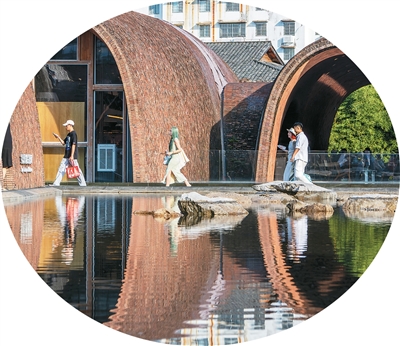
Tourists visit the Imperial Kiln Factory National Archaeological Site Park in Jingdezhen, east China's Jiangxi Province. (Photo/Liu Zhiyong)
The United Nations Educational, Scientific and Cultural Organization (UNESCO) added China's Jingdezhen Handicraft Porcelain Industry Sites to the World Heritage List on July 25 during the 48th session of the World Heritage Committee held in Busan, South Korea.
The inscription brings the total number of World Heritage sites in China to 61, filling the thematic gap of "porcelain" in the registry.
Jingdezhen Handicraft Porcelain Industry Sites are a group of heritage sites representing the handicraft porcelain industry system that developed in Jingdezhen, east China's Jiangxi Province. The sites are linked like pearls along carefully designed tourism routes, where ancient craftsmanship meets contemporary creativity.
At the Xujia Kiln in the Taoyangli Historical and Cultural Block, master kiln worker Feng Shanglun, 70, directs workers carrying saggars — fireproof containers used to hold shaped porcelain pieces — into the kiln. Feng has worked with kiln fire his whole life, starting as an apprentice at the kiln at 13, later working at a porcelain factory, and returning to the kiln after retirement.
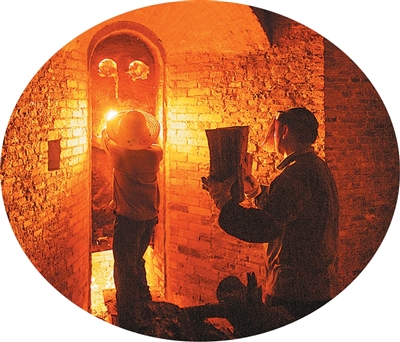
A kiln worker adds firewood to the Xujia Kiln in Jingdezhen, east China's Jiangxi Province. (Photo courtesy of the Taoyangli Historical and Cultural Block)
Built in the late Ming Dynasty (1368-1644), the Xujia Kiln is Jingdezhen's most intact surviving wood-fired kiln and one of many porcelain industry sites within Taoyangli. Its annual re-firing ceremony has become a signature cultural event drawing tourists.
Taoyangli covers a planned area of 3.06 square kilometers and encompasses 108 ancient alleyways, kilns that are more than 400 years old, and ceramic industrial heritage spanning more than 70 years. Its most significant site is the imperial kiln site, once the firing center for royal porcelain under the Ming and Qing (1644-1911) dynasties, where visitors can watch archaeologists piece together and restore broken porcelain fragments in real time.
In Taoyangli, 240 commercial spaces have been revitalized while more than 3,000 local households still live there. Along Pengjia Lane, workshops run by intangible cultural heritage (ICH) inheritors sit beside cafes opened by young entrepreneurs. More than 40 ICH inheritors and over 300 apprentices have taken root in Taoyangli, where locals, artisans, tourists and foreign "Jingpiao" — a term referring to those who've chosen to live, create and chase dreams in Jingdezhen — live harmoniously.
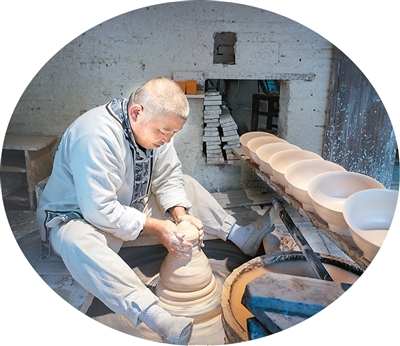
Yin Shengliang, an inheritor of intangible cultural heritage, demonstrates the technique of wheel throwing in Jingdezhen, east China's Jiangxi Province. (Photo courtesy of the Ancient Kiln Folk Customs Exhibition Area)
At the Ancient Kiln Folk Customs Exhibition Area, Yin Shengliang, a municipal-level ICH inheritor of the traditional wheel throwing technique, a key step of the national ICH item of Jingdezhen handicraft porcelain making technology, demonstrates the technique to tourists.
"Jingdezhen handcrafted porcelain making technology involves 72 steps — from kneading and wheel throwing to trimming, painting, glazing and kiln firing — each with strict technical requirements," Yin said.
The Ancient Kiln Folk Customs Exhibition Area attracts more than 200 ICH inheritors and has restored typical types of historic kilns from the Song (960-1279), Yuan (1271-1368), Ming and Qing dynasties. It holds annual re-firing ceremonies where visitors can watch the entire firing process and even add firewood themselves.
By the end of 2025, Jingdezhen had recognized 67 porcelain-related ICH items, with more than 3,200 municipal-level or higher inheritors, and 36 ICH workshops and 45 training bases at the municipal level.
The city has promoted models combining ICH with tourism, cultural and creative products, and e-commerce in recent years. In 2025, the annual output value of ICH-related handcrafted porcelain products in the city surpassed 10 billion yuan (about $1.47 billion), and the industry directly provided job opportunities for more than 50,000 people.
Elsewhere in the city, the Taoxichuan Cultural and Creative Block draws young people from around the world.
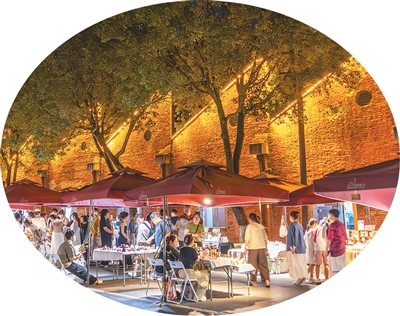
Crowds throng the Taoxichuan night market in Jingdezhen, east China's Jiangxi Province. (Photo/Liu Zhiyong)
Hu Yiming resisted his parents' wish for him to become a welder back home in east China's Anhui Province when he graduated from Jingdezhen Ceramic University two years ago, giving himself "two or three months to try his luck in Jingdezhen" instead. Two months into his drifter life, he made his way to Taoxichuan and started out selling goods at a street market stall, gradually building a following of regular customers.
Taoxichuan holds markets three days a week, where young people can apply for stalls, with free tents, tables and logistics support provided. After six months, vendors become eligible for greater support at a shopping mall in Taoxichuan; kiln firing costs only tens of yuan, and clay and glaze can be delivered door-to-door with a phone call.
At the end of that year, Hu earned 110,000 yuan. Today, he runs a three-room studio in Xianghu village, creating and firing ceramics by day and selling new pieces at night.
More than 33,000 young makers like Hu now work and live in Taoxichuan. It held markets 59 times in 2025, drawing nearly 3 million tourist visits.
Jingdezhen has attracted more than 60,000 "Jingpiao," including over 5,000 foreign nationals.