


China's inbound tourism market has been gaining strong momentum this year, with more foreign visitors no longer simply ticking off famous landmarks on their travel lists. Many are returning for second and third trips to discover a more diverse and authentic China.
In Ordos, north China's Inner Mongolia Autonomous Region, the Xiangshawan Desert scenic area has introduced an innovative summer package combining desert exploration, water activities and even indoor ice skating. Visitors can ride camels and take desert vehicles across the dunes before cooling off with water activities or enjoying ice skating – all within the desert scenic area.
According to local data, the scenic area has welcomed 16,000 foreign visitors since July 1, a 176% increase year on year, with most tourists coming from South Korea, Thailand, Malaysia and Singapore.
In Erenhot, a border city in Inner Mongolia, foreign visitors have also embraced traditional Chinese cultural experiences, including calligraphy and making handmade sugar figurines.
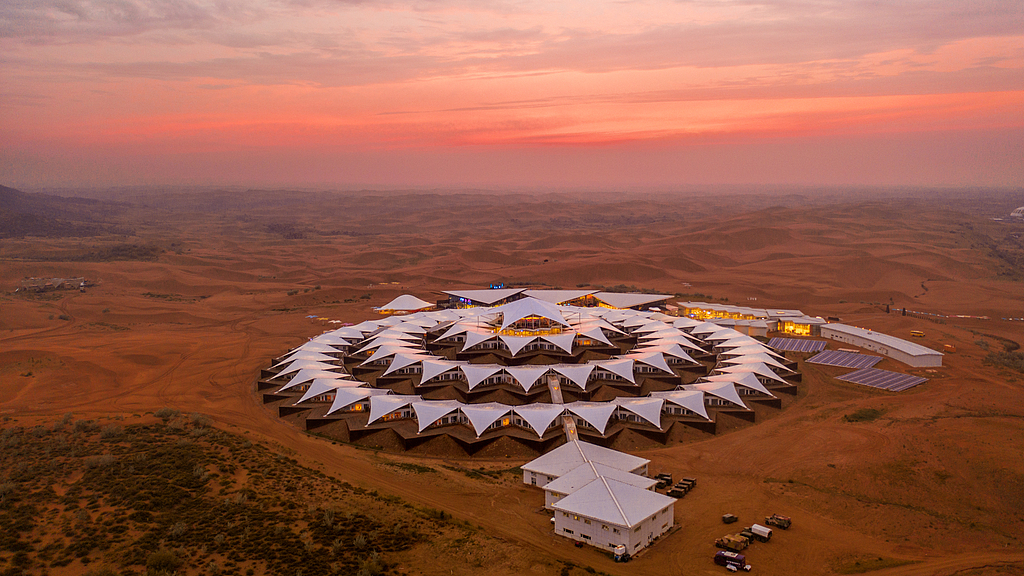
An aerial view of the Xiangshawan Lotus Resort in the Xiangshawan Desert scenic area in Ordos, north China's Inner Mongolia Autonomous Region. (Photo: VCG)
Diverse landscapes and cultures draw global travelers
Across Inner Mongolia, tourism operators are expanding nighttime performances, specialty cuisine and intangible cultural heritage experiences to encourage visitors to stay longer and engage more deeply with local culture. In the first half of this year, the region received 1.0978 million inbound tourists, up 11.9% year on year, while overseas visitors' spending reached 5.501 billion yuan ($766 million), an increase of 16.07%, according to China Media Group (CMG).
Meanwhile, Zhangjiajie in central China's Hunan Province has become a favorite destination for international travelers seeking both natural beauty and outdoor adventures.
Known for its dramatic mountains and unique landscapes, the city offers much more than sightseeing. Visitors can walk across glass bridges, try via ferrata climbing and experience high-altitude zip lines while enjoying the surrounding scenery.
Data shows Zhangjiajie Grand Canyon has received nearly 10,000 visitors a day on average since July, with foreign tourists accounting for more than half of the visitors. To improve the travel experience, the scenic area has introduced a multilingual AI tourism assistant that supports 14 languages, while also upgrading overseas payment services and streamlining ticket procedures.
Meanwhile, China's diverse regional cultures are also drawing international travelers.
In Kashi Ancient City in northwest China's Xinjiang Uygur Autonomous Region, traditional crafts and local customs have become a magnet for overseas visitors. Tourists can watch artisans forge metalware and create pottery, enjoy ethnic music and dance performances and wander through historic neighborhoods to experience the city's unique culture.
In southwest China's Sichuan Province, Baima Tibetan Ethnic Township, a lesser-known destination, is also gaining popularity. Foreign visitors are drawn by the area's authentic ethnic culture, joining local residents in making traditional foods and learning handicrafts to experience Tibetan customs firsthand.
The growing appeal of traveling in China is being supported not only by its natural landscapes and cultural diversity, but also by increasingly convenient travel policies and improved tourism services.

Foreign visitors walk across the glass bridge at Zhangjiajie Grand Canyon Scenic Area in Zhangjiajie City, central China's Hunan Province, May 11, 2026. (Photo: VCG)
Easier access and better services bring visitors back
By April this year, China had introduced unilateral visa-free entry policies for citizens of 50 countries and mutual visa exemption arrangements with 29 countries. The 240-hour visa-free transit policy had expanded to cover travelers from 55 countries. Meanwhile, 160 cities across the country had opened direct international flight routes.
These measures are making travel to China easier and encouraging more visitors to move beyond traditional itineraries that usually focus on major cities.
A British traveler with the first name Ulvi told CMG that China is a destination worth revisiting. She has already visited the country three times and is planning her fourth trip. Her journeys have taken her from Beijing and Shanghai to the Qinghai-Xizang Plateau and Mount Qomolangma, and she hopes to explore the Silk Road next year.
"China travel has really become better and better," she said, adding that China's visa-free policy for British citizens has given her more motivation to explore the country.
Wu Yu, president of a British travel company, told CMG that more British tourists are becoming interested in China after watching travel videos shared on social media. In response, the company has redesigned travel routes to include more distinctive experiences, such as Chongqing's drone light shows, helping visitors discover a more dynamic and multifaceted China.
Cambodian travel blogger Lim Kimsruong, who frequently shares her China travel experiences online, said she is impressed by the country's rapid development and that traveling around China is very convenient because of its extensive high-speed railway network.
For some Cambodian visitors, China is also a destination for business opportunities. Entrepreneur Lim Lida has traveled to China multiple times. He said he hopes to bring advanced Chinese technologies and equipment back to Cambodia.
From desert adventures in Inner Mongolia and cultural experiences in border towns to summer escapes in Zhangjiajie and ethnic traditions in Kashi, destinations across China are attracting international travelers with improved services and an increasingly diverse range of experiences. As travel shifts from simply "seeing China" to truly "experiencing China," more first-time visitors are becoming repeat travelers.