


CHANGSHA, Aug. 8 (Xinhua) -- Cai Gao had gone to the roof to collect her laundry. Before reaching the clothesline, however, she stopped beside a lace fern, pointed out hydrangeas yet to bloom and searched a small pond until a red fish flashed beneath the pennywort.
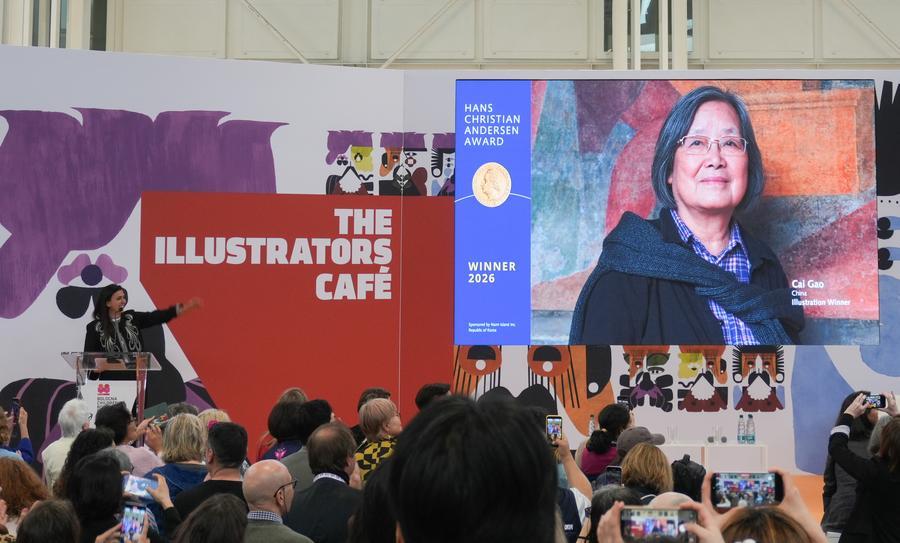
Photo taken on April 13, 2026 shows Chinese illustrator Cai Gao winning the 2026 Hans Christian Andersen Award on the Bologna Children's Book Fair in Bologna, Italy. (Photo: Xinhua)
Only then did the 80-year-old Chinese picture-book artist tend to the sheets she had left in the sun.
These short detours reveal something essential about the way Cai works. Her art begins with attention to things easily overlooked: a bird returning to a balcony, the colors of a carefully mended patch, or a nursery rhyme she can still recall seven decades later.
On Aug. 7, Cai received the 2026 Hans Christian Andersen Award for Illustration at a ceremony in Ottawa, becoming the first Chinese illustrator to win the highest international honor for creators of children's books.
When announcing the award at the Bologna Children's Book Fair in April, jury president Shereen Kreidieh praised the artistry and emotional engagement of Cai's work.
"The way she sees the world is beautiful," Kreidieh said.
Cai has held onto this way of seeing the world, not because she was shielded from hardship, but in spite of it. Throughout her life, she has endured unfair treatment, physical labor, and years of having her work overlooked. The innocence in her books is not a failure to understand the adult world, but a choice made after understanding it.
"I am not naive. I am very mature," Cai once said. "I chose innocence after I had matured."
A STOREHOUSE OF CHILDHOOD
Of the eight decades Cai has lived, it is the first that she returns to most often.
Born in 1946 in Changsha, central China's Hunan Province, Cai grew up in a family whose life followed the rhythms of seasonal festivals, household routines and close ties with relatives and neighbors.
Her grandmother told stories while she worked, took her to local opera performances and prepared food for seasonal celebrations. In Cai's family, even patching worn clothes was done with care: the stitches had to be fine, and the colors had to look right together.
These memories became the foundation of Cai's artistic world.
The Hunan nursery rhyme "mooncake ballad," which she heard as a child from her grandmother, later became one of her best-known picture books. "Where the Moon goes, I go" drew on the main room, courtyard and pomegranate tree of her childhood home. The girl carrying a flower basket and picking pomegranates was a portrayal of her younger self, Cai said.
She describes childhood as an inexhaustible storehouse.
"I was treated well and loved by my whole family," she said. "That became the source of positive strength that has carried me through life."
Cai says she still returns to that storehouse, taking down an old scene or memory, looking at it again and sometimes finding the beginnings of a new idea. She jokes that she now avoids going there at night, fearing she might linger too long.
Cai believes children already possess their own powers of observation and judgment. Picture books should not offer ready-made answers, she says, but leave room for young readers to think and discover for themselves.
A WILD EDUCATION
Cai had no formal academic training in art. Instead, she learned from literature and folk tales, from local opera and rural life, and from years of observing and sketching the world around her.
In her younger years, Cai was sent to rural Hunan, where she taught at a primary school for several years. She made sketches of village landscapes, children, and local residents, using anything and everything, from blackboards and newspapers to school activities, as opportunities to practice her art.
Cai draws a clear distinction between what she gained from those years and the hardships she faced.
"Unfair treatment itself should not be praised," she said. "I do not glorify suffering."
Yet the countryside also gave her something she would always hold on to. Farmers, she recalled, did not judge her for her family background; they simply knew she had come to teach their children. She began storing away the landscape -- mist, field paths, crops and the changing life of the countryside -- as material she would draw on years later.
Those experiences found their way into works such as "The Land of the Peach Blossom." They also became part of a broader way Cai came to see life, as a painting in which light and shadow coexist.
Red needs green beside it to become fully vivid, she said. She once saw an illustration of sunflowers beneath a leaden summer sky and was struck by how the gray made the yellow brighter. Cai does not romanticize suffering. However, she has come to believe that a life, like a painting, cannot be understood by looking only at its darkest parts.
At 36, she joined a children's publishing house as an editor, where she spent decades surrounded by stories and young readers. In 1993, her work "Baoer" won the Golden Apple Award at the Biennial of Illustration Bratislava, marking a milestone for Chinese illustrators on the international stage. After retiring at 55, she had more time to devote herself to picture-book creation.
Cai calls her path "wild" and "original." Yet she reads widely and resists repeating a fixed style, believing that each work demands its own form of expression.
For Cai, form must grow from the subject, while art itself grows out of life.
"Life is the greatest book," she said. "You have to read it, remember it and feel it."
RETURNING TO INNOCENCE
The world Cai creates begins with the land she knows best. Her picture books are deeply rooted in the culture of Hunan, with local dialects, folk songs and regional traditions woven into her artistic language.
"Dialect is our last homeland," she has said.
As cities grow more alike, she believes, the sounds of one's hometown preserve a sense of where one comes from. That deep connection to her roots is also what allows her works to resonate with readers across cultures.
Tan Fengxia, a professor at Nanjing Normal University and a member of the 2026 Hans Christian Andersen Award Jury, said Cai's works stand out because they remain deeply rooted in Chinese cultural traditions while speaking directly to children around the world.
At the 2026 Beijing International Book Fair, a reader from Romania named Andreea said she hoped Cai's works would soon be translated into Romanian.
"I love to see her new perspective on the world," she said.
Cai sees the Hans Christian Andersen award as belonging not only to herself, but also to generations of Chinese children's-book creators and the readers who have supported them.
She is reluctant, however, to turn her own experience into advice. Every generation faces different challenges, she says. What matters is finding something within oneself that remains steady as the world changes.
For her, it has meant finding her own way to live fully within circumstances she could not always choose.
"There are many things in life you don't get to choose," she said. "But even when life leaves you little choice, you can still choose how to live. There is real freedom within limits."
That conviction also shapes her view of artificial intelligence. Cai believes the most valuable part of creation remains uniquely human: memory, emotion and lived experience. Technology may imitate a style, but it cannot remember a grandmother's voice, a childhood rhyme or the feeling of a world once seen through a child's eyes.
At her home in Changsha, a spotted dove regularly comes to feed beneath a wisteria trellis. Cai avoids sudden movements when it appears and often keeps the window closed to avoid disturbing it.
The bird pecks at the food, then raises its head and looks toward her.
Cai likes to think it recognizes her.
She does not worry about growing old. If anything, she worries that there is not enough time.
"At 80, you can still have a fresh start," she said.