


For millennia, the ancient Silk Road connected Chinese and Arab civilizations with constant cultural exchange. Today, translation projects centered in Northwest China's Ningxia Hui Autonomous Region, an important hub for China-Arab exchanges, carry on this legacy, bridging cultural gaps with thoughtful localized storytelling.
"Only when you understand the characters first can the translation fit them," Ma Xuejun, an Arabic localization reviewer for a Chinese television drama, shared.
That drama is the widely acclaimed rural hit Minning Town.
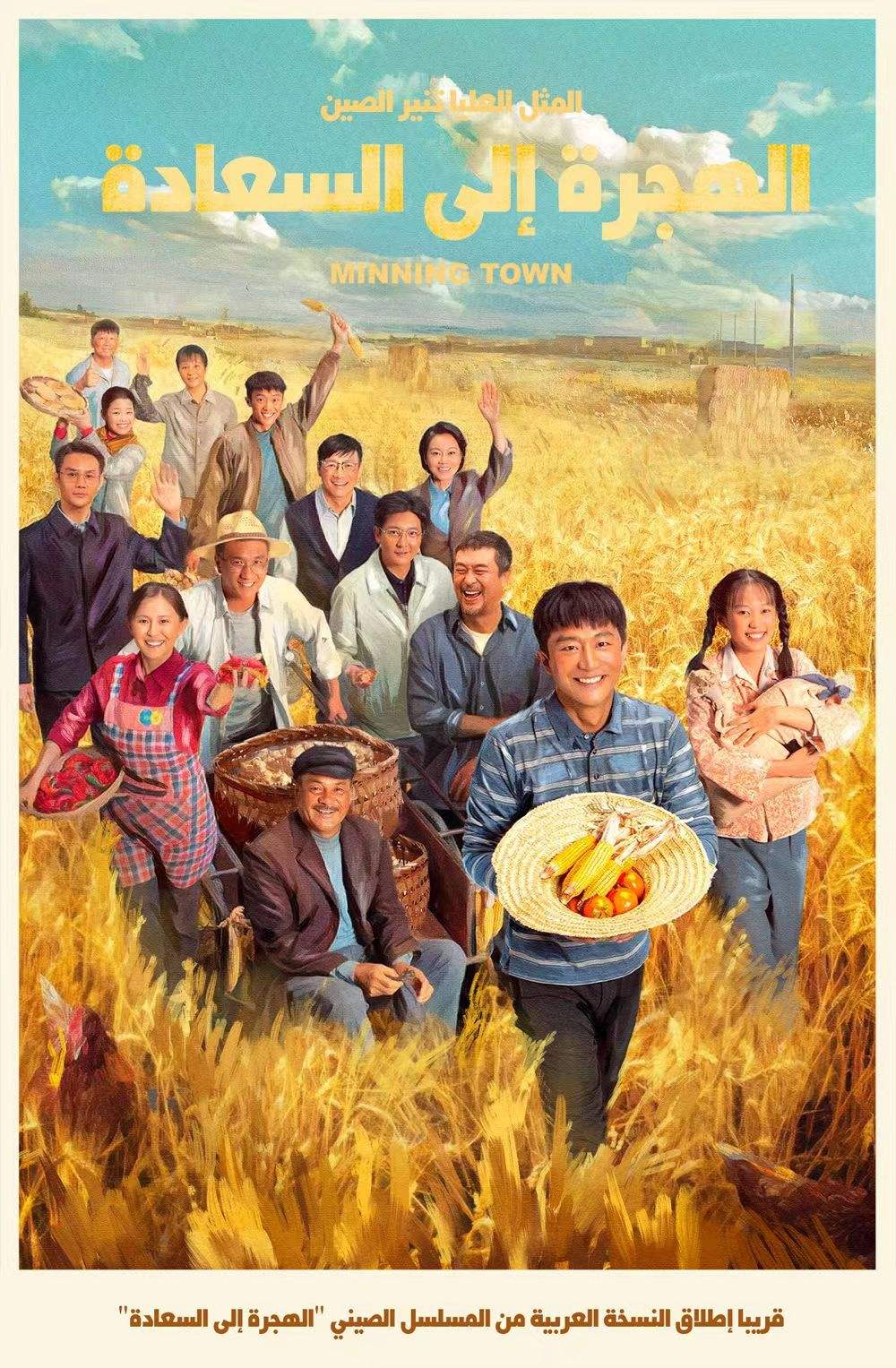
An Arabic poster promotes a popular Chinese TV series Minning Town. (File photo)
In this drama, villager Li Dayou says to school principal Bai Chongli, "Principal Bai, you really are a 'Bai' principal."
The line hinges on the word bai, which means "white" in Chinese. It doubles as the principal's surname and also carries the implication of "in vain," hinting his efforts may go unappreciated. Rendering it simply as "white" would puzzle Arabic-speaking viewers; retaining only the surname would erase the subtle pun.
Ma, who oversaw the drama's Arabic translation review, reworked the line into a rhetorical question about how the principal could account for the children's families. Though the literal wording shifted, the character bond and underlying emotion stayed intact.
Before localization began, Ma's team screened the full series and mapped each role's age, livelihood and temperament to retain authentic rural Northwest Chinese charm.
They selected a colloquial Arabic dialect familiar to ordinary viewers across the Arab world. Chinese linguists anchored translations to the original cultural context, while native Arab experts polished dialogue to fit local speech habits.
The team's expert from Sudan, Essam Audam Adam Ahamed—or, as he is known in Chinese, Zhou Yang—knows these cross-cultural hurdles firsthand. Grammar rarely stands as the biggest barrier. A harder task is rendering uniquely Chinese culture notions with no direct Arabic equivalents.
When tackling concepts like "harmony between humanity and nature" or traditional Chinese "Yin-Yang," he digs into reference works and consults cultural experts, adding subtle explanations or annotations for clarity.
"The first goal of translation is to make sure the audience truly understands," Ahamed said.
Ahamed's own outlook on China evolved through this work.
As a boy, he first grew curious about China via Jackie Chan and Bruce Lee's martial arts films. Before he moved to Ningxia in 2017, he related the area to loess land, sandstorms and poverty.
Collaborating on Minning Town upended that narrow perception. Through the drama's tight-knit villages and tough, hopeful protagonists, he spotted shared life struggles and aspirations binding rural Northwest China and Arab societies alike.
"Now, Northwest China is no longer just a geographical term to me," Ahamed said. "It has become a tangible way of life I can grasp and empathize with."
Arab audiences warmly embraced the series. "The comment sections were flooded with questions about follow-up seasons. And numerous Arab TV stations reached out to license more Chinese productions," Ahamed said. He attributes its popularity to a simple reason: Arab viewers saw echoes of their own daily lives on screen.
Cultural dialogue never flows in one direction. While Ahamed and his teammates adapt Chinese books and screen content for Arab markets, he plans to translate the Sudanese literary classic Season of Migration to the North (موسم الهجرة إلى الشمال) into Chinese.
Ma, meanwhile, persists in audiovisual translation and Chinese-language teaching to foster deeper mutual understanding between China and the Arab world.
When language crosses mountains and oceans, it transforms far more than how stories circulate globally. It widens translators' horizons and reshapes how foreign audiences see distant lands.
As narratives travel both ways, sincere listening, communication and shared resonance close the gap between peoples.