


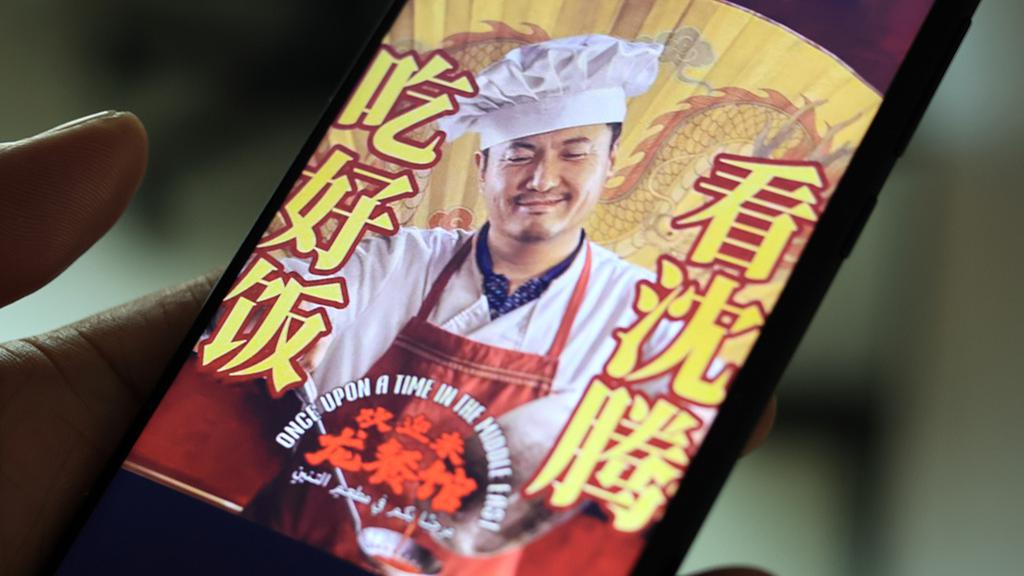
A poster for "Once Upon a Time in the Middle East" is seen on a phone. /VCG
What can preserve the warmth of everyday life amid gunfire and ruins?
Once Upon a Time in the Middle East looks for the answer in a simple place: a kitchen, a dining table, and a phrase familiar to many Chinese people – "eat well."
Set against the backdrop of conflict in the Middle East, the film follows Xu Fu – played by actor Shen Teng – a Chinese chef who travels there and opens a Chinese restaurant. He initially hopes to make a living through his cooking, but as violence spreads, his quiet life is disrupted by the conflict around him. Along the way, he builds relationships with local residents and people from different backgrounds.
Unlike many anti-war films that focus on battlefields, violence and suffering, Once Upon a Time in the Middle East takes a different approach. Instead of placing the story at the center of the fighting, it follows ordinary people trying to hold on to everyday life amid conflict.
The warmth of the restaurant stands in sharp contrast to the violence outside. Inside, steam rises from the kitchen as people share meals and conversations. Outside, explosions and chaos threaten their daily lives. The restaurant on foreign soil becomes more than just a place to eat. It becomes a place where people can briefly return to a sense of normalcy amid the chaos of war.
The meaning of "eat well" goes beyond the words themselves.
In Chinese culture, "eat well" is rarely just about food. For many people, sharing a meal is one of the simplest ways to show care and stay connected with others. Whether at a family dinner or when offering food to someone in need, a meal can become a way to express warmth and trust.
As the war intensifies, the restaurant is forced to move from a proper kitchen to cramped spaces and eventually to ruins. Yet the effort to prepare and share a meal continues.
Near the end of the film, Xu Fu helps a group of children escape the fighting. Covered in dust and surrounded by broken walls, they have little left. But with a damaged cooking pot, a few simple tools and limited ingredients, he prepares a hot meal for them.
In the middle of the ruins, the smell of freshly cooked food brings a brief moment of comfort. For the children, it is more than a meal. It is a reminder that life can continue even after everything around them has been destroyed.
Xu Fu does not have the power to stop the war. But he chooses to protect the people around him in the only way he knows – by cooking. An ordinary person can use his or her own skills to care for those who are more vulnerable and offer comfort amid suffering.
Cooking creates life. War destroys it. Rather than portraying heroes who change the course of history, Once Upon a Time in the Middle East focuses on ordinary people and the choices they make when faced with hardship.
From shared meals among people from different backgrounds to a simple dish prepared among ruins, the film shows how people can still find ways to care for one another even during conflict.
In the end, the film returns to its simplest message: As long as people can sit together, share a meal and care for one another, hope remains.