


At the Longmen Grottoes, digital restoration begins with a strict rule: Do not imagine what is missing.
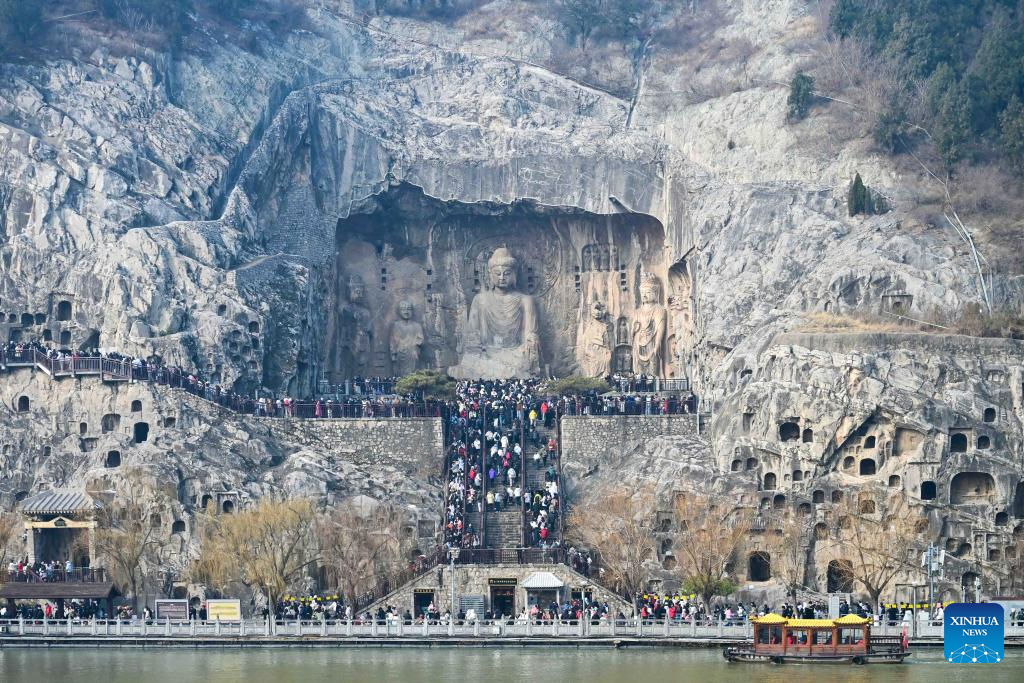
Tourists visit the Longmen Grottoes scenic spot in Luoyang City, central China's Henan Province, on Jan. 2, 2026. (Photo: Xinhua)
"When we do digital reconstruction, it must be based on extremely rigorous textual and photographic data," said Zhang Guofeng, a conservation worker at the Longmen Grottoes Research Institute.
"If we simply reconstruct a piece based on the general style of a period, that leans closer to artistic creation, which cannot be equated with digital restoration in the strict sense."
That principle guides how digital technology is used to preserve, study, and share the grottoes. Located along the Yi River in Luoyang, Henan province, the UNESCO World Heritage Site houses tens of thousands of Buddhist statues carved into steep limestone cliffs. Exposed to the natural environment for centuries, the site suffers from weathering and water erosion.
Because of these natural threats, Zhang noted that the primary goal of digitization is straightforward: to record what exists today.
"The most fundamental goal of digitization is to collect and record existing information in the caves as completely as possible," Zhang explained.
To achieve this, workers capture full 3D data and high-resolution textures to build high-precision 3D models. These digital records are stored long-term, serving as evidence for future research, conservation planning, and physical restoration.
Beyond preservation, digitization also helps solve historical puzzles: finding where lost relics originally belonged.
According to Zhang, when testing whether a missing sculpture matches a specific cave, workers first narrow down the candidates by style and era. They scan the piece in high precision, 3D-print an exact replica, and take it right into the caves for a physical test-fit. Finally, specialized software calculates down to the millimeter how seamlessly it fits—giving experts a scientific answer.
This technology is also changing how the public experiences immovable heritage fixed inside caves.
"Through digital scanning and 3D printing, immovable cultural relics fixed inside the caves can become movable relics that can travel out and be seen by more people," Zhang said.
Using 3D printing and digital display software, the institute has launched digital exhibitions that tour multiple regions, allowing the public to appreciate the details of grotto art at close range.
Yet Zhang acknowledges that digitizing the site is a vast, painstaking process. Longmen encompasses immense sculptures like the colossal Vairocana Buddha at Fengxian Temple, alongside tiny figures just a few centimeters tall and extensive shallow reliefs — all of which require substantial time for both field collection and data processing.
"Because the overall scale is huge, this work requires a great deal of time and effort," Zhang said.
"It is by no means something that can be completed overnight."
This holistic approach aligns with the broader logic of cultural heritage preservation. According to Dawulijiang Yeerhalike, a lecturer at the School of History of Renmin University of China, protection, transmission, and dissemination are deeply interconnected.
"Protection is the foundational baseline, providing reliable content for transmission and dissemination," he said.
"Yet heritage preservation cannot stop at merely keeping objects preserved. By translating professional value into accessible forms for the public, digital displays help foster wider cultural awareness, which in turn builds broader societal consensus and support for ongoing conservation."
Furthermore, he noted that digital tools bridge a critical gap in physical displays. By illustrating the craftsmanship and construction processes behind ancient monuments — beyond simply showcasing damaged, immovable finished products — technology reveals the full historical and artistic value of the grottoes, ensuring they truly remain living witnesses of civilization.