


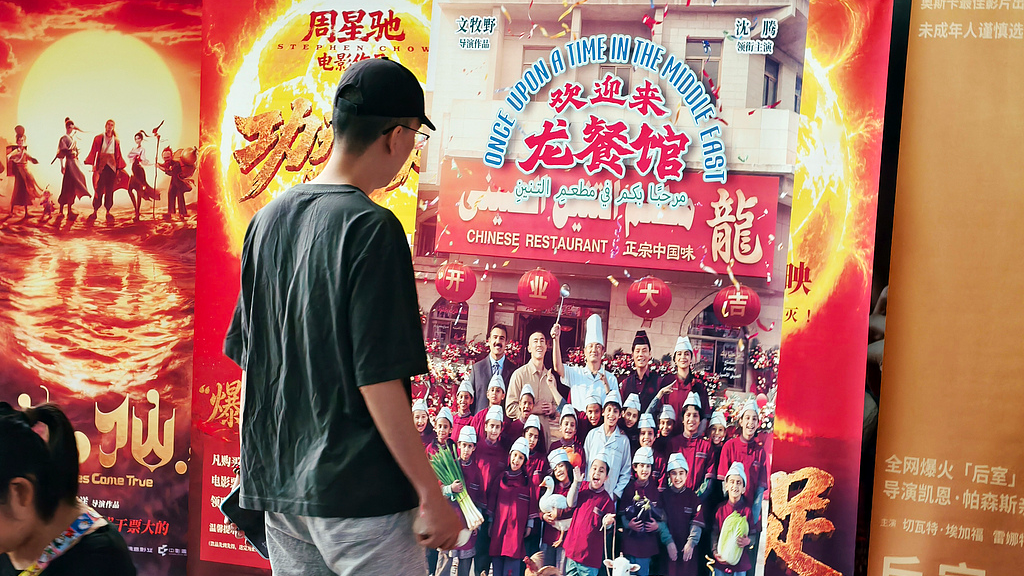
A man looks at a poster for the movie "Once Upon A Time in the Middle East" at a cinema in Shanghai on August 15, 2026. (Photo: VCG)
Whose perspective does a war film take?
In many Hollywood films about the Iraq War, the camera follows the soldiers. Viewers see the battlefield, their missions and their struggles. War is often told as a story of heroes and enemies.
Once Upon a Time in the Middle East takes a different path. Instead of keeping the war at the center of the story, the film follows Xu Fu, a Chinese chef who goes to the Middle East to make a living. From where he stands, the film shows how a war slowly finds its way into the lives of ordinary people.
That shift in perspective raises a bigger question: Who gets to tell a war story? And what do we see when soldiers and military missions are no longer at the center?
We see people whose lives are changed by war.
Like Xu Fu, the people who come to the restaurant are ordinary people with families, feelings and fears. More than anything, they want the simple things that make up everyday life.
But war does not care about these simple wishes. It pushes its way into people’s homes, their families and their everyday lives, taking away the sense of normalcy.
That is why the film does not ask who wins the war. It asks a more painful question: What is left of an ordinary life after war has passed through it?