


Centuries-old artifacts bear witness to vibrant Sino-Italian cultural exchanges
TIANJIN, Aug. 31 (Xinhua) -- Chinese silk and decorative motifs found their way into the art of 18th-century European courts, while European tastes and designs came into contact with Chinese porcelain.
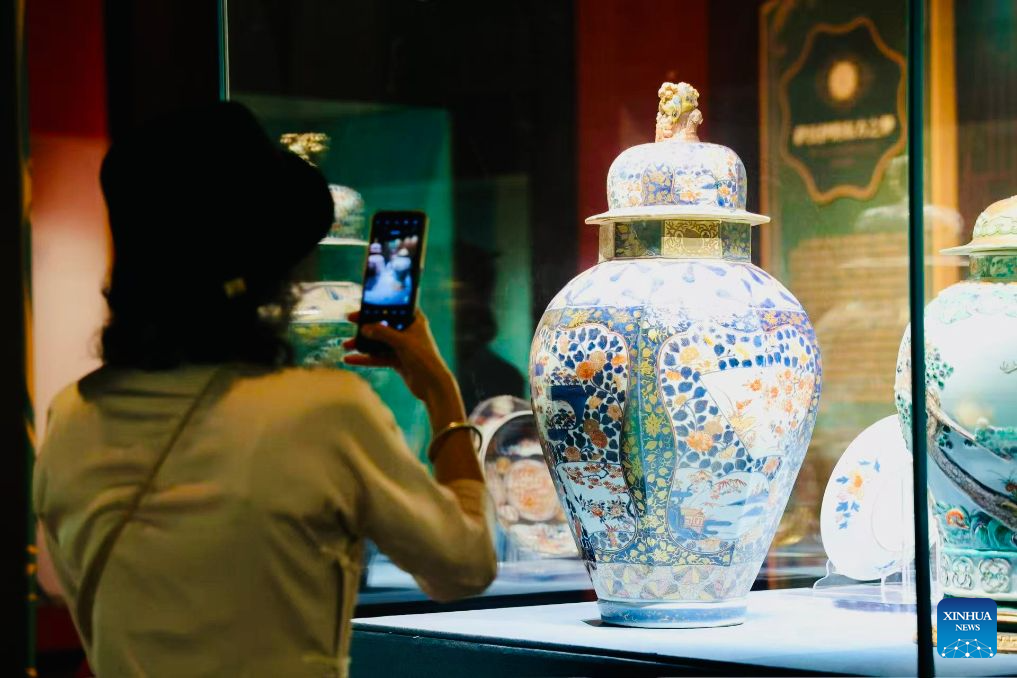
A visitor takes photos during an exhibition titled "Crown of Glory: 18th-Century Italian Court Treasures from the House of Savoy" at the Tianjin Museum in north China's Tianjin Municipality on July 2, 2026. (Photo: Xinhua)
At an exhibition at the Tianjin Museum in the northern Chinese metropolis, more than 150 Italian artifacts offer a vivid glimpse into the rich cultural exchanges between China and Italy centuries ago.
Jointly presented by the Tianjin Museum, the Tianjin Digital Art Museum and the Turin City Museum of Ancient Art in Palazzo Madama, the exhibition, titled "Crown of Glory: 18th-Century Italian Court Treasures from the House of Savoy," ran from Feb. 10 to Aug. 31. The exhibition showcases centuries-old treasures from the House of Savoy, one of the most influential royal houses in Italy in the 17th and 18th centuries.
Rather than simply showcasing the splendor of the Italian royal court, the exhibition traces how Chinese art and craftsmanship influenced European tastes and how Chinese artisans, in turn, responded to European demand, providing a window into the cultural interaction between East and West.
A French court gown from the collection of Palazzo Madama is among the highlights at the exhibition.
According to Li Jun, deputy director of the artifacts research department at the Tianjin Museum and curator of the exhibition, the gown incorporates Chinese silk and embroidery techniques, offering evidence of the popularity of "chinoiserie" at the time. By the mid-18th century, the style had become a hallmark of European aristocrats and the wealthy bourgeoisie.
Another exhibit, a men's robe with decorative patterns, provides further evidence of the influence of Chinese craftsmanship.
According to scholars, the ivory-colored robe with floral patterns was made from precious Chinese fabric. The silk was produced using a combination of weaving, block printing and hand painting techniques.
Such oriental-style fabrics became highly fashionable in European society in the second half of the 18th century. They were used not only for luxury garments but also extensively in interior decoration, becoming an important carrier of the "chinoiserie" aesthetic.
In the 17th and 18th centuries, Chinese porcelain, silk, lacquerware and other goods featuring distinctive oriental aesthetics became increasingly popular in Europe. Travel accounts, images of exotic people and landscapes, and Chinese-inspired decorative motifs further shaped European perceptions of the Orient.
The 18th century also witnessed the Enlightenment in Europe, with thinkers challenging feudal autocracy and religious constraints.
The thoughts of Chinese philosophers emphasizing openness and rationality resonated with some Enlightenment ideas, said Yan Guodong, dean of the School of Foreign Languages at Nankai University and an expert in the history of cultural exchanges between China and foreign countries.
Against this backdrop, an unprecedented craze for Chinese-style art and design, known as "chinoiserie," swept across European society and courts, leaving a lasting imprint on Western art and aesthetics.
The influence of cultural exchanges is even more vivid in the exhibition's "East Meets West" section, where Chinese-style porcelain, round fans and bird-and-flower paintings evoke interactions between Chinese and European artistic traditions.
A Qianlong-period Guangcai porcelain plate with a Swedish coat of arms from the Tianjin Museum's collection is one example.
Li said the piece was commissioned by Count Carl Gustaf Tessin, a prominent European art collector of the 18th century.
"Its value goes far beyond an ordinary commercial transaction. It represents a profound cultural dialogue between East and West based on mutual aesthetic appreciation and romantic imagination," Li said.
Such exchanges were by no means one-way, as Chinese kilns also accepted bespoke orders from European aristocrats, producing armorial porcelain tailored to Rococo tastes, Li added.
Yan said European consumers regarded the patterns on Chinese porcelain, silk and lacquerware as representations of life in China, while Chinese artisans sought to cater to European tastes in the selection and design of porcelain motifs.
"These exchanges were not simply the movement of commodities, but also the interaction of aesthetics, craftsmanship and cultural imagination," Yan said.
The exhibition has so far attracted more than 24,000 visitors.
"I was amazed by the material culture and artistic achievements of the House of Savoy, and even more struck by how some of the pieces ingeniously incorporated traditional Chinese craftsmanship, vividly recreating the 'chinoiserie' craze in 18th-century Europe," said a visitor surnamed Wang in Tianjin.
The artifacts, he added, bear witness to cultural exchanges between China and Italy along the Maritime Silk Road.
For Giovanni Carlo Federico Villa, director of the Turin City Museum of Ancient Art in Palazzo Madama, the journey of these artifacts across mountains and seas to China tells a story that extends far beyond artistic beauty.
"These artifacts not only allow us to look back on exchanges between ancient civilizations, but also provide a historical reference for contemporary cultural cooperation between China and Italy, further strengthening the bonds between our peoples," Villa said.
Massimo Ambrosetti, Italian ambassador to China, said the exhibition reveals the profound influence of Chinese art on European "chinoiserie" aesthetics and the porcelain industry in the 18th century, demonstrating the mutual enrichment of Chinese and Italian cultures and arts.
He expressed hope that cultural exchanges between China and Italy will continue to deepen and deliver lasting benefits.