


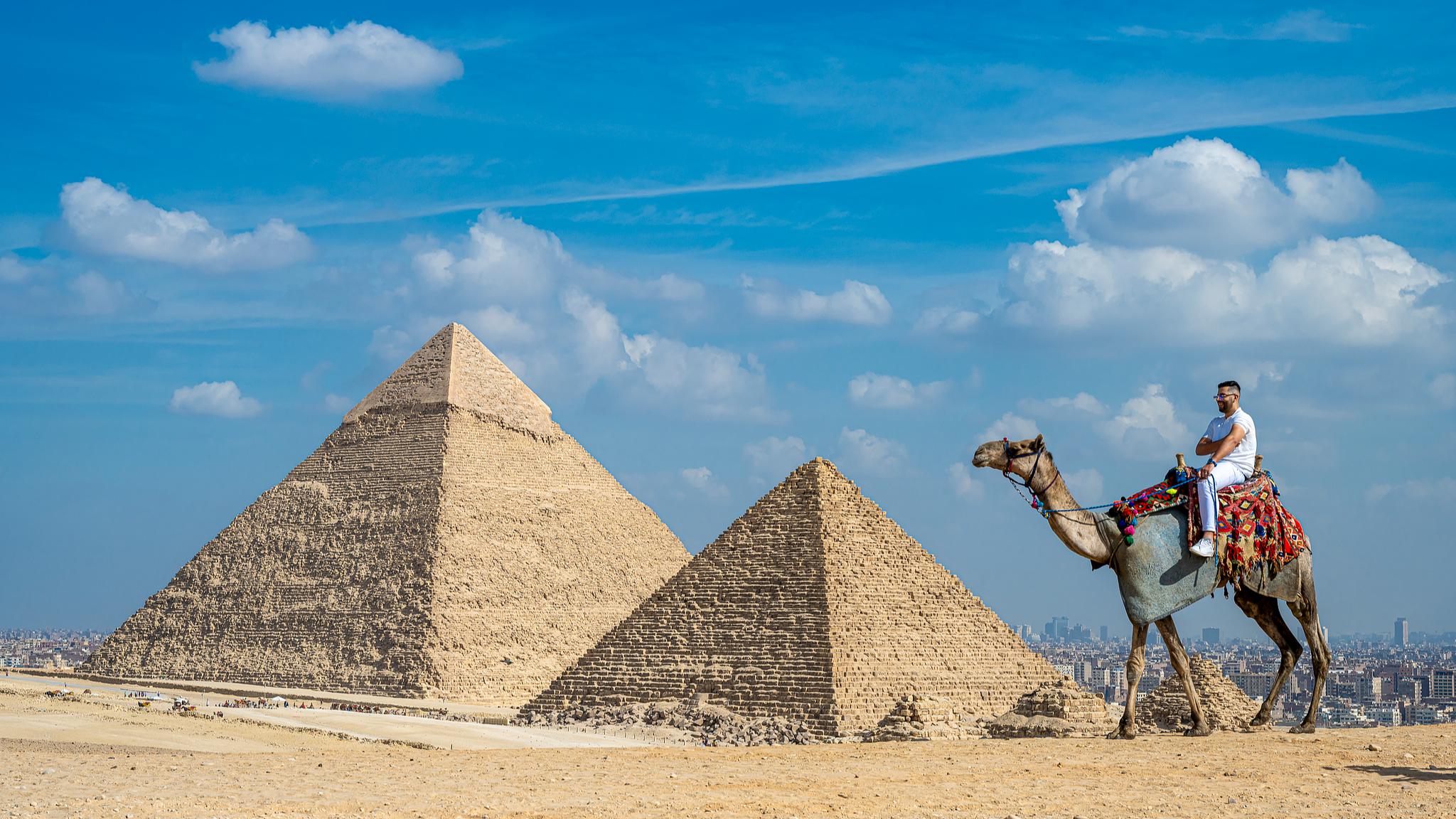
A tourist rides a camel near the pyramids in Giza, Egypt, November 11, 2024. (Photo: CFP)
The Luoyang shovel, invented in the early 20th century and getting its name from the city in central China, where its inventor is said to have lived, has become a symbol of Chinese archaeological drilling tools. It has excavated soil from the Yinxu ruins in central China, one of China's oldest and largest archeological sites dating back over 3,000 years, and explored ancient tombs in Luoyang. Now, this unique Chinese archaeological tool has reached the banks of the Nile, encountering the silt there for the first time.
A shovel bridges millennia
In 2018, the Institute of Archaeology, the Chinese Academy of Social Sciences, signed a cooperation and mutual assistance agreement with the Egyptian Ministry of Antiquities, leading to the first formal excavation by a Chinese archaeological team in Egypt. At the world-famous Karnak Temple, a massive temple complex in Luxor in southern Egypt, you can see not only Chinese tourists, but also Chinese archaeologists exploring the secrets of the ancient temple together with Egyptian scholars.
In 2024, we made the most important discovery since the start of our excavation, finding a small water storage facility on the west side of the Temple of Ma'at, known as the "South Sacred Lake." During the exploration of the South Sacred Lake, it was the Luoyang shovel that helped uncover the site in a high-water area, enabling us to determine the lake's depth and bottom structure and avoid potential damage from blind excavation. This was the first systematic excavation of a sacred lake in the history of Egyptian archaeology. It has rewritten the floor plan of the Karnak Temple and even updated the textbooks widely used today.
The Egyptian-Chinese joint archaeological team has excavated about 2,300 square meters at the site of the Temple of Montu, a falcon-god of war in ancient Egypt, uncovering important temple remains and hundreds of artifacts. Our work has shown the global archaeological community China's capabilities and strength in archaeology, and enabled people to see the vitality that ancient civilizations bring to the modern world.
In 2024-2025, the Shanghai Museum held an exhibition, "On Top of the Pyramid: The Great Exhibit of Ancient Egyptian Civilization," an event hailed as a "cultural epic." Treasures of ancient Egyptian civilization traveled across the seas to be presented to Chinese audiences. The exhibition, based on the research of Chinese scholars, injected a Chinese voice into Egyptology and cleverly incorporated Chinese artefacts for a "civilization dialogue," creating a vivid example of intercultural exchange. It made the exhibition a messenger of cultural communication that built trust.
The enthusiasm of Chinese audiences for the ancient Egyptian civilization showed that scholarship and culture are most meaningful when they reach the people; it is the people who create civilizations. The Chinese have the utmost respect and sincerest feelings for ancient civilizations, and the depth, beauty, and legacy of these cultures resonate harmoniously with ordinary people who carry on these ancient traditions. The exhibition was no longer just an educational or research activity; it became a social event and part of cultural diplomacy, as well as a part of people's daily lives.
China and Egypt are both ancient civilizations with brilliant achievements. In our work, Chinese and Egyptian archaeologists cooperated closely, forming strong friendships. Artifacts from ancient Egypt that traveled across the oceans witnessed the friendly cultural cooperation between Egypt and China, strengthening the friendship between our peoples.
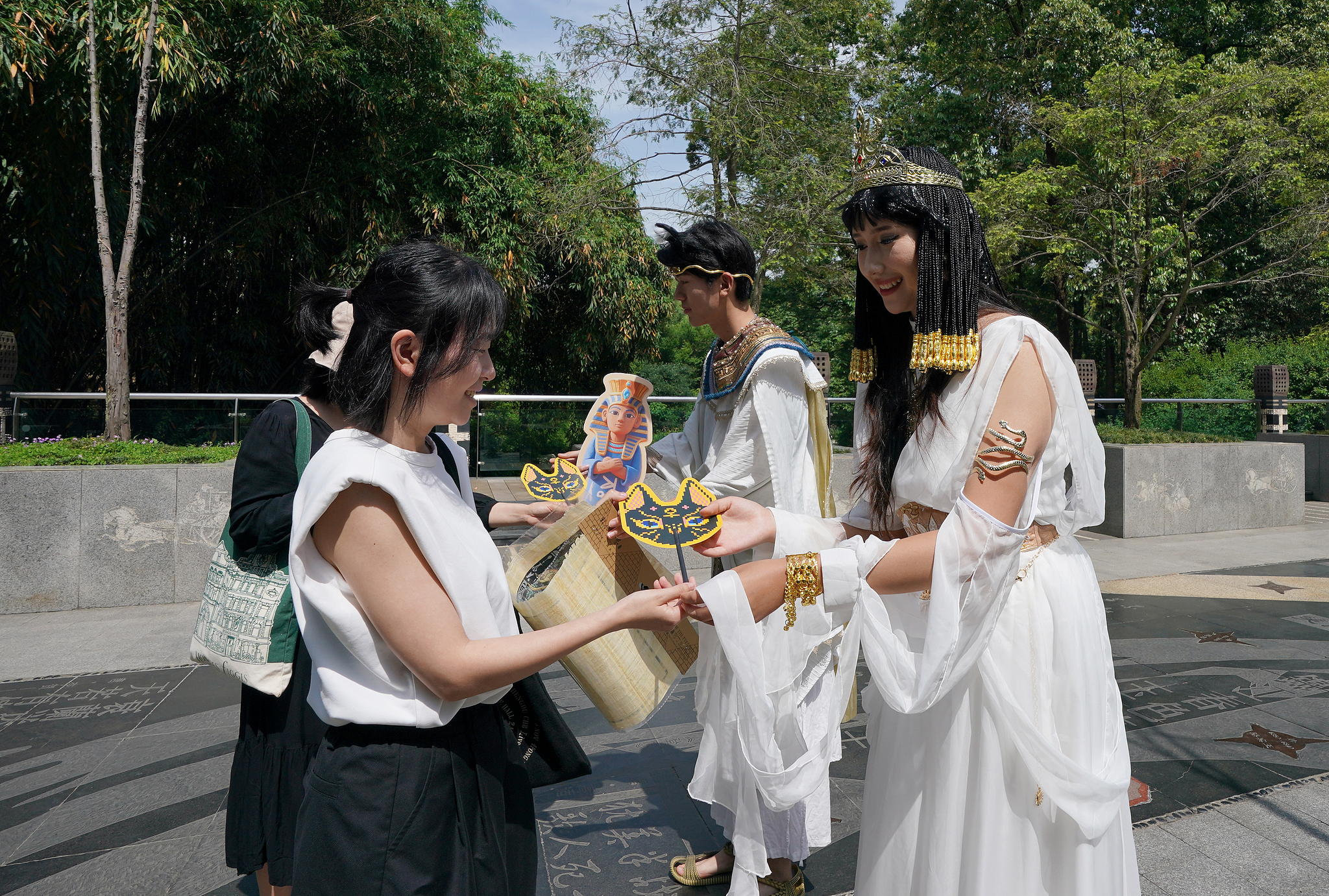
A China-Egypt cultural exchange event in Chengdu, Sichuan Province, southwest China, May 8, 2025. (Photo: CFP)
Civilizations in conversation, not conflict
Since ancient times, China and Egypt have had countless connections. The ancient Silk Road brought Chinese silk and porcelain to Egypt, while it also transported Egyptian glass, spices, and medical knowledge to China.
The progress of civilization doesn't have to come from conquering each other's territories or destroying each other's beliefs; trade and knowledge exchange can equally bring prosperity. Direct military confrontations or religious wars have rarely occurred between these two great civilizations. This is not because of geographical isolation, but because the core values of both civilizations lean toward tolerance and acceptance.
Egypt, as a crossroads of Eastern and Western civilizations, absorbed and integrated Greek, Roman, and Islamic cultures, and its ancient civilization's respect for nature and life, along with the gentle and inclusive national character formed through later multicultural integration. The Chinese civilization promotes the values of "harmony being the most precious" and "harmony without uniformity." Their interaction shows that even with very different cultural backgrounds, dialogue between civilizations can become the norm.
Both Egypt and China believe that "order" and "harmony" are more important than "conflict" and "conquest." This philosophical resonance has made their exchanges transcend material objects and rise to mutual recognition of values. Both countries are ancient civilizations with long histories, both have faced the impacts of modern colonialism, and both are exploring development paths suited to their own national conditions. This shared historical experience gives them a high level of consensus on core issues such as sovereignty and the right to development.
Egypt was the first Arab and African country to establish diplomatic relations with the People's Republic of China. This year marks the 70th anniversary of China-Egypt relations, and Chinese President Xi Jinping's state visit to Egypt signals that the two countries will have more cooperation in the future, and the exchange and mutual learning of civilizations will reach new heights.
The stability of this diplomatic relationship is supported by mutual understanding based on "civilizational dignity." China-Egypt cooperation is not only reflected in infrastructure projects and trade numbers but also in deep cultural and educational exchanges. Egypt's enthusiasm for Chinese language teaching and Chinese culture studies, alongside Chinese universities increasingly focusing on Egyptology, shows that this cooperation is not just for economic mutual benefit but also for jointly uncovering the wisdom of ancient civilizations in the modernization process, providing spiritual support for Global South countries.
The Egypt-China relationship shows that as long as both sides maintain the mindset that all civilizations flourish together in harmony, even with different cultural genes and social systems, a highly trusting strategic partnership can be fully established. This offers a reference model for how civilizations around the world can interact. Avoiding conflict and confrontation isn't a moral utopia; it is a practical wisdom and development path verified by a thousand years of exchanges between China and Egypt.