


Young artisans breathe new life into China's traditional crafts
Across China, a new generation of artisans is finding fresh ways to preserve age-old crafts such as textile weaving, underglaze porcelain making, sword forging, leather carving and embroidery.
Through dedication and innovation, these young inheritors have injected new vitality into intangible cultural heritage items while adapting traditional crafts to modern life.
Carrying forward the textile weaving techniques of the Dulong people
For Kong Yuhua, a young woman from Nujiang Lisu Autonomous Prefecture, southwest China's Yunnan Province, the sound of her grandmother weaving textiles remains one of the most cherished memories of childhood.
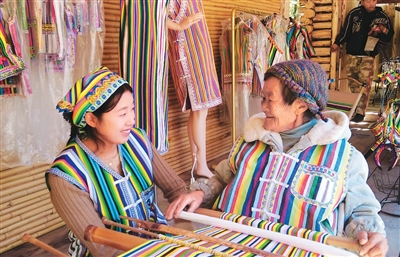
Kong Yuhua (left), a young artisan from Nujiang Lisu Autonomous Prefecture, southwest China's Yunnan Province, learns traditional textile weaving techniques of the Dulong ethnic group from her grandmother. (Photo: Huang Chenghao)
Growing up along the Dulong River, Kong often sat beside her grandmother, watching her weathered yet nimble hands weave colorful threads into traditional patterns of the Dulong ethnic group.
Each pattern carries a story, Kong said. Motifs featuring ox heads represent good fortune and courage, while mountain and river designs express the Dulong people's deep attachment to their homeland.
As machine-made textiles became more common, fewer young people were willing to spend years mastering the time-consuming craft. Seeing her grandmother grow older, Kong decided to take up the baton.
Under her grandmother's guidance, she learned every step of the process, from spinning threads and matching colors to weaving and repairing patterns.
For countless days and nights, Kong practiced patiently, keeping her grandmother's words in mind: "To preserve a craft, one must first cultivate patience, focus and perseverance."
She gradually mastered the essence of the traditional techniques, equipping herself with the skills to preserve the craft's authentic character.
Believing that preserving tradition means adapting it to the times rather than simply sticking to the old ways, Kong has brought bold new ideas to the craft.
She has retained the original Dulong motifs and traditional techniques while incorporating modern designs, creating cultural and creative products, clothing and household items that fit contemporary lifestyles.
By sharing textile weaving videos and stories online, Kong has helped bring the provincial-level intangible cultural heritage item, once confined to mountain villages, to a wider audience.
"My grandmother's works are full of memories and commitment, while mine reflect the craft's inheritance and future," Kong said.
Bringing Liling ceramics into everyday life
In Liling, a county-level city in central China's Hunan Province known as the "millennium-old porcelain capital," young artisan Guo Xinyi is working to make traditional underglaze ceramics part of everyday life.
Liling underglaze porcelain, a traditional local craft recognized as national-level intangible cultural heritage, involves a series of meticulous handcrafting steps, from wedging and wheel throwing to trimming, underglaze painting and high-temperature firing.
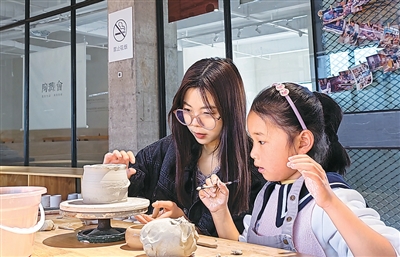
Guo Xinyi (left), a young artisan from Liling, a county-level city in central China's Hunan Province, helps a girl try the pottery-making process. (Photo courtesy of Hunan TR Gallery Co., Ltd.)
After receiving systematic training in ceramic-making theory and techniques at university, Guo chose to stay in her hometown and help promote the local ceramic culture.
She began working at a local ceramic experience center before graduation, starting with guiding visitors through pottery-making activities while learning about store operations, product design and customer service.
Drawing on her years of frontline experience, Guo now oversees the center's daily operations and innovation efforts.
To bridge the gap between traditional ceramics and younger consumers, Guo has maintained the core techniques of hand throwing and underglaze painting rather than simplifying the traditional steps. At the same time, she has developed products that appeal to contemporary young people, including cultural and creative souvenirs inspired by city landmarks, as well as pottery-making courses designed to help participants unwind.
Through short videos showing ceramic-making processes and offline spaces offering hands-on sessions, she has helped transform ceramics from something people simply admire into something they can create themselves.
"In my view, preserving traditional crafts does not mean sticking to established practices," Guo said. "True preservation requires using expressions and forms familiar to and popular among young people to bring Liling ceramics into everyday life."
Giving ancient swords new expressions
Growing up in a family of sword makers in Longquan, east China's Zhejiang Province, Zou Qi never imagined she would one day stand beside a furnace and swing a heavy forging hammer herself.
Her childhood memories were filled with the scene of swords hanging on the walls of her family's old house, the smell of rust and coal in the air, the clang of hammers striking steel and the sight of her father's hands darkened from years of work at the forge.
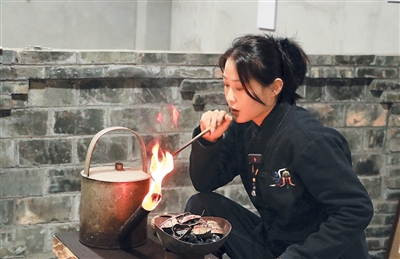
Photo shows Zou Qi, an inheritor of the traditional Longquan sword-making craft in Longquan, east China's Zhejiang Province. (Photo courtesy of the interviewee)
Zou's father did not want her to take up sword forging, believing the work too arduous for his daughter.
After graduating from university, Zou took a regular office job in Hangzhou, capital of Zhejiang Province.
In 2020, when livestreaming emerged as a popular way to promote products in the sword-making industry, her father asked Zou to join the trend and promote Longquan swords online.
In an effort to better introduce Longquan swords to viewers, she began immersing herself in the history and craftsmanship of sword making.
After four months of intensive learning, she became increasingly fascinated by the cultural heritage behind the craft.
In 2021, she quit her job and devoted herself fully to sword making.
Only after working at the forge did she realize how demanding the craft is. Making a Longquan sword involves a series of intricate steps, including refining, forging, chiseling, filing, carving, copper inlaying, heat treatment and polishing.
Zou endured injuries and countless hours of practice before mastering the techniques.
While traditional swords often feature restrained colors such as silver, gray and black, Zou has introduced brighter designs and creative motifs into the craft.
The first sword she helped make was named "Phoenix Nirvana," which later won a gold award at a national exhibition of Chinese time-honored brands.
"Some people doubted whether a woman could make a lasting career in sword making, but I knew I wouldn't be intimidated by difficulties. I was determined to bring fresh aesthetic expressions to traditional swords," Zou said.
In addition to swords, she has also created cultural and creative products incorporating sword elements, including necklaces, fridge magnets and keychains.
"I want to show more young people that traditional crafts are not museum exhibits, but a living, vibrant culture," Zou said.
Creating art on leather
In Hohhot, north China's Inner Mongolia Autonomous Region, young artisan Wu Yao has found her calling in leather carving.
Originally trained in tourism management at university, she encountered the leather carving art of the Mongolian ethnic group, a national-level intangible cultural heritage item, during a study tour of Monishan town, a national 4A tourist attraction in Huimin district of Hohhot. She was fascinated by how ordinary cowhide could become a canvas for intricate designs.
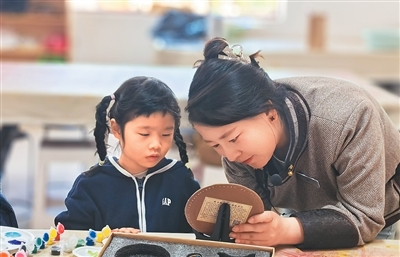
Young artisan Wu Yao (right) demonstrates leather carving techniques to a girl in Hohhot, north China's Inner Mongolia Autonomous Region. (Photo courtesy of the interviewee)
After graduation, she returned to Monishan town to study leather carving and was eventually apprenticed to Jia Hongwei, a representative inheritor of the craft.
Jia often reminds his apprentices that mastering the techniques is only the foundation, and that what truly sustains their development in the field is patience, focus and dedication, according to Wu.
Leather carving may appear simple, but it is a craft that demands precision at every step, Wu said.
The dried cowhide used as the material is tough and coarse, requiring thorough soaking and softening before it can be carved, she explained.
The raw material is also costly, Wu said, adding that because each cut is irreversible, even a single mistake can ruin a piece and lead to waste.
Through years of practice, she gradually mastered the techniques and learned how much pressure to apply with each stroke.
According to Wu, the years spent carving have not only refined her skills, but also cultivated her patience and attention to detail, making her more composed and thoughtful.
Today, she works with a team to create leather carving artworks while also teaching visitors the basics.
In Monishan town, Wu is not alone in learning the craft. Many young people from diverse backgrounds have taken up leather carving, with some hoping to master the skill to make a living, while others are driven purely by their passion for the art.
They have preserved traditional Mongolian motifs while integrating leather carving into everyday items, including phone cases, keychains and cultural and creative blind boxes, allowing the time-honored craft to move beyond exhibitions and become part of people's daily lives.
"For me, leather carving has grown from a hobby into a lifelong pursuit that I am determined to dedicate myself to," Wu said.
Painting miniature worlds inside bottles
At Zibo Polytechnic University in Zibo city, east China's Shandong Province, a student named Chen Moyan is learning another delicate traditional craft: Lu-style inside painting, or inner painting, which has been recognized as national-level intangible cultural heritage.
Originating in the Qing Dynasty (1644-1911), Lu-style inside painting is a traditional art form that involves creating intricate artwork by manipulating a specialized brush through the neck of a bottle.
In 2024, shortly after she began her studies at the School of Ceramics, Glass and Art Design of Zibo Polytechnic University, Chen became fascinated by the craft during a visit to the China Ceramics and Glass Museum in Zibo.
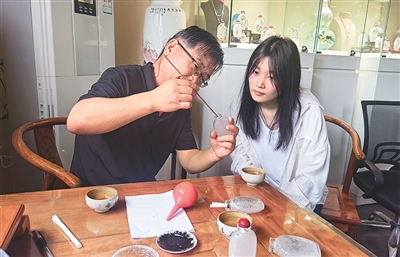
Chen Moyan (right), a student at Zibo Polytechnic University in Zibo city, east China's Shandong Province, learns Lu-style inside painting techniques from a senior artist. (Photo courtesy of the interviewee)
Through a specialized course in inside painting offered by her school, she gained a systematic understanding of the development of Lu-style inside-painted snuff bottles and got to know Li Huitong, a Chinese master of arts and crafts and a leading figure in the field.
At the end of 2024, Chen began studying the craft under Li's guidance.
From binding specialized brushes to mastering reverse painting techniques, she has spent countless hours practicing basic skills, gradually gaining a grounding in the techniques of Lu-style inside painting.
"Inside a small bottle lies a world of craftsmanship," Chen said, noting that works of Lu-style inside painting link the long-standing commitment of senior artists and the enthusiasm of young learners.
Practicing two hours every evening, Chen is determined to hone her skills and preserve the Eastern aesthetics embodied in the tiny world inside a bottle, one delicate brushstroke at a time.
Stitching freehand brushwork into embroidery
Xia Yu, a young man from Yinchuan, capital of northwest China's Ningxia Hui Autonomous Region, has integrated freehand brushwork in traditional Chinese painting into Ningxia embroidery, an item on China's list of national-level intangible cultural heritage.
As a child, Xia often watched his grandmother embroider, which sparked his interest in the craft.
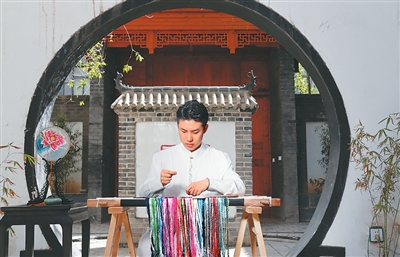
Xia Yu, a young artisan from Yinchuan, capital of northwest China's Ningxia Hui Autonomous Region, works on an embroidery piece. (Photo courtesy of the interviewee)
"I repeatedly asked my grandmother to teach me, and one day, she casually sketched a little swallow and asked me to give it a try. I sat there for an entire afternoon and carefully finished the pattern," Xia recalled.
The result of Xia's first try surprised his grandmother, who recognized his gift for the craft.
"She said, 'The kid really has a knack for it,'" Xia recalled, noting that from that moment on, embroidery became his greatest passion.
At the age of 15, Xia was admitted to Ningxia Art Vocational College, where his embroidery practice pieces impressed Li Xiayin, a representative inheritor of Ningxia embroidery who was invited as a guest lecturer at the college.
In the winter of 2017, Xia started to learn Ningxia embroidery systematically at Li's embroidery workshop.
The experience helped him better understand the unique charm of Ningxia embroidery.
"Unlike Su embroidery and Xiang embroidery from the southern regions, Ningxia embroidery carries the distinctive simplicity and rugged character of northwestern China. It is rooted in everyday life and created for everyday use," Xia said, noting that the floral and bird motifs of Ningxia embroidery reflect the lives and sentiments of local people.
In 2022, Xia established his own art studio and started blending traditional Ningxia embroidery techniques with the aesthetics of freehand brushwork.
Using needles as brushes and threads as ink, Xia has drawn on his traditional Chinese painting skills to create innovative embroidery works on Xuan paper, a type of handmade paper originally used for Chinese calligraphy and painting, and on sacred fig leaves.
He has also been working to introduce the craft to more young people.
Through cultural and creative products such as book protectors, tablet computer bags and tote bags embroidered with Ningxia cultural elements, Xia has captured the hearts of young people.
"I'm willing to continue serving as a 'thread' connecting the time-honored craft and modern lifestyles, carrying Ningxia embroidery into the future in my own way," Xia said.