


Jingdezhen's blue-and-white porcelain keeps craftsmanship, cultural exchanges alive
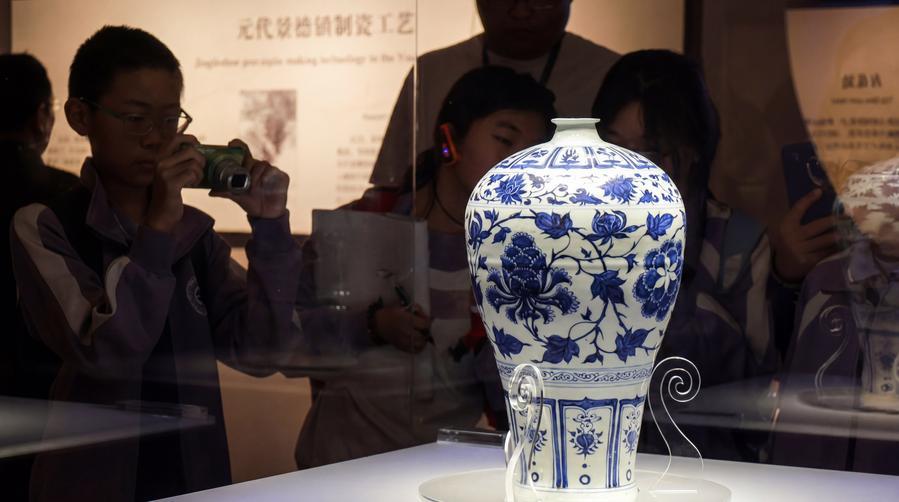
A piece of blue-and-white porcelain made in the Yuan Dynasty (1271-1368) is on display at the Jingdezhen China Ceramics Museum in Jingdezhen, east China's Jiangxi Province, May 8, 2025. (Photo: Xinhua)
The Jingdezhen Handicraft Porcelain Industry Sites in east China's Jiangxi Province were recently added to UNESCO's World Heritage List, filling a long-standing gap for porcelain heritage on the list and bringing China's total number of World Heritage sites to 61.
Blue-and-white porcelain is one of the most iconic products of Jingdezhen, globally renowned as the millennium-old "Porcelain Capital." The craft has witnessed the city's rise and prosperity and become a prized global commodity, serving as a testament to exchanges among civilizations.
At the imperial kiln site, where porcelain was produced for the imperial family during the Ming (1368-1644) and Qing (1644-1911) dynasties, archaeologists have unearthed tonnes of imperial porcelain fragments. Researchers have used them to restore rare pieces, including blue-and-white dragon-patterned jars and plum vases from the Yongle and Xuande reigns of the Ming Dynasty, painted with imported cobalt pigment.
The shards have helped reveal the pinnacle of blue-and-white craftsmanship and provided crucial physical evidence for studying the history of Chinese porcelain.
Old kiln sites bear witness to porcelain-making history, but it is heritage inheritors who keep the craft alive.
Huang Yunpeng, in his 80s, is a representative inheritor of Jingdezhen handmade porcelain-making, a national intangible cultural heritage (ICH) item, and continues to study the restoration of ancient ceramics. To better recreate the essence of blue-and-white porcelain made in the Yuan Dynasty (1271-1368), he has traveled to museums and ancient kiln sites such as the Hutian Ancient Kiln Site in search of raw materials, testing repeatedly to get the formula right.
"Every ancient porcelain shard is a witness to history," Huang said at a ceramic art museum he founded. The museum displays his reproductions of antique porcelain and doubles as a workshop where children can try traditional porcelain techniques themselves.
"Creating reproductions of antique porcelain isn't the goal; it's the means," Huang said. "I want to pass down the ancient craft."
Cai Wenjuan, a Jingdezhen native born in the 1980s, said she found her true calling in Yuan Dynasty blue-and-white porcelain. Four generations of her family have worked in fields related to blue-and-white porcelain. As an ICH inheritor, she has built her own brand, drawing on ancient porcelain fragments and traditional patterns to design scarves, jewelry and other products with contemporary appeal.
Generations of inheritance and exploration in step with the times have kept Jingdezhen's traditional porcelain culture, represented by blue-and-white porcelain, shining in new ways.
Chentian Ceramics Co., Ltd. produces creative products including porcelain versions of popular licensed characters, co-branded ceramic incense burners, ceramic Bluetooth speakers that combine practicality with aesthetic appeal and ceramic night lights.
"We're combining traditional craftsmanship with trendy toys, and young people are drawn to them," said Xu Wan, general manager of the company, describing its shift from traditional porcelain-making toward the trendy toy market in recent years.
"We hope to make porcelain a vehicle for new trends, bringing it into everyday life in new ways," Xu added.
Technology is also boosting efficiency. At the smart manufacturing workshop of Jingdezhen Yishan Ceramics Co., Ltd., the entire process, from material loading to shaping and trimming, is now automated.
The production line produces a porcelain body in eight seconds and can glaze more than 1,500 pieces an hour, lifting overall efficiency by 40 percent. A quality traceability system gives each piece a digital identity, allowing its origin and destination to be verified.
Higher education has helped fuel this innovation. Jingdezhen Ceramic University, the only multidisciplinary university in China named after ceramics, has become an incubator for innovation in blue-and-white porcelain.
In recent years, the university has advanced its academic development by integrating materials science with art and design. Beyond disciplines like ceramic art, design, and materials science and engineering, it now offers courses in traditional ceramic appreciation and digital ceramic art.
At the university, students can learn traditional techniques such as wheel-throwing and glazing alongside modern technologies like 3D printing and digital forming, and they can take part in the design and development of real products.
At the Taoxichuan Cultural and Creative Block, former factory buildings have become galleries, livestreaming studios and markets, drawing waves of "Jingpiao," or "Jingdezhen drifters," outsiders who have chosen to pursue their dreams in the city.
Beyond the steady flow of visitors, a complete industry ecosystem and a community of like-minded creators have made the block fertile ground for people to put down roots and create.
Blue-and-white porcelain embodies cross-cultural exchanges. Its signature cobalt pigment originated in Persia, and its rise was tied to the ancient Maritime Silk Road. It has a long history as an export, favored in both East and West, with notable collections held at Istanbul's Topkapi Palace and the National Museum of Iran.
Exports surged again during the Kangxi to Qianlong reigns of the Qing Dynasty, with craftsmanship and decorative designs blending Eastern and Western aesthetics.
"Blue-and-white porcelain is a vivid example of exchanges among civilizations," said Zhang Chen, head of the Home of Jingdezhen Drifters.
Today, it shines on the world stage as a defining symbol of Chinese culture, writing a new chapter in that story.
Blue-and-white porcelain elements have appeared on major international stages, from medal-ceremony outfits at the 2008 Beijing Olympics to state-banquet tableware at the G20 Hangzhou summit in 2016 and haute couture on the runways of Paris Fashion Week and Milan Fashion Week.
"Jingdezhen drifters" from dozens of countries, including the U.S., France, Japan and South Korea, have traveled to Jingdezhen, drawn by its cultural atmosphere, to learn blue-and-white porcelain techniques and pursue their own artistic work.
Statistics show that 60,000 "Jingdezhen drifters" have settled in the city, including several thousand from across the world.
Canadian artist Phil Reed is a foreign "Jingdezhen drifter." He painted his first blue-and-white piece more than three decades ago at an old kiln site in the city. Many of his works, which blend blue-and-white porcelain techniques with watercolor painting, are on display at his studio in the Taoxichuan Cultural and Creative Block.
Traditional porcelain craftsmanship, represented by blue-and-white techniques, is the cultural soul of Jingdezhen, he said. That soul drew him to the city, and it is what he hopes to convey through his work.
Reed said proudly that he also heads a volunteer service team for foreign "Jingdezhen drifters." He and fellow volunteers freely share their own experiences with newcomers who need help, from visa applications to daily life and artistic pursuits.
Jingdezhen is his home now, and Canada is where he is from, Reed said. From performing dragon dances and making dumplings with local residents during festivals to teaching children English at a language corner in Jingdezhen's Zhushan district, he said he has become part of the city.