


Traditional Chinese sports culture comes alive in Hungary
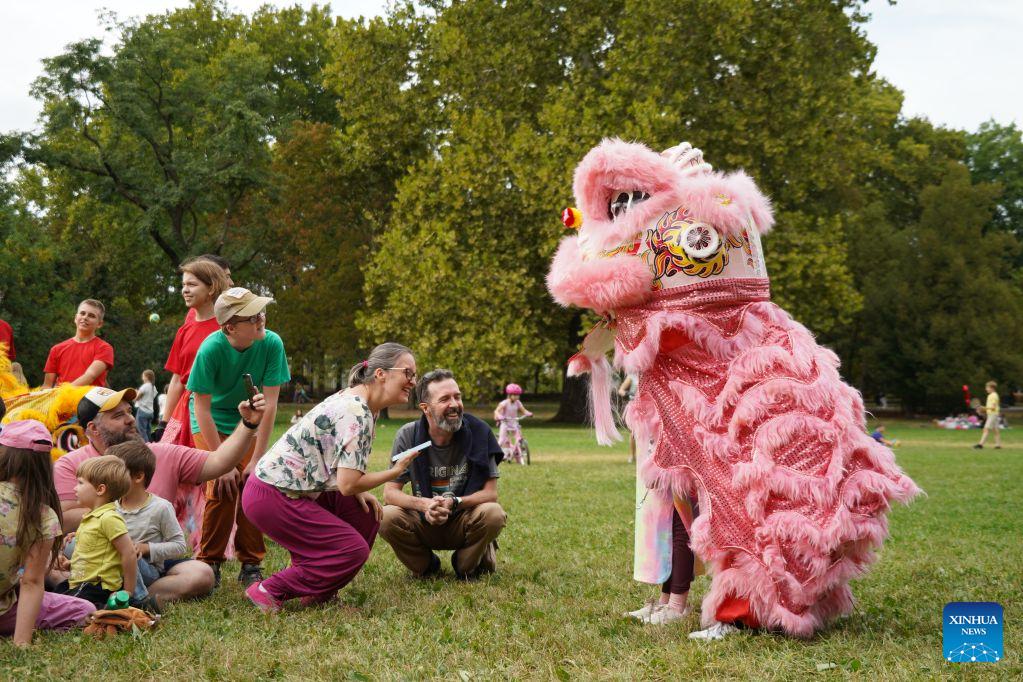
People interact with lion dancers during the 6th Family and Friends Gathering of the Hungarian Chan Wu Federation on Margaret Island in Budapest, Hungary, Sept. 13, 2026. (Photo: Xinhua)
by sportswriters Zhou Xin and Huang Fuhui
BUDAPEST, Sept. 14 (Xinhua) -- On a lawn on Budapest's Margaret Island, shuttlecocks flew, drums sounded and colorful lions moved through the crowd as children gathered around. One child stood on tiptoe trying to reach a large drum, while nearby dogs barked along with the beat, drawing laughter.
Demonstrations of Yongchunquan, Shaolinquan, Taijiquan, fan and sword routines followed, alongside lion dance, tea ceremony, calligraphy and Chan culture.
The activities were part of the sixth Family Day organized by the Hungarian Chan Wu Federation, founded in 2003 to promote traditional Chinese sports and culture among local people.
Istvan Vargo, president of both the Hungarian Wushu Association and the Hungarian Chan Wu Federation, said the federation has around 300 to 400 participants, with about 100 attending this year's event. Around 3,000 people in Hungary regularly practice wushu, he said.
Margaret Island is one of Budapest's most popular weekend leisure spots, and Vargo said the open setting often turns passers-by into participants.
"Many people who were just passing by became our friends," he said.
Some have gone far beyond simply watching.
Fourteen-year-old Rusz Levente Andre has practiced lion dance for about a year and performs at the front of the lion.
"I love performing," he said, adding that the hardest part is finding the right position within the team, remembering the routine and staying sharp through regular practice.
Sandor Mikes, president of the Hungarian Lion Dance Association and vice president of the Chan Wu Federation, said the team has grown steadily through public training sessions and performances.
"Today we had six lions in the demonstration. The youngest member is 13 and the oldest is 48," he said. The team trains every Sunday and has eight complete lion dance sets ordered from China.
After the demonstrations ended, 17-year-old high school student Pinter Kuncna Luna was still asking her coach for advice and repeating her movements.
She has practiced Shaolinquan for nearly three years and trains three times a week.
"I like Shaolin because it develops both the body and the mind," she said. "Physical strength is important, but a lot of things really depend on your mindset."
While Shaolinquan emphasizes power and speed, Taijiquan is slower and more controlled.
Molnar Krisztina, 60, has practiced Taijiquan for 19 years. She began at 41 after returning to wushu following a long break.
"I mainly practice Chen-style Taijiquan, and I also train with the sword, sabre, fan and staff," she said. "I practice five or six times a week, almost every day."
From teenagers to practitioners in their 60s, traditional Chinese sports in Hungary are no longer confined to festival performances. For many, they have become part of everyday life.
Vargo said Hungary will host the European Wushu Championships in 2027, with a national competition planned later this year as part of the selection process. He expects participation in the national event to reach a record high.