


240-million-year-old giant horseshoe crab tracks found in eastern China
Fossilized tracks of a previously unknown giant horseshoe crab species dating back more than 240 million years have been discovered in eastern China, offering new evidence that marine ecosystems recovered far faster after Earth's deadliest mass extinction than previously thought, according to a press release that the research team sent to the Global Times on Monday.
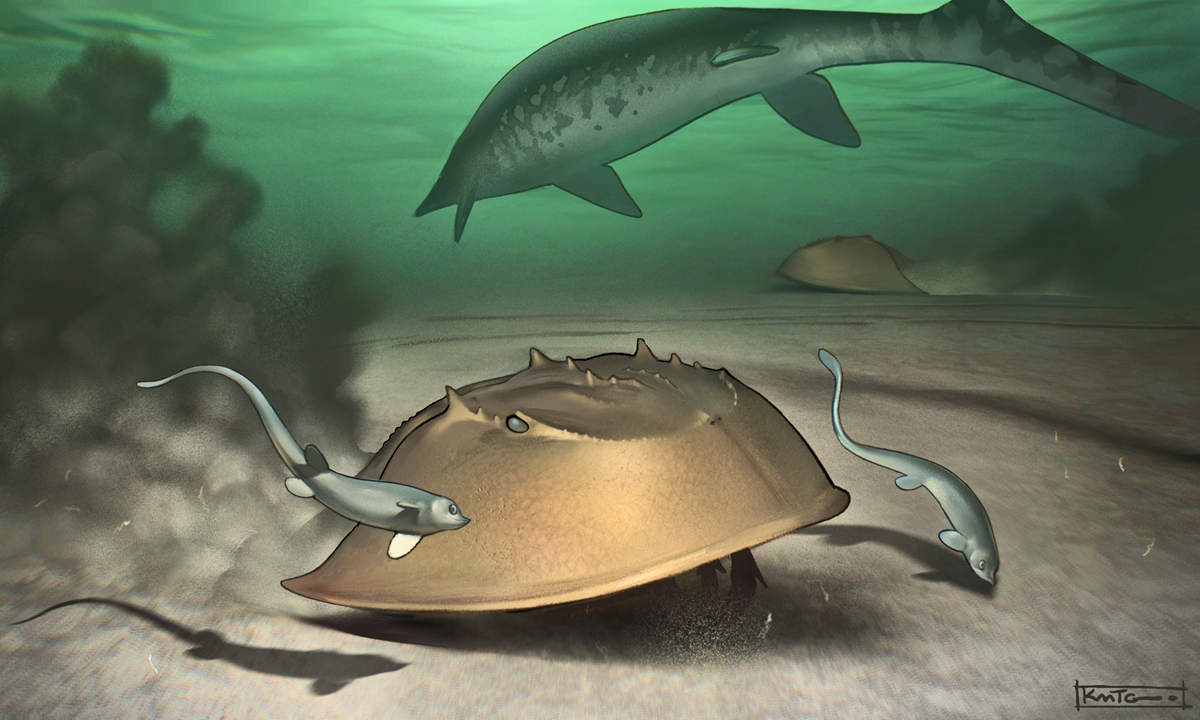
Restored image of giant horseshoe crab. (Photo: Courtesy of Xing Lida)
Unearthed from the Lower Triassic Nanlinghu Formation in Chaohu, East China's Anhui Province, the well-preserved trackways mark the first confirmed presence of large horseshoe crabs in the renowned Chaohu Fauna, a diverse Early Triassic marine biota famous for ancient ichthyosaurs, fish and ammonites. The findings were published in the Journal of Paleontology.
Researchers identified nine complex track and trail imprints across two marlstone surfaces at the Majiashan section. Ranging from straight to curved, the longest trace stretches 5.2 meters, with widths varying from 3.1 to 29.8 centimeters.
Characterized by discontinuous parallel scratches and granular sediment accumulations, the fossil traces do not fully match any known fossil ichnotaxa, indicating a unique, unrecorded locomotion behavior in ancient horseshoe crabs.
Morphometric analysis suggests the track-maker was an exceptionally large horseshoe crab, with an estimated maximum body width of 45 centimeters and total length up to 95 centimeters. Prior fossil records show most Triassic horseshoe crabs were small, with carapace widths rarely exceeding 20 centimeters.
"The new discovery pushes the emergence of giant horseshoe crabs back to the Early Triassic epoch," Xing Lida, a well-known Chinese paleontologist, told the Global Times on Monday.
He added that previously documented comparable giant specimens were from the Late Jurassic of France and the Late Triassic of northern China, with body lengths of around 85 and 89 centimeters respectively.
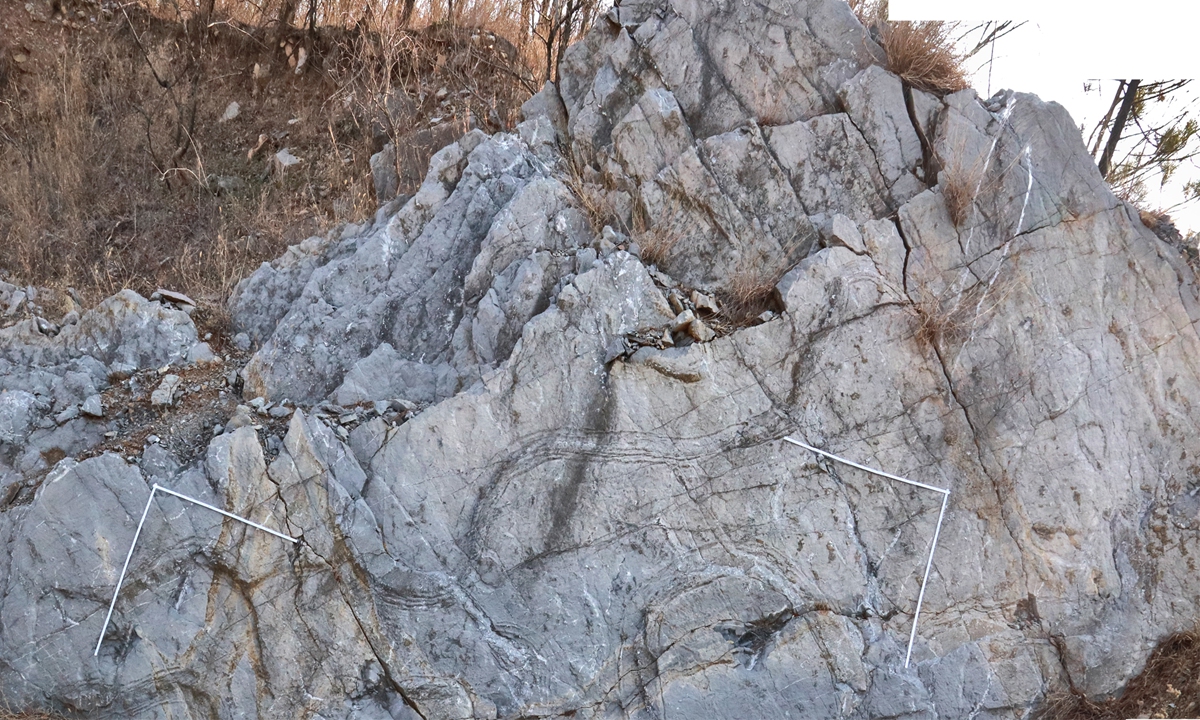
Fossilized tracks of a previously unknown giant horseshoe crab species. (Photo: Courtesy of Xing Lida)
Track morphology reveals the creature swam or crawled close to shallow seafloors, with its limbs and carapace occasionally touching the seabed. Unlike modern horseshoe crabs, which swim upside down, this ancient species moved with its carapace facing upward. Scientists attribute the distinct posture to adaptive behavior for shallow-water habitats or structural differences in its primitive exoskeleton.
The discovery adds a key large arthropod member to the Chaohu Fauna. It also helps reconstruct a more complex Early Triassic marine food web, in which giant horseshoe crabs served as important intermediate consumers, preying on worms and bivalves while serving as prey for top predators including Saurichthys fish and Chaohu ichthyosaurs.
The structured trophic system emerged only millions of years after the end-Permian mass extinction, providing evidence of rapid ecological recovery of shallow marine environments. Though horseshoe crabs are known as "living fossils" with broadly stable body structures over hundreds of millions of years, the study shows extinct lineages evolved extraordinary body sizes and distinct behavioral patterns.