


Li brocade in Hainan weaves its way onto world stage
In late July, more than 30 foreign ambassadors, charge d'affaires, representatives of international organizations and senior diplomats gathered in Maona village, Wuzhishan city, south China's Hainan Province, for a hands-on encounter with Li brocade, a traditional textile of the Li ethnic group.
Daouda Bitie, Burkina Faso's ambassador to China, praised Li brocade after learning that it can take months, or even up to a year, to complete a single fine piece.
Once seen mainly in the everyday dress of young Li people, the centuries-old textile is now finding a wider international audience and gaining official recognition as well. In December 2024, UNESCO transferred the traditional Li textile techniques of spinning, dyeing, weaving and embroidering from the List of Intangible Cultural Heritage in Need of Urgent Safeguarding to the Representative List of the Intangible Cultural Heritage of Humanity, during the 19th session of the UNESCO Intergovernmental Committee for the Safeguarding of the Intangible Cultural Heritage.
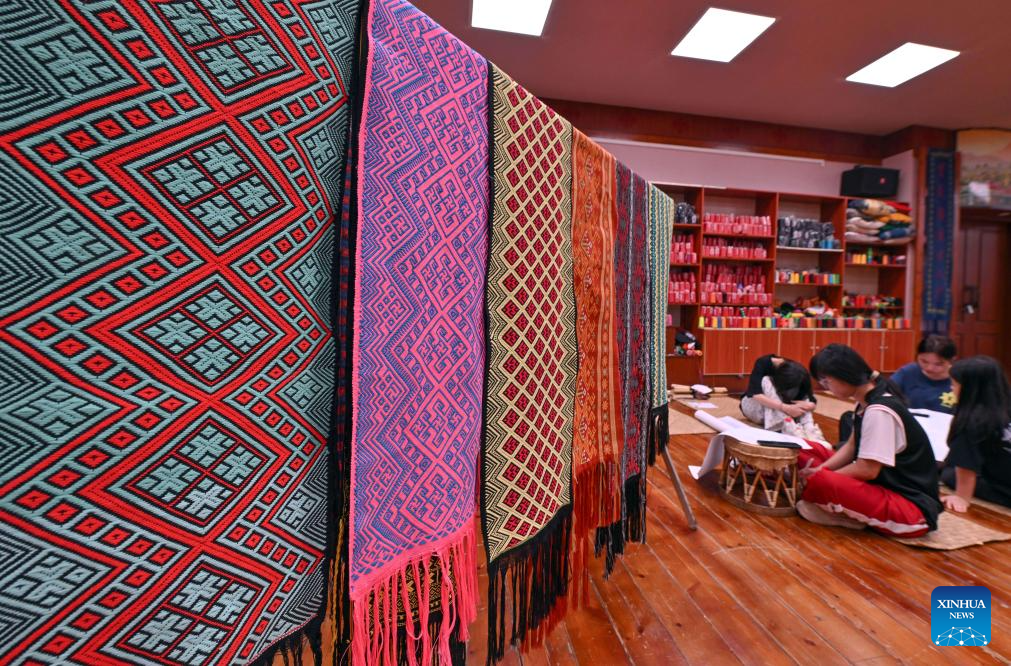
This photo shows pieces of the Li brocade weaved by students displayed at Hainan Minzu Technical School in Wuzhishan City, south China's Hainan Province, June 10, 2025. (File photo: Xinhua)
Behind that milestone lies years of effort by Hainan's Li brocade practitioners to bring the craft out of remote villages, into classrooms and onto the world stage.
During this year's Sanyuesan Festival, a traditional celebration for the Li and Miao ethnic groups, Wuzhishan staged a fashion "village show" on a floating stage, with models in Li brocade attire whose reflections appeared in the water below.
Chen Mengli, the young entrepreneur behind the show, has loved Li brocade since childhood. After majoring in textile engineering and trade in college, she apprenticed with Liu Xianglan, a national-level inheritor of the craft, in 2014, mastering its techniques of spinning cotton and flax, dyeing with plant-based materials, weaving on a waist loom and embroidering intricate patterns.
Chen has since built a company producing more than 100 kinds of Li brocade-inspired cultural and creative products, helping more than 20 formerly impoverished households and over 300 local artisans earn extra income.
So far, more than 5,400 people in the city have acquired Li brocade skills. More than 20 leading practitioners have emerged, with over 100 master-apprentice pairings established. A tiered pool of practitioners spanning older, middle-aged and younger generations is gradually taking shape, with more young people taking up the craft.
Elsewhere, inheritors are taking Li brocade into schools. This spring, Fu Huili, a municipal-level representative inheritor of the craft in Dongfang city, Hainan, and her mother Fu Yu brought a loom to a cultural festival at a middle school in the provincial capital Haikou to teach students to weave by hand.
"I grew up beside my mother's loom. Only by exposing students to Li brocade from a young age can we plant the seeds of a lasting love for it," Fu Huili said.
Similar efforts are spreading. A student fashion troupe at Hainan University has performed in Li brocade at events including the World Expo 2025 in Osaka, Japan. Changjiang Li Autonomous County has added the craft to school curricula and clubs, hosting more than 280 activities a year, training 27,000 participants in total. The county has held Li brocade skills competitions for primary and secondary school students for several consecutive years.
In 2025, Hainan's provincial government issued a five-year action plan (2025-2029) for the protection and development of traditional Li textile techniques, calling for stronger training for intangible cultural heritage instructors and supporting representative inheritors in teaching at schools and taking part in educational research. More than 100 primary and secondary schools in the province currently offer practical Li brocade classes, and the province's pool of inheritors of the craft has grown from fewer than 2,000 in 2009 to more than 20,000 today.
Tan Chaoyan, a municipal-level representative inheritor of the craft in Wuzhishan born in the 1990s, took her loom all the way to Paris. Since founding a small studio in Wuzhishan in 2015, her business has grown from a two-person operation into a company with more than 100 employees.
A training program with Italy's top art school Istituto Marangoni exposed Tan to new ideas, such as pairing leather with brocade and experimenting with irregular pattern sizes, that reshaped her approach to the craft. When the chance came to take part in product design for Paris Fashion Week, trainees in the program wove 250 pieces of patterned fabric and sewed them into cushions in just two weeks. The cushions proved popular with guests at the show.
From mountain villages to global catwalks, Li brocade has made its way onto the world stage, telling ancient cultural stories in a fresh new way, bridging past and future and connecting China with the world.