


French scholar in pursuit of century-old cultural imprints in coconut carvings
HAIKOU, Sept. 28 (Xinhua) -- Roland Bourdeix, a French researcher devoted to coconut genetics for over two decades, has chosen to bring his cherished collections back to China for restoration, seeking the origins of the century-old cultural exchanges centered on coconut carvings.
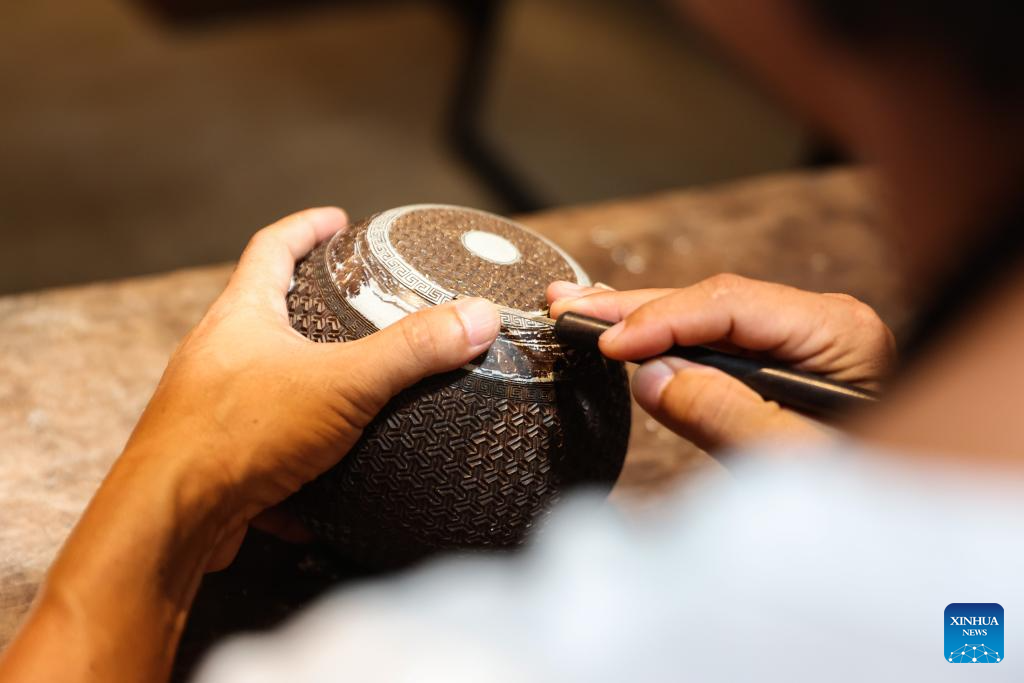
Wu Mingju, an inheritor of coconut shell carving, carves on a coconut shell at a workshop in Haikou, south China's Hainan Province, Aug. 9, 2024. (File Photo: Xinhua)
The scholar has visited more than 40 tropical countries for his research. He regards the coconut tree as the "tree of life" and believes that coconut shell carving stands out as one of the most exquisite forms among the material and symbolic cultures derived from it.
Aiming to build a coconut-themed ecological museum, Bourdeix has collected a large number of rare ancient coconut carvings from around the world over the past 25 years, including a batch of Chinese coconut carvings dating back to the Qing Dynasty (1644-1911) that were exported to Europe about a century ago.
Since the 19th century, Chinese coconut carvings have been sold to Europe and Southeast Asia as souvenirs or diplomatic gifts via southern Chinese cities of Guangzhou and Macao. Some of these works were subsequently passed down through generations in European families.
When Bourdeix discovered that some of the collections had cracked or been damaged over time, he decided to bring them back to south China's Hainan Province for restoration rather than having them repaired locally in Europe.
He explained that this is not merely about restoring the artifacts, but also a cultural journey back to their origin, expecting his efforts to draw greater public attention to the culture of coconut carving.
A traditional carving art using coconut shells, coconut wood and other materials, coconut carving is mainly practiced in Hainan. Records of Hainan coconut carvings date back to as early as the Tang Dynasty (618-907), and the carvings were presented as treasures to the imperial court during the Ming and Qing dynasties.
Hainan coconut carving was included in the national intangible cultural heritage list in 2008.
In 2025, the province launched a three-year action plan to systematically promote the inheritance and innovation of coconut carvings.
Coordinated by the provincial coconut industry association, Qiongtai Normal University in the province undertook the restoration.
Wu Mingju, a national intangible cultural heritage inheritor of coconut carving and a teacher of coconut carving courses at the university, immediately identified the works' age and craftsmanship features upon seeing them.
"Most of them feature Chinese mythological figures, and although the appearance is flawed, the complete lineage of traditional craftsmanship is still evident," he said.
Zhang Bidi, a coconut carving artist with the industry association, introduced a comprehensive restoration plan: bonding broken parts with epoxy resin, meticulously repairing and carving along the original grain with chisels, and grinding and filling damaged fragments with coconut material of the same type.
The artisans consulted with Bourdeix and confirmed every detail of the restoration. A shared understanding of craftsmanship that transcended language and culture soon established full mutual trust between the two sides.
Recalling his encounter with Wu, the Frenchman said that despite their different cultural backgrounds, he regarded Wu as a brother, and that both were driven by the same passion, curiosity and love for multiculturalism.
They discussed restoration techniques, their personal collections and ways to promote coconut carving, and agreed to co-author academic papers and jointly participate in the museum's construction that Bourdeix is preparing in France.
"The coconut carvings' journey witnessed another reconnection of a cultural bond that transcends remote mountains and seas," said Gao Yiping, a professor at the university's school of fine arts.
In recent years, cultural and creative products that integrate coconut carvings with trendy brands have repeatedly won popularity in the domestic market, showcasing the strong vitality of traditional craftsmanship in modern times, according to the professor.
Bourdeix believes the open platform of the Hainan Free Trade Port (FTP) is providing a broader space for coconut carvings to reach the global stage.
He expects Chinese coconut-carving culture to reach more parts of the world and for the country's coconut research resources to be further integrated into the international academic network.
Hainan FTP began island-wide special customs operations on Dec. 18, 2025. In the first half of 2026, Hainan recorded 1.603 million inbound and outbound passenger trips, including 883,000 by foreign nationals.