


Portraying Confucius: Giving form to an ideal
An elderly man with a lined face, a calm expression and a dignified bearing: the familiar image of Confucius. Yet we cannot be certain what the philosopher actually looked like.
On September 28, commemorations marked the 2,577th anniversary of his birth. The 2026 Nishan Forum on World Civilizations also opened that day in Qufu, his hometown in east China’s Shandong Province. The occasion offers an opportunity to ask how a thinker who lived more than 2,500 years ago acquired such a recognizable face.
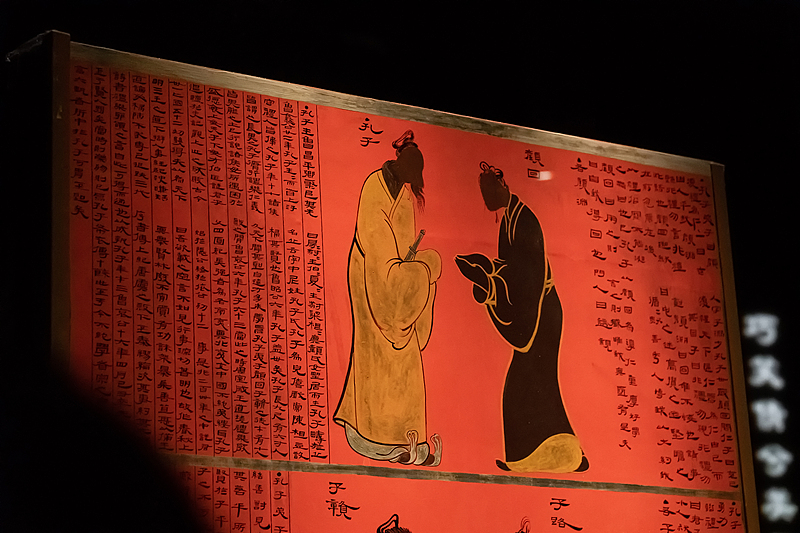
Detail of a replica of the lacquered dressing mirror bearing the earliest known portrait of Confucius (left), on display at the Nanchang Relic Museum of Haihunhou State of Han Dynasty (202BC- 220AD). (Photos: VCG)
No authenticated portrait made during Confucius’s lifetime, traditionally dated 551 to 479 BC, is known to survive. Later artists drew on literary descriptions, inherited artistic conventions and their own interpretations of the sage.
Some of those written descriptions reveal more about his demeanor than his features. The Analects, a collection of sayings and conversations associated with Confucius and his disciples, portrays a teacher whose conduct reflected the values he taught. The text developed over generations, and its precise compilation remains debated. Different versions circulated during the Han dynasty.
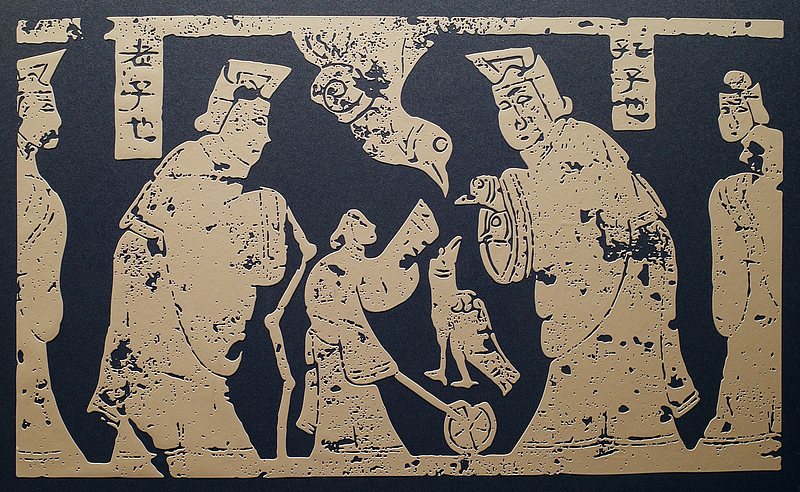
A Han dynasty depiction of Confucius meeting Laozi, on display at the Beijing Dabaotai Site Museum. Confucius appears on the second left.
In one passage, Confucius is described as “warm yet firm, dignified without being fierce, and respectful yet at ease.” In his community, he appeared modest and unassuming, “as though he were unskilled in speech.” In a description of his conduct while receiving guests on his ruler’s behalf, he advances with quick steps, “like a bird spreading its wings.”
Other texts go further. Writing roughly three centuries after Confucius’s death, the Western Han historian Sima Qian recorded an unusual detail in his Records of the Grand Historian: the crown of Confucius’s head was said to have been depressed in the centre at birth. The account links this feature to his given name, Qiu, meaning “hill” or “mound.”
The Family Sayings of Confucius, or Kongzi Jiayu, describes him as exceptionally tall, with elongated eyes and a prominent forehead. Such accounts belong to the literary tradition surrounding the sage and cannot establish precisely what he looked like.
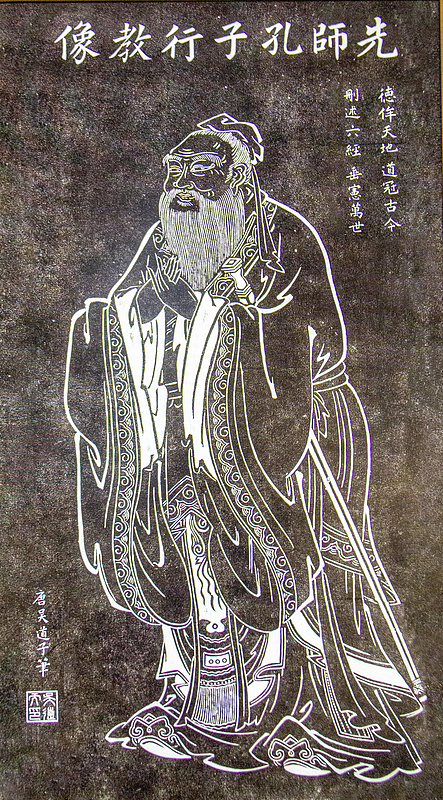
A stone engraving of Portrait of Confucius Teaching, based on a lost painting traditionally attributed to the renowned Tang dynasty painter Wu Daozi. The stele is housed at the Temple of Confucius in Qufu, Shandong Province.
For artists, however, these descriptions offered material from which to fashion a likeness. One influential portrait tradition, associated with the Tang dynasty (618-907AD) painter Wu Daozi, shows Confucius as an elderly man with his hands clasped before him. Preserved in stone carvings and ink rubbings, it became the version later generations came to know.
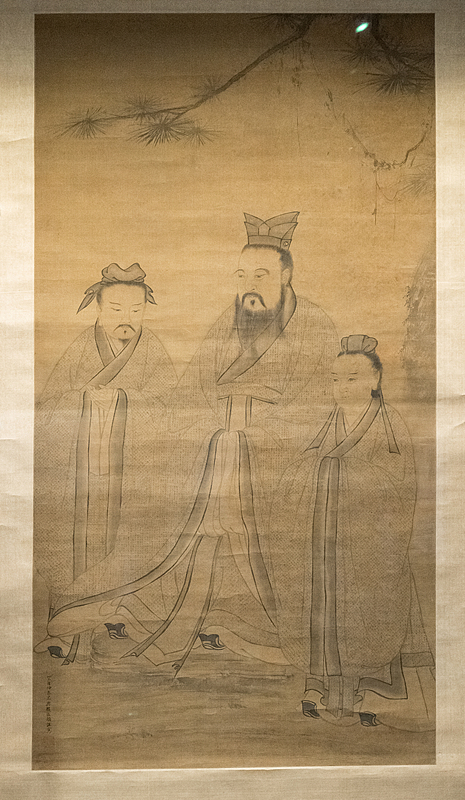
Portrait of the Three Sages, a Ming dynasty (1368-1644) painting in the collection of the Confucius Museum. Confucius is depicted in the centre.
Across the centuries, to paint Confucius was to interpret him. The posture, expression and bearing chosen by artists gave visible form to qualities associated with the sage: learning, dignity, humility and respect. His portraits can therefore be read as expressions of how successive generations understood both the man and his teachings.