


Ghanaian student masters the art of face-changing
ACCRA — Amid the lush greenery of Legon Hill in northern Accra, Ghana's capital, lies the University of Ghana, the country's premier higher-education institution, which spans 11.4 square kilometers.

Austin Elikem Afiawo, a final-year student of Chinese language and linguistics, learns Chinese at the Confucius Institute of the University of Ghana in Accra, Ghana. (Photo: Xinhua)
The university is home to various schools, departments, and institutes, including the Confucius Institute, where young Ghanaians come to learn the Chinese language and explore the country's culture.
Among them is 20-year-old Austin Elikem Afiawo, a final-year student of Chinese language and linguistics who spends much of his time at the institute honing his language skills and deepening his understanding of Chinese culture.
For young Afiawo, university life extends beyond classroom lessons and written examinations. His academic journey is enriched by cultural activities, including Chinese dance, stage performances, music and drawing.
One traditional art form that has particularly captured his interest is bianlian, the face-changing technique associated with Sichuan Opera.
Afiawo's fascination with the art began during his first year at university, when he attended a cultural performance at the Confucius Institute. What started as an evening of watching from the audience would eventually lead him to become a performer himself.
"I watched one gentleman, Jesse Twumasi-Ankrah, on stage in a blue costume, changing faces. I was really shocked and got interested in it. So, I decided to approach him after the program and ask him how he did it," Afiawo recalls.
Twumasi-Ankrah, then a senior student, began teaching him the basics of the art. Afiawo gradually refined his technique, later receiving additional guidance from teachers at the Confucius Institute at the University of Ghana.
Learning the art was not easy. As a novice performer, Afiawo struggled with both the technique and the demands of appearing on stage. With time and practice, however, he mastered the skill and established himself as a face-changing performer in Ghana.
"While people think the performance is just about changing faces, the real challenge is the costume. Putting it on is a very difficult part of the performance," he says.
"The costume, with its several masks, is very heavy. It puts a lot of stress on you. So those are some of the difficulties we face.
"I remember my very first performance, which was here at the Confucius Institute. I was very nervous, being the first time I stood in front of a large audience to perform, and one mistake could destroy the entire performance," he says.
To overcome his stage fright, Afiawo avoided eye contact by looking above the audience's heads and imagining he was alone in the auditorium, which helped him relax and enjoy his performance.
Since then, he has honed his skills and performed at events organized by the three Confucius Institutes in Ghana, as well as at functions hosted by Chinese organizations in the country.
Liu Baijun, a Chinese director at the CIUG, speaks highly of Afiawo's enthusiasm and dedication. "He's very active in CIUG activities. He always comes to the Confucius Institute and learns about Chinese culture."
"Face-changing is a tradition in China. Maybe it's quite strange for some foreigners, but Austin likes it very much. He practices face-changing in his spare time, and his skill has improved a lot."
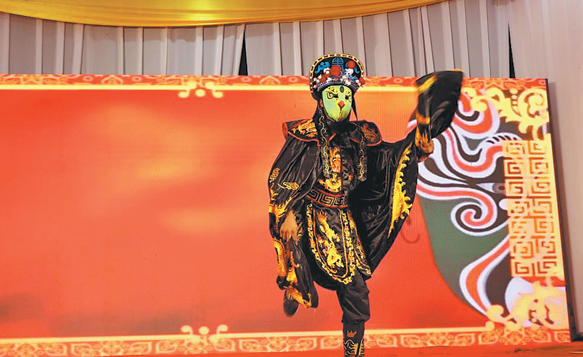
Afiawo performs the face-changing act during the Ghanaian finals of the 2026 Chinese Bridge competition in Kumasi, Ghana, on May 22. (Photo: Xinhua)
Beyond mastering a distinctive performance technique, Afiawo says the experience has taught him the value of perseverance. Performing in Ghana's warm, humid tropical climate can be physically demanding, particularly when he wears the heavy costume, which causes him to sweat profusely. The need to manage the multiple masks and change them seamlessly on stage also calls for patience, discipline and sustained practice.
"But after every performance, we realize that no matter the struggle we go through, we can actually pull through," adds the Ghanaian student.
Afiawo is grateful to the CIUG for its continued support, both in his academic studies and in his training as a performer.
Liu says interest in Chinese language and culture has been growing among Ghanaians in recent years. The institute plans to introduce more aspects of Chinese culture to local audiences, ranging from traditional arts to the latest developments in Chinese technology.