


Across China: Young hands, new ideas reforge Tibetan intangible heritage
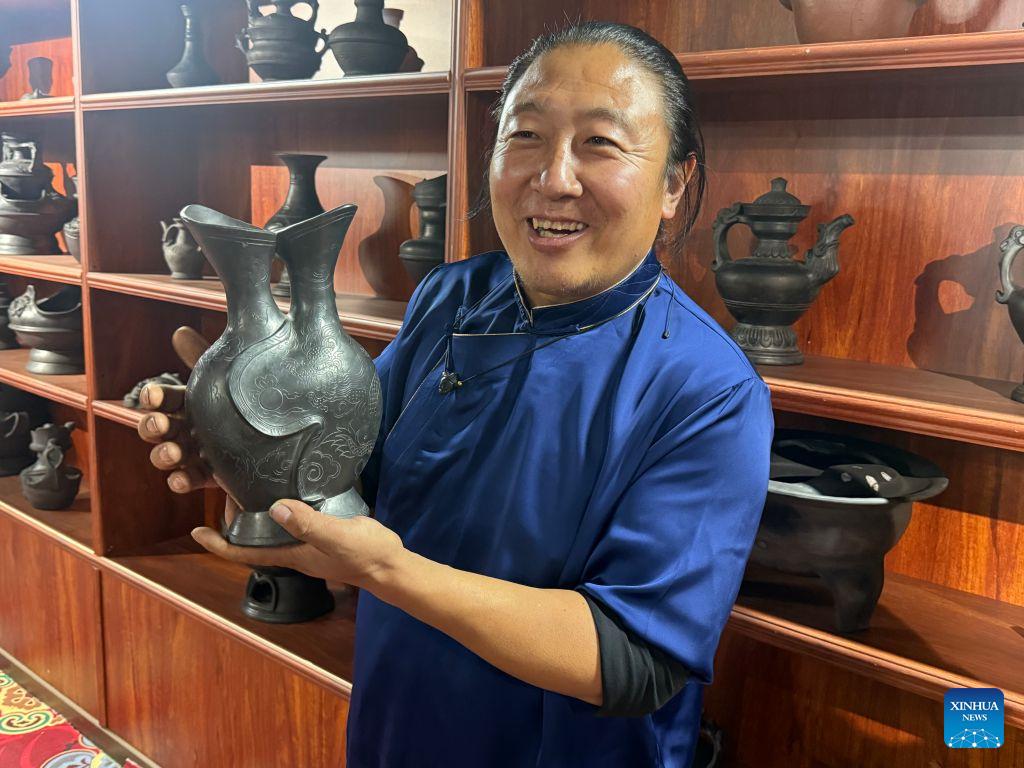
Padma Chojor, a national-level inheritor of the Tibetan black pottery firing craft, presents an artwork of black pottery in the Tibetan Autonomous Prefecture of Yushu, northwest China's Qinghai Province, Oct. 26, 2026. (Xinhua/Wang Jinjin)
XINING, Nov. 7 (Xinhua) -- Though winter is the off-season for pottery firing, 21-year-old Tsering Lhamo and her co-workers have packed black pottery coffee cups in their workshop, readying their new creations for a livestream sale and nationwide shipping.
"Based on experience, all 180 sets of mugs will sell out the moment the livestream starts," she said with a smile.
Tsering Lhamo hails from Nangqen County in the Tibetan Autonomous Prefecture of Yushu, northwest China's Qinghai Province. After graduating from college, where she studied medicine, she returned home to join her father, Padma Chojor, a national-level inheritor of the Tibetan black pottery firing craft, in carrying it forward.
"If young people can master a local skill, they don't have to leave for migrant work. It's both a way to make a living and the foundation for keeping rural intangible heritage alive," she noted.
Having grown up in the workshop and seen artisans shaping and polishing clay day after day, Tsering Lhamo picked up the basics on her own.
Her father has limited formal education and struggles with online platforms and paperwork. With her college background, Tsering Lhamo fills that gap, managing e-commerce operations, handling communications, listing products and even using basic 3D modeling and AI tools. She earns over 3,000 yuan (about 447 U.S. dollars) a month.
Her young perspective also drives product innovation. She has proposed new items tailored to contemporary tastes: pottery bracelets, pendants and tea pets -- tiny ceramic animals or figurines that tea drinkers "raise" by pouring tea over them. Even the weaving methods for the bracelets were researched and taught by her and her mother.
While the workshop raced to meet a surge of online orders, Padma Chojor was busy collecting oral histories from local elders to document the craft's full story.
Legend has it that Princess Wencheng of the Tang Dynasty (618-907) brought black pottery techniques to the Yushu area during her journey to the Tubo Kingdom for her marriage alliance with Tibetan King Songtsen Gampo. Locals, grateful that she taught them to make clay cups for drinking tea, called them "warm cups."
"Archaeological findings prove that black pottery firing here dates back at least 4,000 years," Padma Chojor explained. "Princess Wencheng helped revive the craft."
According to Padma Chojor, the technique uses local red clay, and the best time to collect soil is when cuckoo birds arrive between late May and July, but only on cloudy days. The entire firing process relies on 37 ancient formulas, producing pottery that is "black as coal, hard as porcelain" and safe for cooking food or brewing tea.
Meanwhile, 45-year-old Dacheng Tashi, a former coppersmith who previously earned less than 2,000 yuan a month, opted to switch to pottery a few years ago. With his craftsmanship background, he mastered the new skill faster than his peers.
Now his monthly income has tripled. "This gives local farmers and herders another path, learning a skill at the doorstep and taking home a steady wage," Dacheng Tashi said.
So far, Padma Chojor has trained more than 1,700 apprentices, helping create eight workshops nearby. Over 100 households have additional income thanks to this form of craftsmanship.
Not far away in Acho Township, the clang of hammers echoes from dawn to dusk at a Tibetan knife workshop called "Three Big Noses." The Acho Tibetan knife forging technique is also a national intangible cultural heritage item.
"Three Big Noses, that's my two brothers and me. We all have big noses," said 50-year-old Padma Tashi, a provincial-level inheritor, while presenting a gilded copper knife with a horn handle inlaid with coral and turquoise. His elder brother, 62, is a national-level inheritor.
The youngest craftsman there, 23-year-old Palden Norbu, is Padma Tashi's son. A fan of online shopping and short videos, he suggested the workshop make small, pendant-sized knives for young buyers, which sold very well.
Beyond knives, the workshop also produces incense burners and holders, adding new revenue streams.
The government is backing these efforts. Tashi Tsering, head of the county's culture, sports and tourism bureau, said the county boasts over 200 types of intangible cultural heritage items of various levels. Each year, 200,000 yuan to 300,000 yuan is allocated to organize livestream sales and set up dedicated heritage booths at horse racing festivals, traditional Guozhuang dance competitions and soccer matches.
In September, China issued a 15th Five-Year Plan (2026-2030) on Cultural Heritage Protection and Inheritance, which calls for solid progress in safeguarding intangible cultural heritage, revitalizing traditional crafts, upgrading related workshops, and using heritage to renew historic classic industries. Across the country, the emphasis has shifted from preservation alone to turning "skills at the fingertips" into sustainable livelihoods.
Data shows that in 2025, Yushu received 2.7 million tourist visits and generated tourism revenue of 1.86 billion yuan, up 29 percent and 37 percent year on year, respectively.
The tourism boom has inspired Padma Chojor to dream bigger: turning Nangqen into a black pottery cultural town. The idea came from a CD given to him by a peer from Jingdezhen, known as China's Porcelain Capital in eastern Jiangxi Province, showing immersive ceramic culture on every street.
"Even the streetlights and roadside trash cans there reflect ceramic culture," he said. "I hope Nangqen can one day become a town where black pottery culture is everywhere, attracting more visitors to experience our craft firsthand." ■