


Shenyang Palace Museum in northeast China marks centennial via scattered relics reunion, fresh storytelling
SHENYANG, Nov. 16 (Xinhua) -- Shenyang Palace Museum in the capital city of northeast China's Liaoning Province celebrated its centennial on Monday, and received a donation of 41 porcelain pieces as a birthday gift.
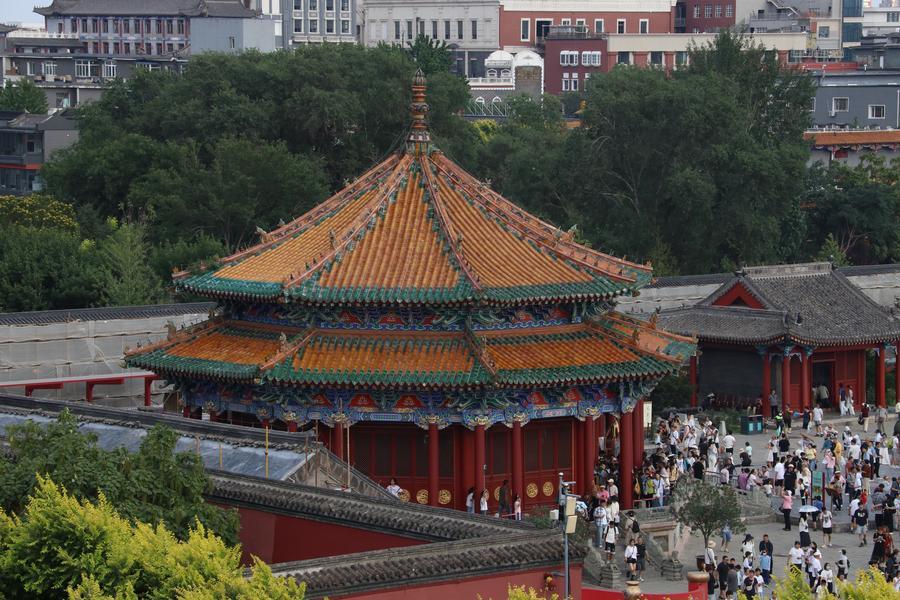
People visit the Shenyang Palace Museum in Shenyang, northeast China's Liaoning Province, Aug. 12, 2025. (Photo: Xinhua)
The donated collection, all export porcelain spanning three major categories, fills a blank in the museum's export porcelain holdings and further improves the collection system, said Zhang Guobin, director of the collection department of the museum.
The pieces were donated by Zhao Qiang, chairman of the Macau Association for Preservation of Cultural Relics. "These porcelain pieces once crossed mountains and seas to reach the world. Today, they have entered the museum. It is my hope that through research and display, they can tell more stories of the exchange between Chinese culture and the world," he said.
Shenyang Palace Museum, where the former imperial complex of three emperors of the Qing Dynasty (1644-1911) was located, was set up in 1926 and opened to the public in 1929. In 2004, it was added to the World Cultural Heritage List.
To mark its centennial this year, the museum is hosting multiple exhibitions highlighting its history, including an exhibition of 100 of its most precious items and another featuring photographs from the past century.
Since the late Qing Dynasty, the last feudal dynasty in China, many of the museum's artifacts have endured troubled journeys. During the war years of foreign invasion, pieces from Shenyang were scattered across institutions including the Palace Museum in Beijing, the Nanjing Museum in east China and the Taipei Palace Museum.
The scattered items have paper labels bearing the Chinese character Feng representing the old name for Shenyang, showing where the artifacts came from. With the help of fellow cultural heritage institutions during the centennial celebrations, these pieces have returned to Shenyang for a reunion exhibition, said Meng Fantao, Party secretary of the Shenyang Palace Museum.
After the liberation of Shenyang, the museum's preservation work entered a new phase. For instance, in the 1980s, it carried out several rounds of restoration, including repairs to buildings whose mortise-and-tenon joints had loosened due to earthquakes.
Over the past decade, meanwhile, the museum has secured 40.63 million yuan (about 6 million U.S. dollars) in national special funds for large-scale structural reinforcement, renovation and the restoration of painted decorations on ancient buildings, thus putting in place a system of standardized restoration, routine maintenance and scientific monitoring. Its preventive conservation projects for paintings, textiles and metal objects have passed national appraisal, said Shang Wenju, head of the museum's ancient architecture department.
With northeast China's revitalization and the region's cultural tourism boom, visitor numbers have climbed year after year. By Nov. 1, Shenyang Palace Museum had received more than 6 million visitors this year, setting a new record high.
Far from being stuck in the past, the century-old museum is reinventing itself. It has innovated night sessions that break with the traditional guided-tour format, with guides serving as non-player characters in scenario-based storytelling, enabling visitors to experience court history, imperial food culture and ancient architecture via dialogue. The museum has also introduced a VR immersive project which enables visitors to experience how the palace was built.
If visitors feel tired along the way, they can enjoy hot milk tea bearing the museum's logo or mousse cakes molded in the shape of a palace building. Refrigerator magnets designed after ornate jewelry pieces are especially popular with young visitors to this venue.
Shenyang Palace Museum has held regular international academic seminars involving the Capital Museum in Beijing, the Edo-Tokyo Museum in Japan and the Seoul Museum of History in the Republic of Korea, using academic exchange to share experience on museum development. Its collections have also traveled overseas many times, showcasing China's long history and splendid culture to the world.
"From a royal forbidden ground to a public museum, from a treasure of ancient Chinese architecture to a World Cultural Heritage site, the century-old Shenyang Palace Museum is writing a new chapter with a more open attitude," said Zhang.