


Millennium-old Mazu culture finds new life in the modern era
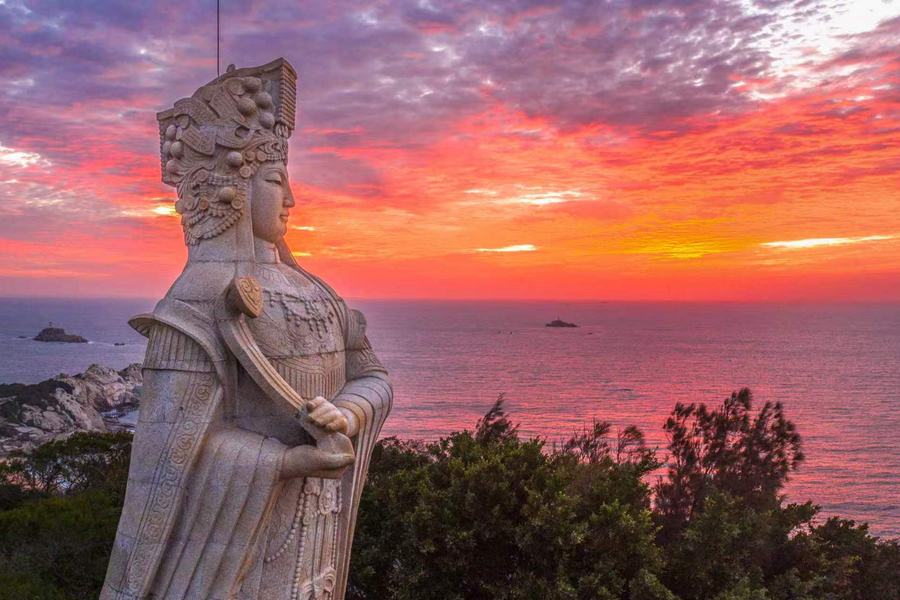
Photo shows a stone statue of Chinese sea goddess Mazu on Meizhou Island, Putian, southeast China's Fujian Province. (Photo/Cai Hao)
The culture surrounding Mazu, the Chinese sea goddess, continues to evolve in the modern era. She is traditionally said to have lived on Meizhou Island in Putian, southeast China's Fujian Province.
Legend has it that Mazu helped fishermen through treacherous waters and died at 28 while saving others at sea during the Song Dynasty (960–1279). Over the centuries that followed, emperors bestowed imperial titles on her 36 times.
Today, some 11,000 Mazu temples in more than 50 countries and regions carry on her legacy. Her values — virtue, benevolence, and universal love — are still taught and celebrated.
Over the centuries, Mazu's role has continued to expand within Chinese folklore. She began as a protector of fishermen caught in storms, then guarded grain convoys on the Grand Canal and ships along the coast, and later watched over trade itself. Envoys carried her on voyages abroad, and overseas Chinese brought her faith with them as a link to home.
Today, her emphasis on helping others has inspired women to pursue their own development. On Meizhou Island, Mazu's birthplace in Putian, a "Digital Mulan" program has run four training sessions for homestay managers, giving 160 rural women free digital skills training. The program has helped tie the island's homestay industry to Mazu culture and coastal tourism.

Photo shows a view of a training session for "Digital Mulan" homestay managers on Meizhou Island in Putian, southeast China's Fujian Province. (Photo courtesy of the Publicity Department of the Communist Party of China Putian Municipal Committee)
Mazu's spirit of benevolence and universal love echoes the values the Red Cross works by: humanity, fraternity and dedication.
At the 2026 Global Mazu Culture Forum, the Fujian Red Cross Foundation and the Meizhou Mazu Charity Foundation jointly launched a charity fund in Mazu's name. Through it, Mazu volunteers will train with the Red Cross in first aid and pass those skills on to their communities.
Mazu, renowned in legend for her knowledge of the skies, now lends her name to a Chinese meteorological warning system. MAZU (Multi-hazard, Alert, Zero-gap and Universal) has been deployed directly in eight countries, including Pakistan, Ethiopia, Jordan and Sri Lanka. More than 50 others use it through a cloud platform.

A charity fund named after Mazu is established during the Global Mazu Culture Forum in 2026. (Photo courtesy of the organizer of the event)
The Mazu satellite, China's first designed to detect sea-surface winds and waves, is in orbit. An upgraded version of the country's ocean forecasting model, MaCOM 2.0, was unveiled recently. The MAZU Scholarship supports exchanges and training for visiting meteorology scholars from Belt and Road partner countries. In Brazil, São Paulo has designated a "Mazu Day," an occasion that has helped make academic exchanges on Mazu culture and maritime civilization between the two countries a regular fixture.
Through such efforts, Mazu culture continues to adapt to the times and benefit people around the world.