


New dinosaur fossil discovery fills gap in Early Cretaceous fossil record in Inner Mongolia, North China
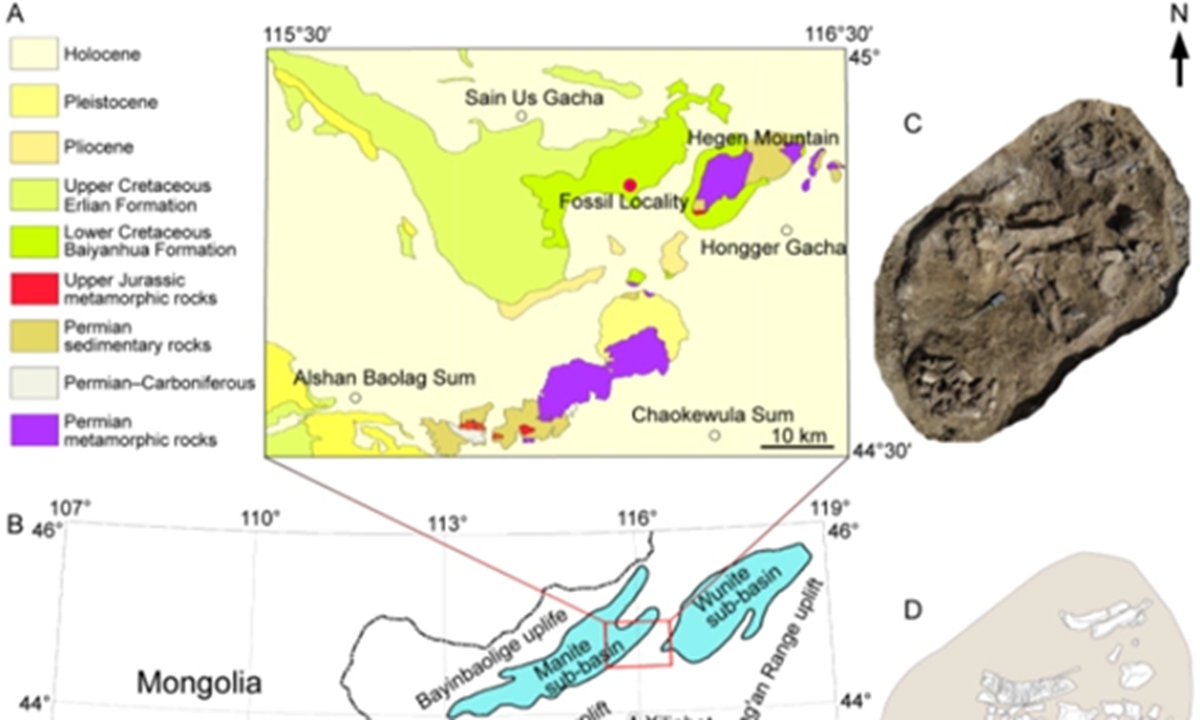
Fossil localities and specimen photographs Photo: Inner Mongolia Museum of Natural History
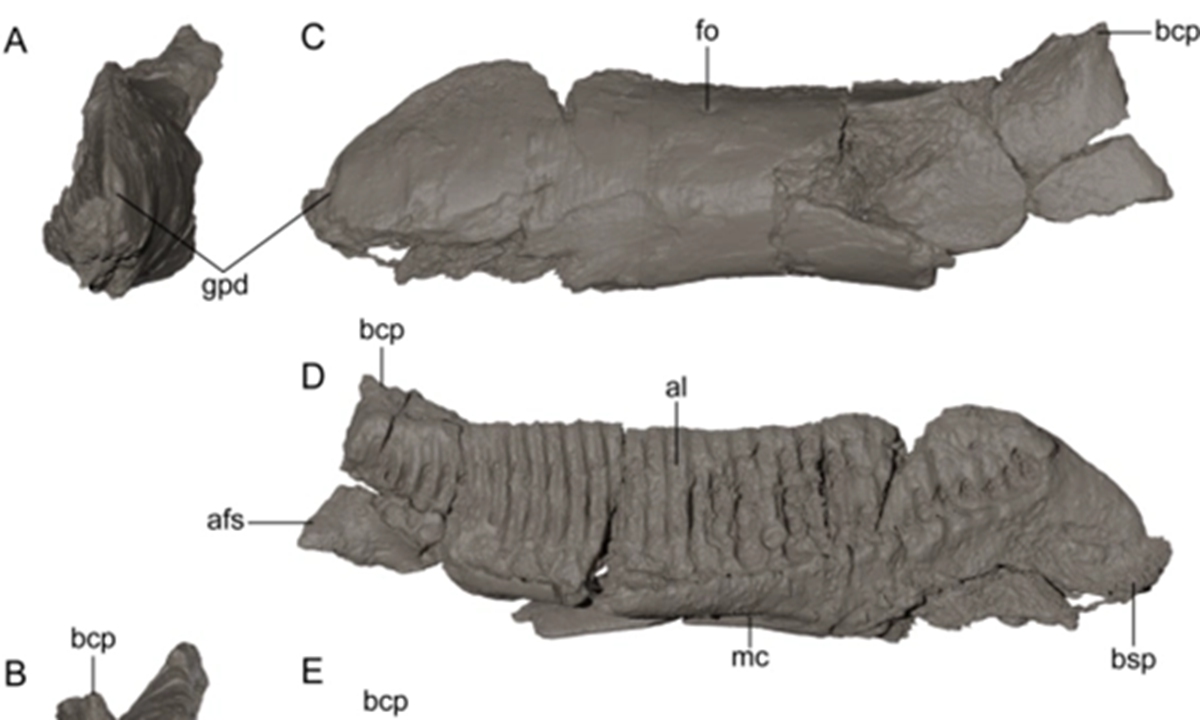
Digital reconstruction of the dentary (Photo: Inner Mongolia Museum of Natural History)
Chinese researchers have discovered the first Early Cretaceous hadrosauroid dinosaur fossil in the Erlian Basin in North China's Inner Mongolia Autonomous Region. The study, published in the international paleontological journal Fossil Record, fills a gap in the region's fossil record and offers new clues to the early evolution and diversification of the herbivorous dinosaur group.
The study, titled "The First Hadrosauroid Dinosaur from the Lower Cretaceous of the Erlian Basin, Inner Mongolia, China," was led by the Inner Mongolia Museum of Natural History, with participation from the Institute of Vertebrate Paleontology and Paleoanthropology of the Chinese Academy of Sciences and Shenyang Normal University, among other institutions.
Unearthed in Ejin Horo township, East Ujimqin banner, the fossil is the first recorded hadrosauroid specimen from the Lower Cretaceous strata of the Erlian Basin.
The specimen is now housed at the Inner Mongolia Museum of Natural History, comprising a left dentary, teeth, vertebrae, toe bones and several bone fragments. Although fragmented and scattered, the bones were found concentrated in a relatively small area, suggesting that the specimen was buried close to its original position, according to preliminary assessments.
Hadrosauroids were among the most abundant groups of herbivorous dinosaurs of the Cretaceous Period. Their earliest known fossils date back to the Early Cretaceous, and the group reached its peak diversity in the Late Cretaceous before spreading worldwide.
Early Cretaceous hadrosauroid fossils have mainly been found in East Asia, including western Liaoning Province, Mazongshan in Gansu Province, the Alxa-Bayannur region of western Inner Mongolia and the eastern Gobi Desert in Mongolia. Most studies suggest that Asia was the center of origin and early diversification and dispersal of hadrosauroids.
Located between these fossil-rich regions, the Erlian Basin had previously yielded no reported Early Cretaceous hadrosauroid fossils. The discovery has filled a gap in the fossil record between these localities, indicating that hadrosauroids were already inhabiting the basin during the Early Cretaceous.
Researchers found that the new specimen exhibits a combination of primitive and more advanced traits. It retains primitive features of early ornithopod dinosaurs, such as accessory ridges on both the mesial and distal sides of the primary ridge on its upper jaw teeth. It also displays several features closer to those of hadrosaurids, including an elongated toothless region at the front of the dentary, more tooth positions and a primary ridge positioned near the center of the teeth.
These traits provide important clues for reconstructing the early evolutionary sequence of key features in hadrosaurids and suggest that hadrosauroids had already developed considerable diversity during the Early Cretaceous.
Despite the incomplete preservation of the specimen, its distinctive combination of morphological features suggests that it may represent a new genus and species of hadrosauroid outside the hadrosaurid family.
More systematic field surveys and rescue excavations aimed at obtaining more complete fossil material will be essential for determining the specimen's exact taxonomic position and clarifying how key hadrosauroid traits evolved.
The fossil was recovered through a rescue excavation conducted under a project commissioned by the department of natural resources of the Inner Mongolia Autonomous Region. In recent years, the Inner Mongolia Museum of Natural History has stepped up efforts to survey regional fossil resources, carry out rescue excavations, restore specimens, develop joint research platforms and promote public science education.