


China launches Zhuque-3, achieving its first rocket recovery on land
Video: CMG
JIUQUAN, Aug. 19 (Xinhua) -- China launched the reusable rocket Zhuque-3 on Wednesday morning, achieving its first recovery of a rocket's first stage on land.
The Zhuque-3 Y2 rocket blasted off at 7:35 a.m. (Beijing Time) from the Dongfeng commercial space innovation pilot zone in northwest China.
Approximately 137 seconds after the liftoff, the first and second stages of the rocket separated. The first stage then entered its preset return phase, and completed a series of key maneuvers, including high-altitude flight attitude adjustment, re-entry propulsive deceleration, controlled aerodynamic glide, deceleration burn and landing leg deployment.
"As the rocket tore through low altitude skies, it was still at a supersonic speed. There was only a single chance in such process, just like nailing a high-speed parking maneuver in one shot," said Dai Zheng, Zhuque-3's chief commander.
The land-based recovery was completed as planned, with the rocket's first stage touching down smoothly at the designated recovery site in Minqin County of northwest China's Gansu Province. The second stage kept flying and sent the onboard Honghu-03 satellite into the preset orbit. The flight mission was a complete success.
This mission followed the successful sea-based net recovery of the Long March-10B's first stage on July 10.
It marked China's first successful land-based controlled recovery of a rocket's first stage using deployable landing legs, highlighting a major breakthrough in the country's reusable rocket technology.
Zhuque-3, developed by Chinese commercial aerospace company LandSpace, is approved by the China National Space Administration (CNSA) as a new-generation liquid oxygen-methane-powered rocket for low-cost, high-capacity and high-frequency launches.
The launch vehicle adopts a single-core, two-stage configuration, with an overall length of 66.1 meters. It features a body diameter of 4.5 meters for both stages, and a 5.2-meter-diameter payload fairing.
Its major structure is made of stainless steel, with its methane tank placed above the liquid oxygen tank, keeping the center of gravity optimally balanced during the flight.
Its first stage is powered by nine TQ-12A liquid oxygen-methane engines, with thrust adjustable from 40 percent to 110 percent of rated power.
Industry experts believe the successful validation of Zhuque-3's technical approach, combining liquid oxygen-methane propulsion, stainless steel body, as well as vertical landing and recovery, will help accelerate the deployment of China's low-Earth-orbit satellite constellation.
Prior to Wednesday's mission, LandSpace conducted a test flight for the Zhuque-3 Y1 rocket last December. The rocket's second stage managed to enter the designated orbit, but recovery of its first stage failed.
Based on the data and engineering experience from the previous flight, the Zhuque-3 Y2 rocket introduced multiple optimizations, including reducing the number of engines ignited for landing to simplify the system and improve reliability, adding predictive landing point safety control to enhance recovery security, as well as improving its resistance to extreme re-entry mechanical and thermal loads, according to LandSpace.
The rocket developer also disclosed that, tailored to the latest mission, the Zhuque-3 Y2 also carried a self-developed stacked-satellite clamp-and-release system that uses non-explosive actuators, which will enable rapid, large-scale constellation deployment and higher launch cadence.
LandSpace said that Wednesday's mission further verified the design and the product reliability of the Zhuque-3 reusable launch vehicle system, and validated the recovery capability and engineering maturity. "The rocket is now transitioning from the recovery technology validation phase to the operational reuse validation phase," it said.
For the rocket's prospect in future commercial use, it depends on whether its recovered stage can be reused at relatively low cost. Inspections and evaluations on its engines, body, propellant tanks, landing mechanisms and other segments need to be conducted. Remaining service life, maintenance costs and reuse time cycle will directly determine the economic viability of a reusable rocket, according to a report by Shanghai Securities News.
Generally speaking, liquid oxygen-methane propellant costs account for only one to three percent of the launch cost, while the first stage of a rocket represents approximately 70 percent of the total cost. The more a rocket is reused, the lower the launch cost becomes.
LandSpace plans to re-fly the recovered booster as soon as possible, to build a closed-loop of launch, recovery, inspection and reuse for the following high-frequency, low-cost commercial operations.
Future missions will also be carried out to verify reliability of the rocket under different payloads, orbits, and environmental conditions, according to the company.
The CNSA said the administration will continue advancing the operational deployment of reusable launch vehicles in China, effectively enhancing the country's heavy-lift, low-cost and high-frequency access to space.
Alongside the advancement of reusable rocket technologies, the construction of large-scale low-Earth-orbit constellations is also accelerating, making batch-produced satellites and high-frequency launches mutually reinforcing.
The Honghu-03 satellite aboard the Zhuque-3 Y2 rocket reflects this industry trend. "From its core components to the complete system, the satellite has been developed via the technical path suitable for batch production ever since its design phase," said Wan Jun, chairman of Beijing LandSpace Hong Qing Technology Co., Ltd., the satellite's developer.
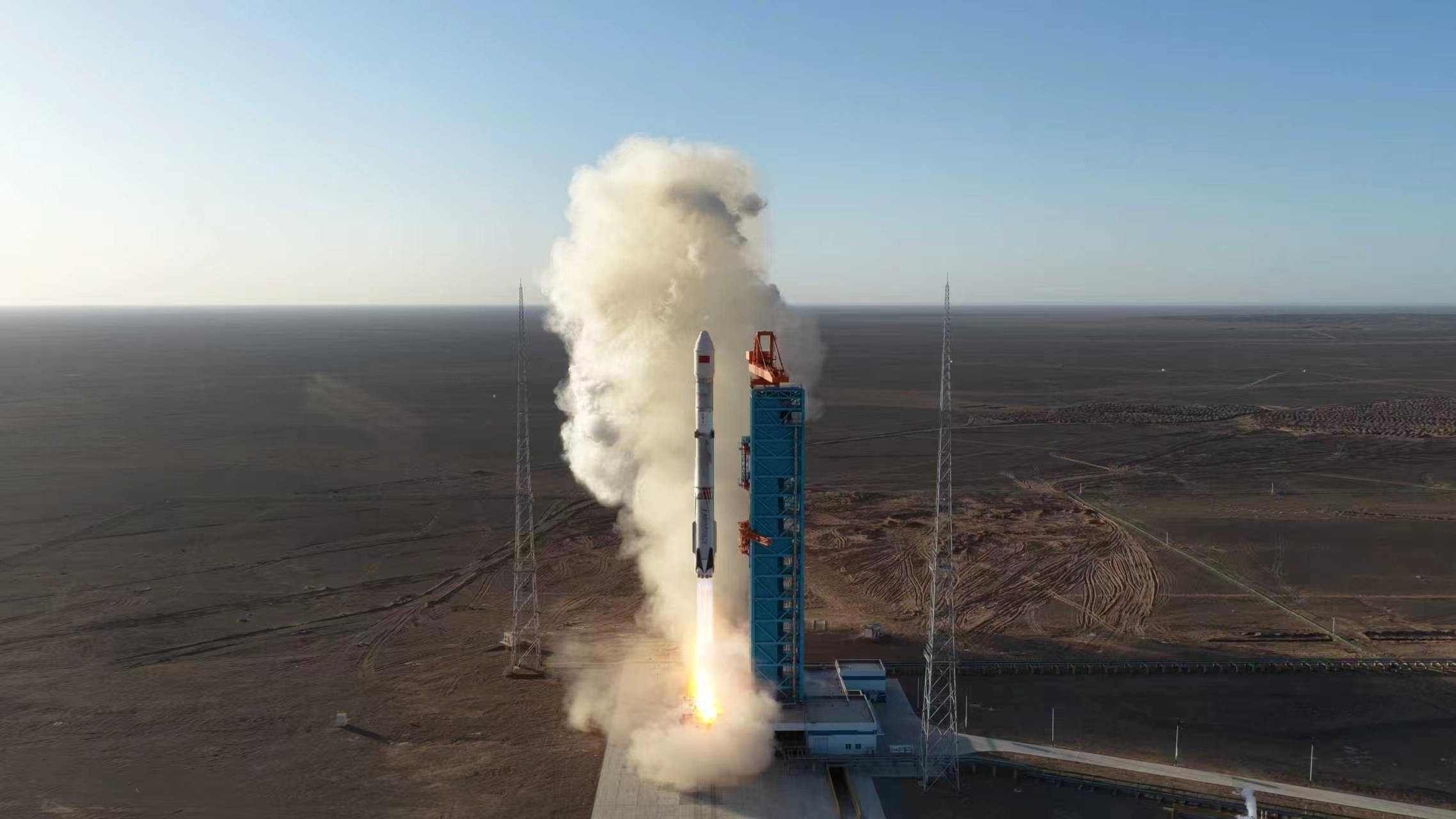
Photo: Landspace