



Time cannot erase the truth. The more evidence surfaces, the harder it becomes to hide the scars left by aggression.
In December 1949, a military tribunal in Khabarovsk, then known as Boli in the Soviet Union, convened the first-ever public trial dedicated to biological warfare crimes.
Through undeniable evidence, the tribunal revealed the atrocities committed by Japan's Imperial Army Unit 731 in China, setting an essential precedent for postwar international justice.
Recently, Russia transferred a collection of archival documents to China, further exposing Unit 731's crimes. These records, centered on the Khabarovsk trial, span the periods before, during and after the proceedings. They complement the 1950 publication Materials on the Trial of Former Servicemen of the Japanese Army Charged with Manufacturing and Employing Bacteriological Weapons, offering a comprehensive historical account.
The newly transferred archives include interrogation records of war criminals, witness testimonies, handwritten confessions and medical forensic reports. These materials reinforce existing Unit 731 crime archives and physical evidence preserved in China, creating a robust and interconnected evidentiary chain.
Collectively, these records substantiate the war crimes committed by Unit 731, including human experimentation, biological weapons development and the deployment of biological warfare. They conclusively demonstrate that Japan's biological warfare program was not a series of isolated incidents but a state-sponsored operation carried out through a deliberate, organized and systematic chain of command.
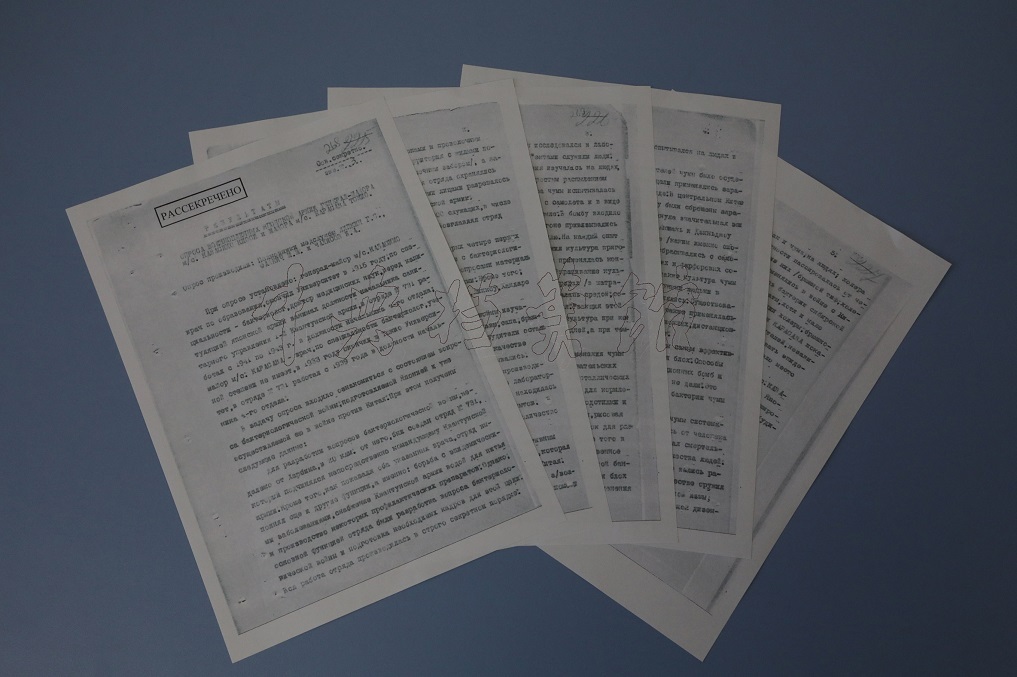
This undated photo shows some Russian-provided archive copies related to the infamous Unit 731, a Japanese germ-warfare unit that operated during World War II. (Photo: CMG)
The Khabarovsk tribunal first exposed horrific details of "special transfers," human experimentation and biological warfare operations.
Former Unit 731 military doctor Ryuji Kajitsuka testified that commander Shiro Ishii described the "secret of secrets" as the research, application and human experimentation linked to biological warfare.
Former military police squad member Satoru Kurakazu recalled frostbite experiments where the fingers of five Chinese victims turned black and broke off, leaving only exposed bone.
Testimonies also revealed a "special detention prison" within Unit 731's core site, the infamous "square building," where innocent civilians from China, Russia, Korea and more were subjected to experiments with frostbite, anthrax, plague and other diseases before being tortured to death.
Archives from Japan, the United States and other countries corroborate these findings. For example, Japan's National Archives preserve the Roster of the Epidemic Prevention and Water Purification Department of the Kwantung Army, identifying the perpetrators by name. Similarly, declassified human experimentation reports from the US Library of Congress and National Archives echo the Khabarovsk tribunal's testimony with precise data. Together, these sources render the crimes of Unit 731 irrefutable and immune to denial.
Unit 731's operations extended far beyond a single unit. During World War II, under the direct command of Unit 731, the Japanese Army established an "epidemic prevention and water purification" network comprising 69 units. Spanning much of China as well as East and Southeast Asia, this network wove a sinister web of atrocities.
At present, Japan's political landscape raises serious concerns. The country's growing rightward shift and the potential resurgence of militarism demand vigilance. Japanese Prime Minister Sanae Takaichi has continued right-wing policies aimed at reviving militarist tendencies.
The historical revisionism is deeply harmful. Legally, it violates the principles outlined in key international documents, such as the Cairo Declaration and the Potsdam Proclamation, thereby undermining the postwar global order. Emotionally, it inflicts profound wounds on the people of victimized countries, including China. Japan's increase in arms exports and shift to offensive defense capabilities are viewed as a significant threat to regional peace and stability.
Facing history honestly and engaging in deep reflection are not just moral obligations for Japan—they are also legal and international responsibilities as a defeated nation in World War II. Trials like the Tokyo Trial, the Nuremberg Trials and the Khabarovsk tribunal are the cornerstones of the postwar world order.
The crimes against humanity committed by Unit 731 were legally established by the Khabarovsk tribunal decades ago. In 2002, a ruling by the Tokyo District Court further recognized that Japan's Imperial Army violated international law by using biological weapons during its aggression against China, causing massive casualties.
These judicial conclusions, supported by overwhelming evidence, demand that Japan confront its historical culpability.
Having endured profound suffering, the Chinese people understand the invaluable nature of peace. Today's China is no longer the weak and impoverished nation of the past. It will not allow right-wing forces in Japan to rewrite history or permit the resurgence of militarism.
China stands ready to join hands with all peace-loving nations to preserve the hard-won outcomes of World War II, uphold the international order and safeguard world peace.
The author is the curator of the Exhibition Hall of Evidences of Crime Committed by Unit 731 of the Japanese Imperial Army.