


Observer: A green bond bridging China and the US

The Mu Us Desert in North China's Inner Mongolia Autonomous Region is now lush with trees and teeming with life. It was here that Yin Yuzhen, a pioneering Chinese desertification fighter, reunited with her American friend, Ronald Sakolsky, after 26 years apart.
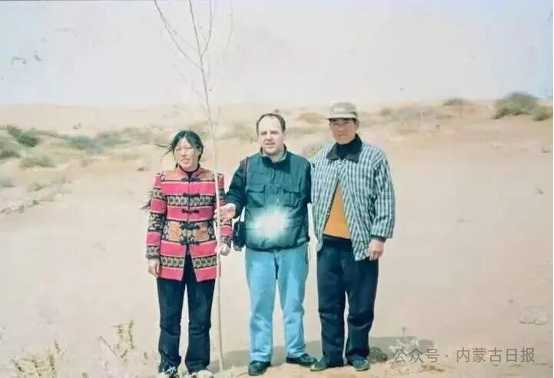
Ronald Sakolsky (middle), Yin Yuzhen and Yin's husband plant a tree in the Mu Us Desert in North China's Inner Mongolia Autonomous Region. (File photo: Inner Mongolia Daily)
In 1999, Sakolsky was teaching in Luoyang, Central China's Henan Province, when he was deeply moved by Yin's story of planting trees and battling desertification in the arid landscape. Under the Chinese name "Sai Kaosi," he raised $5,000 to support her work.
More than two decades later, those early acts of kindness have helped nurture more than 50,000 trees, turning once-barren stretches of sand into green oases. What began as a simple gesture has grown into a lasting story of friendship between ordinary people in China and the United States.
It is a vivid example of how friendship between the Chinese and American peoples can be carried forward from generation to generation.
Though separated by oceans, language and culture, Yin and Sakolsky found common ground in their shared commitment to making their surroundings greener and better.
Their story reflects fundamental values shared by the two peoples: the aspiration for a better life, respect for nature and a willingness to stand up for what is right. Such sentiments can transcend borders and bridge cultural differences.

Ronald Sakolsky and Yin Yuzhen hug each other at Ejin Horo Airport in Ordos, North China's Inner Mongolia Autonomous Region, August 23. (Photo: Inner Mongolia Daily)
The Chinese tradition of building friendships through sincerity and cherishing the kindness of others found an echo in the goodwill of an international friend half a world away, giving this people-to-people friendship the strength to endure the test of time.
Chinese President Xi Jinping has said that the hope of China-US relations lies in the people, their foundation rests in society, their future depends on the youth and their vitality comes from exchanges at the subnational level.
This view is firmly rooted in the long history of friendship and mutual understanding between the Chinese and American peoples. Over the years, countless stories of people-to-people exchanges have shown that friendship can overcome differences in geography, culture and national borders.
The century-old friendship forged in Kuliang, the shared experience of fighting side by side during the World Anti-Fascist War and Ping-Pong Diplomacy, which helped pave the way for the normalization of China-US relations, are among the best-known examples. Each has left memories that continue to resonate across generations.
In 2023, Xi proposed inviting 50,000 young Americans to China on exchange and study programs over the following five years. That target was reached two and a half years ahead of schedule. Exchanges and mutual understanding among young people are injecting fresh vitality into the friendship between the Chinese and American peoples.
History and reality have repeatedly shown that friendship between the peoples is the deepest social foundation of China-US relations and a reliable source of strength for the relationship to withstand challenges and move forward steadily.
Mutual understanding and goodwill between the peoples can, in turn, create space for practical cooperation. Ecological conservation is one area where the interests of China and the US converge.
The transformation of the Mu Us Desert from barren sands into a green landscape is a vivid testament to China's achievements in combating desertification.
For more than half a century, generations of Chinese people have dedicated themselves to this cause, working tirelessly to find approaches suited to the laws of nature and China's national conditions. Their efforts have brought about a historic transformation from "sand forcing humans to retreat" to "trees forcing sand to retreat."
China's sustained efforts to promote ecological conservation have not only strengthened its own ecological security but also created opportunities for international exchanges and cooperation, enabling more international partners to see firsthand the country's commitment to and responsibility for green development.
Today, global challenges such as climate change, land desertification and biodiversity loss are becoming increasingly acute. Protecting our shared planet is a common cause of humanity. No country can stand apart from these challenges, and working together to address them remains the right path forward.
Guided by the vision of building a community of life for humanity and nature, China has actively shared its experience in combating desertification, promoted appropriate technologies and trained professionals.
Through concrete actions, China is contributing to global ecological governance. It has contributed to the development of Africa's Great Green Wall project, supported ecological restoration efforts around the Aral Sea in Central Asian countries, and conducted exchanges and cooperation with Arab countries on water-saving agricultural technologies for arid regions.
As two major countries with significant global influence, China and the US share extensive common interests in areas including environmental protection, clean energy and climate governance. Cooperation in these fields would benefit not only the peoples of both countries but also give new impetus to global green development.
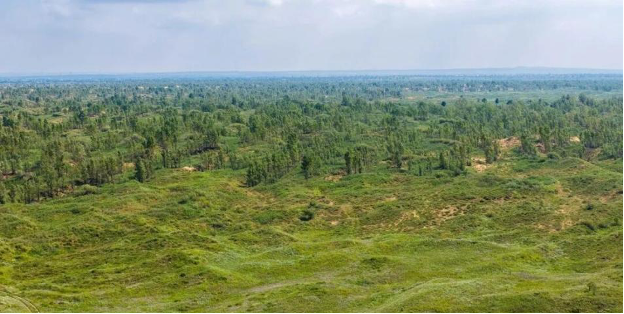
About 85 percent of the Mu Us Desert has been restored. (Photo: Inner Mongolia Daily)
A single sapling can grow into a vast forest, and a single act of kindness can bridge mountains and seas. The story of Sakolsky and Yin shows how the sincere efforts of ordinary people can create an impact far beyond their expectations. When major countries approach each other with goodwill, they can bring even greater benefits to the world.
By continuing to nurture the strong foundation of people-to-people friendship and uphold the principle of mutually beneficial cooperation, China and the US can build greater consensus and expand cooperation, allowing more seeds of friendship to take root and flourish.
Together, they can bring greater stability and positive energy to a world undergoing profound change and turbulence, while working hand in hand to protect the common home on which humanity depends.