


At a press conference on January 13, Wang Lingjun, deputy head of the General Administration of Customs, showcased the final customs declaration of 2024, which inscribes the export information of a private enterprise from Shenzhen. This marked the last of nearly 88.38 million such declarations for the year, symbolizing the conclusion of China's foreign trade activities.
In 2024, China's total foreign trade, including both imports and exports, reached a record 43.85 trillion yuan ($5.98 trillion), marking a 5 percent year-on-year increase. Private enterprises accounted for 24.33 trillion yuan ($3.31 trillion) of this total, an 8.8 percent increase and represented 55.5 percent of the country's overall foreign trade, solidifying their position as the largest driving force behind China's foreign trade sector.
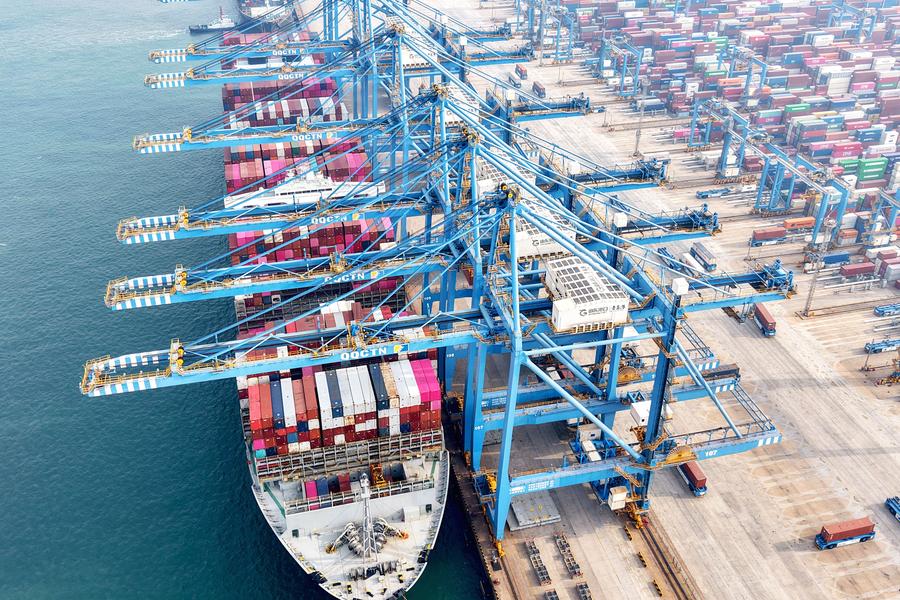
Containers are unloaded at Qingdao Port, East China's Shandong Province, December 10, 2024. (Photo: Xinhua)
As 2024 unfolded, China's foreign trade landscape was shaped by challenging global conditions. Among the key players, private enterprises stood out for their resilience and adaptability, achieving what were dubbed "three firsts."
The first milestone was the number of private enterprises with import and export records surpassing 600,000, reaching 609,000 for the first time.
In 2024, the number of business entities in China with recorded import and export activity approached 700,000, setting a new record. Among them, the number of private enterprises exceeded 600,000 for the first time. This surge reflects private companies' growing presence and importance in China's foreign trade, marking them as a key contributor to the sector's expansion. They now represent a broad spectrum of industries, from manufacturing to consumer goods and are vital to both innovation and market expansion.
One such company is Timekettle, a Shenzhen-based tech firm specializing in AI translation earbuds. Founded in 2016, Timekettle quickly found success, becoming a top seller on Amazon just two years later. Its products have now captured more than 30 percent of the North American market and have a global user base exceeding 300,000. The company reports an annual export growth rate of over 80 percent. "Our goal is to continue innovating and offering high-quality translation experiences to users worldwide," said Li Feng, brand director of Timekettle. "We aim to break down language barriers and foster better communication globally."
The second achievement was that private enterprises became the largest importers and exporters of high-tech products in China.

A worker operates an automated equipment for chip packaging and testing production in a semiconductor production company in Jiujiang, East China's Jiangxi Province on March 21, 2024. (Photo: CFP)
In 2024, private enterprises' import and export of high-technology products grew by 12.6 percent, raising their share of China's total import and export value of similar products by three percentage points to 48.5 percent. Exports of high-end equipment, such as ships, and imports of specialized equipment, such as semiconductor manufacturing equipment, grew by more than 20 percent.
These developments underscore the deepening involvement of private enterprises in China's high-tech sector, fueling innovation and development. Innovation has become ingrained in the DNA of private enterprises. These companies increasingly invest in advanced production equipment, driving technological upgrades and ensuring that innovation directly translates into trade opportunities. Private enterprise exports of products are proliferating in ships and marine engineering equipment, aerospace equipment, electronic information products, and other high-tech fields. In promoting green and low-carbon development, private enterprises play a leading role, with their share in the export of solar energy, lithium batteries, and electric manned vehicle exports continuing to rise. Private enterprises are the driving force of innovation and development.
The third milestone came when private enterprises seized over 50 percent market share of China's consumer goods imports for the first time. This figure rose by 2.8 percentage points from the previous year to 51.3 percent. In products such as daily chemical products and fruits, the proportion is over 60%.

Exhibitors promote fruits via live-streaming during the seventh China International Import Expo (CIIE) in East China's Shanghai, November 6, 2024. (Photo: Xinhua)
As China's Spring Festival approaches, ports like Huangpu New Port in Guangzhou remain busy, with a steady flow of goods arriving. From 50,000 tons of high-quality sugar for local food manufacturers, 17 tons of imported plastic toys destined for children's gifts, to a batch of skin-care products ready to adorn consumers celebrating the Spring Festival, private enterprises are integral to fulfilling the diverse needs of the Chinese market. December 2024 saw China's consumer goods imports reach 167.82 billion yuan ($22.89 billion), a new high in nearly 21 months, with imports increasing by 3.9 percent year-on-year and 14.4 percent month-on-month.
China's large-scale domestic market continues to offer opportunities for both local and international companies. In 2024 the country imported nearly 3 billion tons of bulk commodities, over 7 trillion yuan ($954.78 billion) in mechanical and electrical products and nearly 1.8 trillion yuan ($245.52 billion) in consumer goods, meeting the growing demands of both industry and consumers. Private enterprises have been pivotal in adapting to these needs, further enriching domestic options and contributing to the broader goals of improving quality of life.
As China's foreign trade continues to evolve, private enterprises will likely remain at the forefront, driving growth and innovation amid a complex global trade environment. The fundamentals of China's economy, which features stability, multiple advantages, strong resilience and great potential, remain unchanged, and the supporting factors for promoting high-quality development of foreign trade are still solid. With the implementation of various laws and measures to encourage the development of the private economy, private enterprises will undoubtedly play a more significant role in stabilizing foreign trade and contribute to further stimulating the vitality of foreign trade development.
(Translated by Qiao Wai, Fan Liuyi, Fu Junjie and intern Feng Qingyuan; Edited by Li Yuanxin)