


As nature awakens and mountains turn lush, China enters the best season to plant trees.
Recent data reveals that in 2024, China completed about 6.67 million hectares of land greening.
The country's forest coverage now exceeds 25 percent, with total forest stock volume surpassing 20 billion cubic meters. China also leads the world in artificial forest area and the growth of forest resources.
Forests are the backbone of terrestrial ecosystems and are essential to human survival. Large, science-based afforestation is an important initiative for China to expand forest resources and restore ecosystems, playing a significant role in advancing ecological civilization construction.
China continues to advance the integrated conservation and systematic management of mountains, rivers, forests, farmland, lakes, grasslands and deserts.
Its afforestation efforts have reached new heights and made new achievements, driving high-quality development.

An aerial drone photo taken on early July 5, 2024 shows a view of the Saihanba National Forest Park in Chengde city, North China's Hebei Province. (Photo: Xinhua)
The achievements include the remarkable transformation of Saihanba from a barren wasteland into a vast forest, the creation of a green belt surrounding the Taklimakan Desert, progress made in the landmark projects for the national shelterbelt program in Northwest, North and Northeast China and the establishment of over 2,600 tree-planting bases that harness the power of the internet to engage the public in reforestation efforts.
While striving to build a beautiful China and meet people's aspirations for a better life, China's forest coverage rate, per capita forest area and forest stock volume remain below the global average. Forest resources are also unevenly distributed and of relatively low quality.
China is one of the countries with the largest desertified areas, the highest number of affected people and is most severely jeopardized by sandstorms.
This year's government work report pointed out that China will take a holistic and systematic approach to the protection and conservation of mountain, water, forest, farmland, grassland and desert ecosystems and strive for major progress in the landmark projects for the national shelterbelt program in Northwest, North and Northeast China.
This means the country must continue expanding forest and grassland resources, make sustained afforestation efforts and achieve lasting results through persistent efforts and steady progress.
Science-based afforestation must prioritize both quantity and quality.
It should follow the principle of planting the right trees in the right places, at the right time and using the right methods.
Tree and grass species should be chosen based on local climate, geography, vegetation growth patterns and water availability to ensure they thrive.
Meanwhile, the forest chief scheme should be effectively carried out to detect and address risks, protecting the valuable progress made through greening efforts.
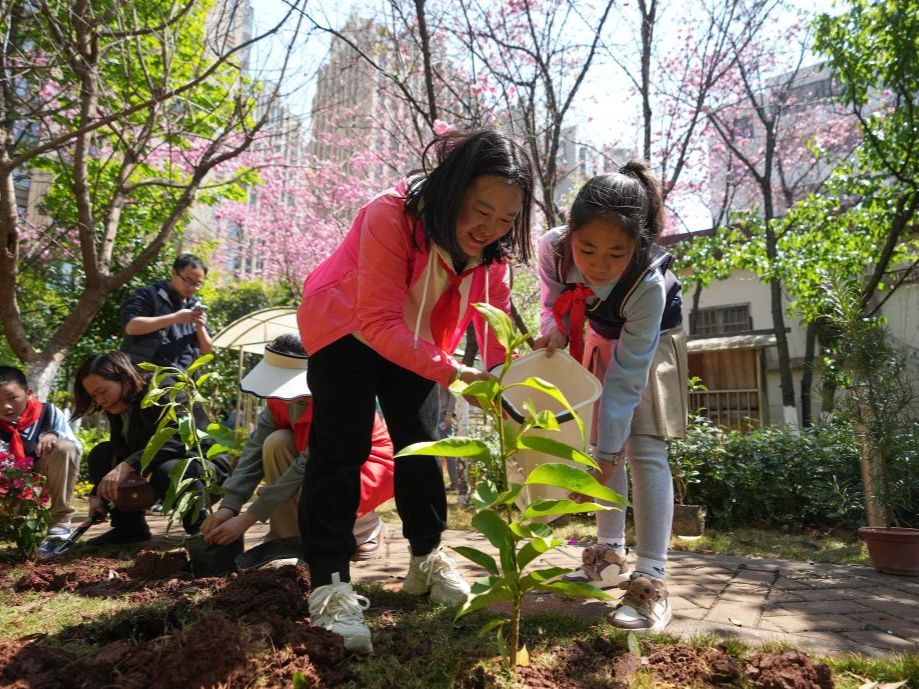
Local residents water saplings in Panlong District of Kunming, Southwest China's Yunnan Province, March 11, 2025. (Photo: Xinhua)
The forestry and grassland industry is an ecological engine for prosperity.
In 2024, China's forestry and grassland industry generated a total output value of 10.17 trillion yuan (about $1.4 trillion).
Forest food production surpassed 200 million tons, becoming the third most important agricultural product after grain and vegetables.
In the same year, forests developed for economic purpose reached nearly 46.67 million hectares, generating an annual output value of over 2 trillion yuan.
Forty million hectares of forest land was dedicated to the under-forest economy, generating an annual output value of about 1 trillion yuan.
China must prioritize protection, use forest resources sustainably, fully tap into the potential of forests and continuously strengthen the green engine for all-round rural revitalization, transforming ecological advantages into development opportunities.
Afforestation is a cost-effective way to achieve China's goals on carbon peak and carbon neutrality.
The annual carbon-sink capacity of forests and grassland in China has exceeded 1.2 billion tons of carbon dioxide equivalents, ranking first in the world.
This capacity is a cornerstone for achieving the country's carbon neutrality goal, playing an irreplaceable role in mitigating global climate change.
To boost carbon-sink capacity, efforts should be made to expand forest and grassland coverage, enlarge forest and grassland carbon pool, improve the quality of forest and grassland resources and strengthen conservation of forest and grassland resources to reduce carbon pool loss.
Efforts should also be made to innovatively create application scenarios for forest carbon sinks, exploring ways to enhance the carbon-sink capacity of forests and develop new models to realize their value.
In 2024, urban and rural greening continued to advance in China.

An aerial drone photo taken on June 21, 2024 shows scenery at the Wenquan River wetland park in Fuping County, Weinan City of Northwest China's Shaanxi Province. (Photo: Xinhua)
More than 6,200 pocket parks were built and more than 7,300 kilometers of urban greenways were established, meeting residents' expectations for green views from their windows, shade along their paths and parks just outside their doors.
Concerted efforts should be made in green expansion, invigoration and protection.
Trees must be planted one after another and from generation to generation, so as to continuously enrich the country's green resources and consolidate the ecological foundation for the sustainable development of the Chinese nation.