


In the first half of 2025, China's foreign trade achieved three historic "firsts."
Exports surpassed 13 trillion yuan (about $1.81 trillion) for the first time in the same period, marking a 7.2 percent year-on-year increase. The number of foreign trade enterprises with import and export records exceeded 600,000 for the first time, reaching 628,000. Additionally, private enterprises' total import and export volume surpassed 12 trillion yuan for the first time.
These breakthroughs reflect China's tenacity in pushing forward against headwinds and reinforce the resilience of its foreign trade sector.
True resilience emerges through adversity. Achieving such results in the face of global challenges was no easy feat.
Confronted with rising unilateralism and protectionism, China has expanded into new markets, ultimately ensuring growth in trade volume, improvements in quality, and enhanced control of variables.
Many international media outlets have remarked on the resilience of China's foreign trade, noting that "robust trade figures are sending positive signals to the market," "a surge in exports and rebound in imports are injecting fresh momentum into the economy," and "export growth has exceeded expectations."
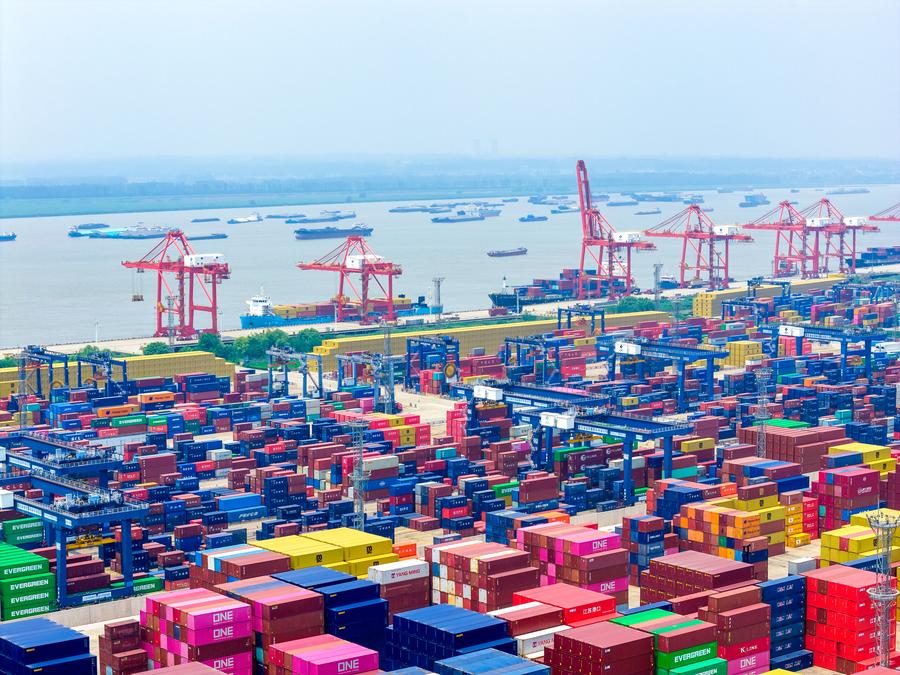
This aerial drone photo taken on July 10, 2025 shows a view of Longtan Container Terminal of Nanjing Port in Nanjing, East China's Jiangsu Province. (Photo: Xinhua)
Total Volume Grows Thanks to Broad-Based Synergy
China's total import and export volume has remained above 10 trillion yuan for nine consecutive quarters. Notably, in June, all three key indicators—imports, exports, and total trade—achieved positive year-on-year growth, with growth rates continuing to rebound. The import and export volume for June reached 3.85 trillion yuan, up 5.2 percent year on year, marking the second-highest monthly total on record.
Provinces and municipalities with strong foreign trade remain the cornerstone of stability. In the first half of the year, Guangdong, Jiangsu, Zhejiang, Shanghai, and Shandong accounted for 64.1 percent of China's total foreign trade, with a combined year-on-year growth rate of 4.8 percent—1.9 percentage points higher than the national average—contributing 3 percentage points to overall foreign trade growth.
Among them, Shandong posted the fastest growth rate: up 6.8 percent to 1.73 trillion yuan, 3.9 percentage points higher than the national average, contributing nearly 20 percent of the overall national trade increase.
From the coast to inland border regions, and from eastern to western China, the country's opening-up is expanding in both depth and breadth—growing from isolated hubs to connected corridors and broader regional networks. Localities and departments are aligning their efforts, forming a powerful joint force propelling foreign trade forward.
Improved Foreign Trade Quality Driven by Innovation and Product Strength
China's high-tech product exports have increased by 9.2 percent, marking the ninth consecutive month of growth. Furthermore, Chinese brands have captured a 32.4 percent share of the high-tech export market. China's export share of industrial robots rose to second globally, with export growth of 61.5 percent. Exports of lithium batteries and wind turbines also surged by over 20 percent. Innovation has become a defining feature of China's export offerings.
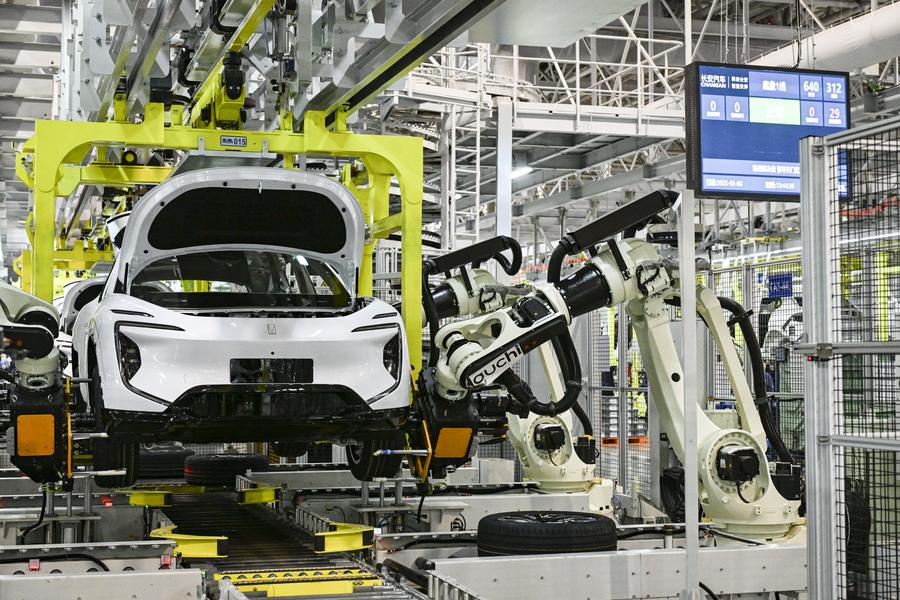
This photo taken on March 6, 2025 shows an automated production site at the final assembly workshop of Chang'an Auto Digital Intelligence Factory, in Yubei District of Southwest China's Chongqing. (Photo: Xinhua)
"If a product is truly irreplaceable, short-term market fluctuations won't matter." "When the market shifts, we respond with innovation and new offerings." — These are common sentiments among many Chinese exporters navigating today's complex global landscape.
Facing a complex and evolving global environment, Chinese foreign trade enterprises remain unfazed. Anchored in innovation, they are actively exploring new markets and new tracks, providing high-quality supply tailored to global demand.
In the first half of the year, exports of mechanical and electrical products totaled 7.8 trillion yuan, up 9.5 percent, accounting for 60 percent of total exports. Among these, high-end equipment closely related to new quality productive forces saw growth of over 20 percent. Meanwhile, exports of the "new trio," namely solar batteries, lithium batteries, and electric vehicles, rose by 12.7 percent. More and more Chinese innovative products are ascending to the mid- and high-end of global industrial and value chains.
Controllable Variables through Market Diversification
Recently, the third China International Supply Chain Expo was held in Beijing. The event featured 651 enterprises and institutions from 75 countries and regions, showcasing new technologies, products, and services across key upstream, midstream, and downstream segments—highlighting the vast opportunities of an open China.
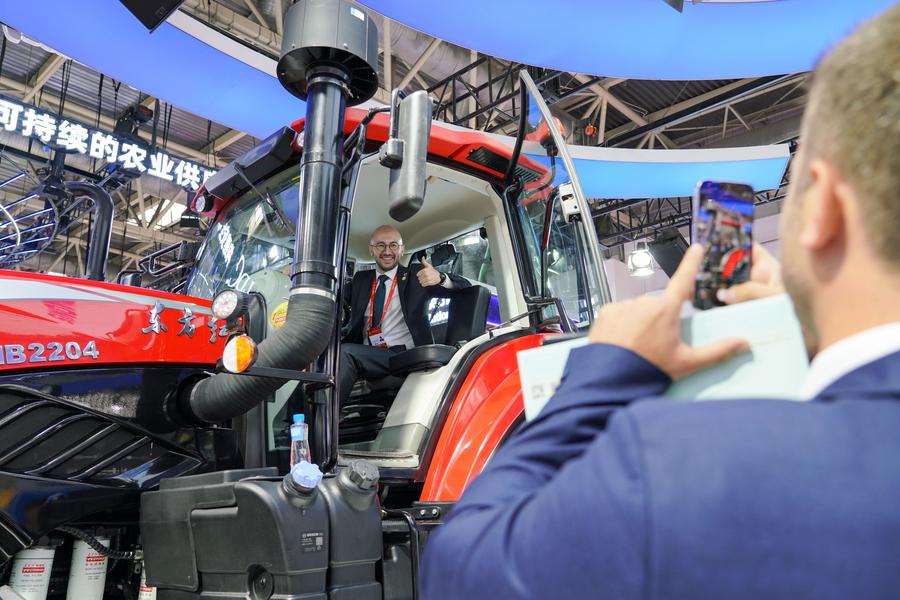
A visitor poses for photos with a tractor at the booth of China National Machinery Industry Corporation (Sinomach) in the Green Agriculture Chain area of the third China International Supply Chain Expo (CISCE) in Beijing, capital of China, July 16, 2025. (Photo: Xinhua)
Confronting unilateralism and protectionism, China continues to expand its "circle of friends," strengthening economic and trade ties and jointly responding to rapid shifts in the external environment.
China's trading partners have become increasingly diverse. In the first half of the year, China's trade with over 190 countries and regions increased. The number of partners with bilateral trade volumes exceeding 50 billion yuan rose to 61—five more than in the same period in 2024.
While China has maintained trade growth with traditional markets such as the EU, Japan, and the UK, emerging markets contributed more incremental gains. Trade with Belt and Road partner countries has reached 11.29 trillion yuan, up 4.7 percent and accounting for 51.8 percent of China's total trade, a 0.9-percentage-point increase from the previous year.
It is in rough seas that a vessel's resilience truly shines. The global trade environment remains complex and volatile. Several international organizations have recently downgraded forecasts for global trade growth in 2025. Sustaining stable growth in foreign trade will require continued, concerted effort.
Yet, a diversified and stable market base, a growing array of innovative, high-quality products, and a dynamic community of adaptable and forward-looking enterprises give China the confidence, strength, and capability to rise to any challenge.
By unswervingly handling its own affairs well, deepening reform and opening-up, and promoting innovation-driven development in foreign trade, China is well-positioned to sustain the high-quality development of its foreign trade, despite the uncertainties of the international economic landscape.