


The Ministry of Industry and Information Technology has recently announced revisions to the lithium-ion battery industry specification conditions and the lithium-ion battery industry specification announcement management measures, raising the standards for technology and product quality in the lithium-ion battery industry. Chinese industry experts believe that these higher entry requirements will steer the lithium-ion battery industry onto a healthier and more sustainable path of high-quality development.
The rapid growth of China's lithium-ion battery industry, driven by increasing supply and rising market demand, has positioned it as a significant competitive sector.
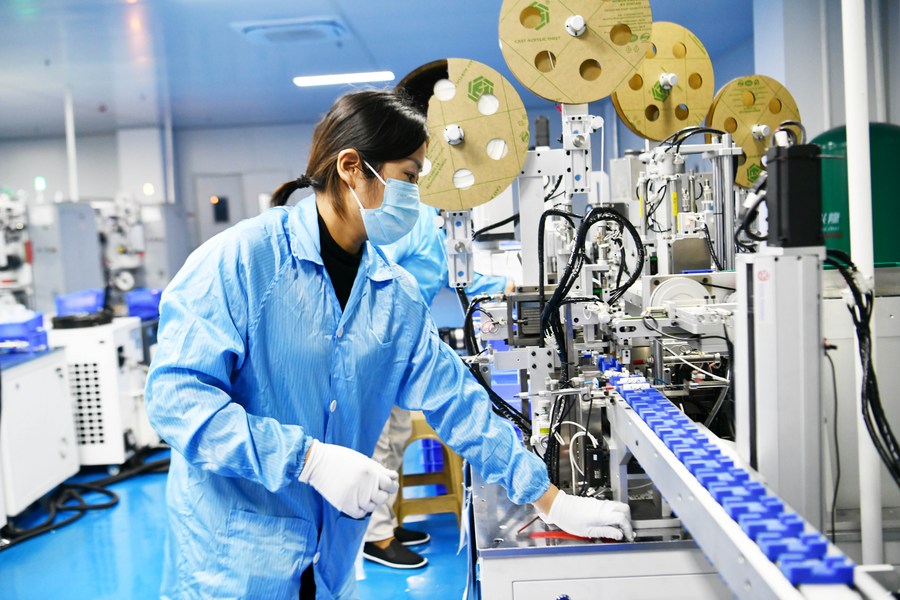
Workers operate at a workshop of a lithium battery company in Zaozhuang, east China's Shandong Province, Jan. 3, 2024. (Photo: Xinhua)
From the perspective of scale and production, in 2023, China's total lithium-ion battery output exceeded 940 gigawatt-hours, marking a 25 percent year-on-year increase, with the industry's total output value surpassing 1.4 trillion yuan (about $192.6 billion).
China's lithium-ion battery exports for 2023 reached $65 billion, 4.1 times higher than in 2020. As one of the "new trio" of China's foreign trade, the burgeoning and internationally expanding lithium-ion battery has added a new bright spot to Chinese manufacturing.
From a technological standpoint, China's lithium battery industry has established an advanced technological capability, a complete industrial chain and a competitive industrial system. Mass-produced power-type lithium-ion battery cells in China can reach an energy density of up to 300 watt-hours per kilogram. Energy storage-type lithium batteries have a cycle life exceeding 12,000 cycles, which places them at the forefront internationally.
Denis Simon, a distinguished fellow at the Institute for China-America Studies, said that China is at the forefront of developing new battery technologies, including advancements in solid-state batteries and improvements in solar panel efficiency.
The rapid development of the industry has enhanced technological capabilities and driven a surge in investment enthusiasm, making lithium-ion battery one of the few industries in China that have been widely distributed across most provinces and municipalities. A lithium-ion battery boom should be viewed from two aspects.
On one hand, the lithium-ion battery industry has broad market demand and its fundamental outlook is promising in the long term.
The lithium-ion battery industry has a long industrial chain and a wide range of applications from upstream critical mineral raw materials and refined products to secondary materials, to midstream lithium battery primary materials like cathode materials, anode materials, separators, electrolytes and downstream applications encompassing power, consumer and energy storage batteries.
Particularly at the end-user level, lithium-ion battery products are widely used in portable electronic devices, electric vehicles, e-bikes, humanoid robots, energy storage systems, aerospace and medical equipment.
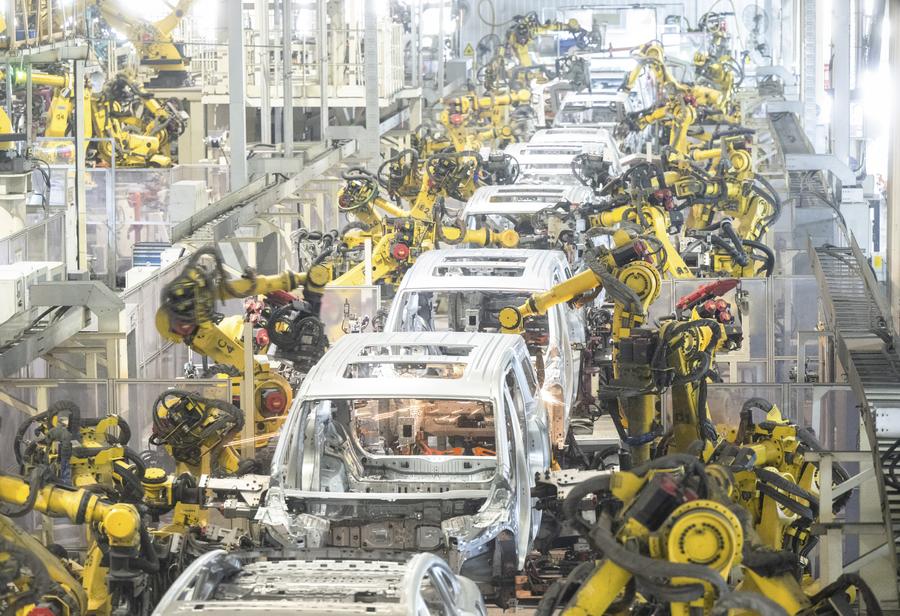
Robots work at a welding workshop of Voyah, a Chinese electric auto brand, in Wuhan, central China's Hubei Province, April 1, 2024. (Photo: Xinhua)
In the foreseeable future, whether it's the power batteries widely needed for new energy vehicles or the energy storage batteries used in new energy storage systems, mass demand increments will persist. Overall, the lithium battery industry shows a sustained long-term positive trend.
On the other hand, facing issues of disorderly competition, it is necessary to promote supply-side structural reform and further optimize industrial order.
Many places have designated lithium batteries as a "pillar industry," attracting enterprises and capital inflows.
This has led to periodic and structural mismatches in supply and demand, with some outdated and low-end capacities also entering the market.
As the industry has rapidly developed, competition has intensified, causing a gradual decline in profit levels within the lithium battery sector. Particularly in the past two years, profit margins for segments like lithium battery equipment have seen a downturn.
These factors indicate that the lithium-ion battery industry is entering a phase of deep adjustment, necessitating further regulation of industrial order.
In fact China has consistently adhered to high standards and strict requirements for the lithium-ion battery industry. The guidelines for the lithium-ion battery industry were first issued in 2015 and subsequently revised in 2018 and 2021.
The relevant government departments have revised these conditions amidst a general improvement in lithium-ion battery technology and a deep adjustment phase for the industry, aiming to guide enterprises to reduce manufacturing projects solely focused on expanding production capacity and to encourage companies to allocate funds and efforts towards strengthening technological innovation, improving product quality and reducing production costs.
Going over the regulatory conditions, the measures can be distilled into two parameters: technical and comprehensive energy consumption. Technical parameters include energy and power densities, which focus on the quality and technological progress of the product. Comprehensive energy consumption indicators must meet ever-stricter energy-saving and carbon reduction requirements from both home and abroad.
Using these two parameters to guide the industry's accelerated technological progress and transformational development can be seen as beneficial both in the short and long term.
In the short term, it will help accelerate the survival of the fittest in the market and promote the elimination of backward production capacity.
In the long term, it encourages proactive investment by enterprises, reduces redundant construction and resource waste, and promotes a more balanced supply-demand framework.
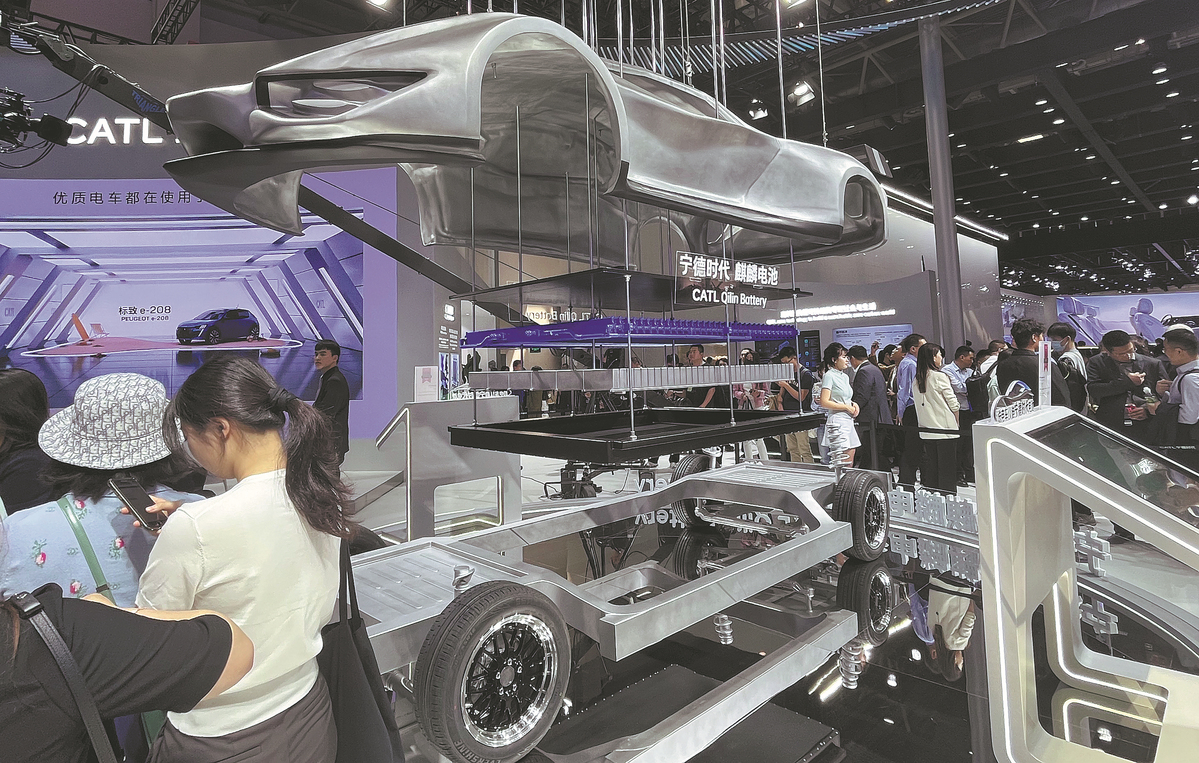
The world's largest battery provider CATL showcases its Qilin battery at the Beijing auto show in April, 2024 (Photo: Xinhua)
Many industry insiders have welcomed this development.
"The revision of the guidelines is conducive to the quality upgrading of the lithium battery industry in China," said Zhang Xiang, director of the WDEF Digital Automotive International Cooperation Research Center in Hangzhou. In Zhang's opinion, the concentration of the lithium battery industry may further increase in the future.
Su Bo, former vice minister of Industry and Information Technology, called for efforts at a recent industry meeting to make technological breakthroughs in high strength, lightweight, high safety, low cost and long service-life power batteries, encouraging enterprises to develop new lithium battery products, help the innovation and development of the industrial chain of lithium battery and proactively foster new quality productive forces.
China is igniting the engine of innovation and accelerating the development of new quality productive forces, with lithium batteries standing as a prominent representative of emerging industries.
At the same time, the Chinese government is keenly aware that the focus should not be set only on the "new trio" of new energy vehicles, lithium-ion batteries and photovoltaic products, nor should industries rush into things or disperse efforts in a frenzied rush. Active and prudent development is the only means to healthier, higher-quality development.
It is believed that with the revision of the guidelines and related scientific supervision regulations, China's lithium battery industry will stride steadily towards high quality development and keep creating new advantages.