


China made 5.68 trillion yuan (about $810 billion) in water conservancy investments during the 14th Five-Year Plan period (2021-2025), said Chen Min, vice minister of Water Resources, at a press conference held by the State Council Information Office on January 9.
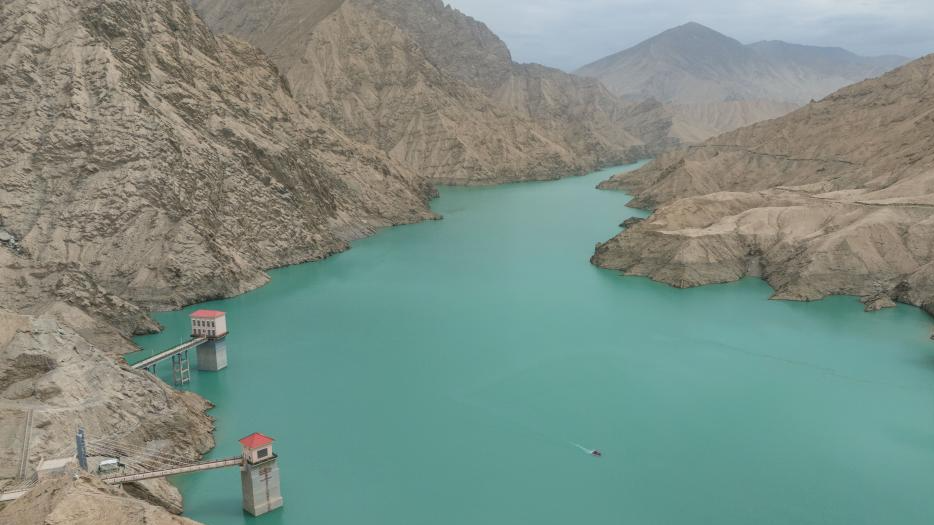
An aerial drone photo taken on August 6, 2025 shows the Wuluwat water conservancy project in Hotan prefecture, Northwest China's Xinjiang Uygur autonomous region. (Photo: Xinhua)
According to Chen, China's annual investment in water conservancy projects has exceeded 1 trillion yuan for four consecutive years since 2022.
Currently, the national water network covers 80.3 percent of the country's land area, ensuring water security for the implementation of major national strategies, key economic zones, major city clusters, energy bases, major grain-producing areas, key ecological function zones, and important water transport channels.
Some may wonder what exactly the national water network is and why it is imperceptible.
In fact, it is all around us.
It is in a glass of water. Water from South China quenches North China's thirst. Over 80 percent of the tap water in Beijing now comes from the South-to-North Water Diversion Project. In Zhengzhou, Central China's Henan Province, more than 90 percent of residents' domestic water is supplied by the project. In the basin of Heilonggang River in Hebei Province, over 5 million people have bid farewell to high-fluoride and brackish water. To date, the eastern and central routes of the South-to-North Water Diversion Project have transferred more than 85 billion cubic meters of water.
It is in the harvests that sustain us. In Zizhong county, Southwest China's Sichuan Province, oranges were recently harvested. Many orchards there are irrigated with water from the Dujiangyan irrigation system. This project, built over two millennia ago and continuously upgraded, now irrigates 11.647 million mu (about 776,467 hectares) of farmland.
It is in the beautiful countryside. In Huailuo Village, Wanggang Township, Yingshang county, East China's Anhui Province, the Huaihe River flows gently nearby, and homes on the riverbank have become "beautiful courtyards." All 38 projects for further management of the Huaihe River have commenced. Once plagued by "disordered water systems," the Huaihe River now has significantly enhanced flood storage capacity, featuring smoother flood discharge channels and more solid embankments.
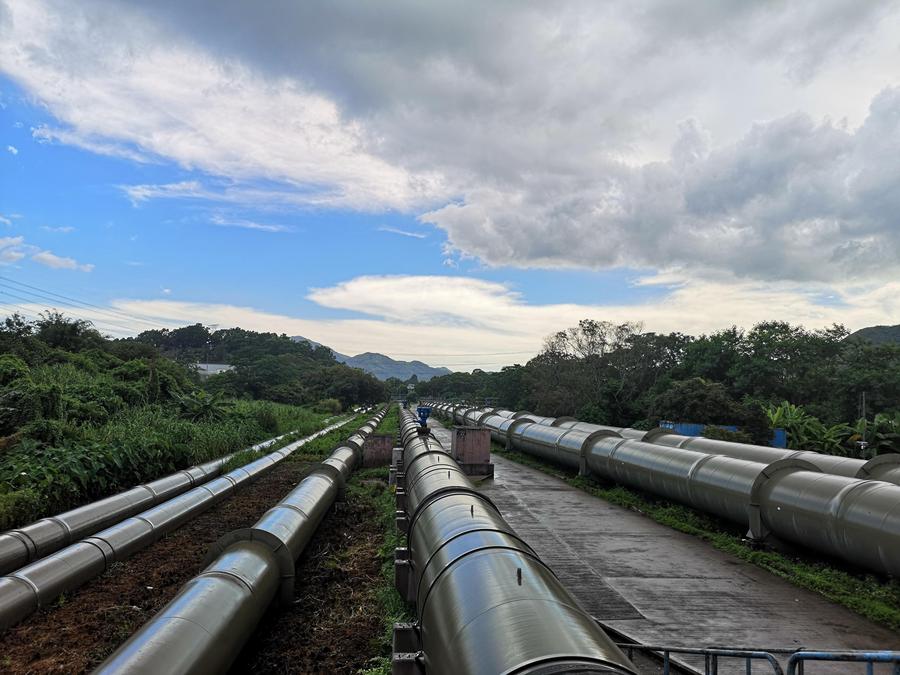
This file photo shows pipelines at the Muk Wu Raw Water Pumping Station in Hong Kong, south China on March 25, 2025. (Photo:Xinhua)
The national water network operates as a silent, yet vital force. China has established the world's most extensive water infrastructure. This vast system encompasses both the major water "arteries" that traverse the landscape and the pipelines that deliver water directly to homes. In 2025, efforts accelerated across all levels: building core water channels and storage hubs, and developing interconnected provincial, municipal, and county-level networks. The result is a growing tapestry where engineered structures and natural rivers and lakes are seamlessly linked.
What has this water network achieved? Four figures tell the story.
— During the 14th Five-Year Plan period, the country's water supply capacity increased by 31.8 billion cubic meters.
The Pearl River Delta Water Resources Allocation Project, a backbone national water network project, diverts water from the Xijiang River system to the eastern Pearl River Delta. From June 1, 2024 to the present, its water supply has exceeded 1 billion cubic meters. The Phase II Yangtze-to-Huaihe Water Diversion Project has begun supplying water to residents in northern Anhui, ending their reliance on brackish water. With reservoirs storing water and the operation of diversion lines, the national water network optimizes water resource allocation and ensures water supply security.
— During the 14th Five-Year Plan period, the irrigated area of farmland increased by over 53 million mu.
Water conservancy is the lifeline of agriculture. The Qingtongxia irrigation area in Northwest China's Ningxia Hui Autonomous Region has undergone modernization upgrades; the Liaoyang irrigation area Northeast China's Liaoning Province has innovated its management model; and the Jiaokou Chouwei (Weihe River Pumping) irrigation area in Northwest China's Shaanxi Province has ensured drainage and disaster reduction for over 380,000 mu of farmland. Water authorities have stored ample water resources, optimized scheduling, and fully ensured irrigation water supply. In 2025, grain output from irrigated farmland accounted for 80.76 percent of the national total grain output.
— By the end of 2025, the national rural tap water coverage had reached 96 percent.
The national water network connects to the taps of hundreds of millions of rural residents. Across the country, integrated urban-rural water supply and large-scale centralized water supply have been advanced. Small-scale water supply projects have been standardized and upgraded based on local conditions, and county-wide unified management has been actively promoted. China has established the world's largest rural centralized water supply system, serving the biggest rural population, and has become the country making the most significant efforts globally to improve rural drinking water conditions.
— China has developed a total of over 5,500 rivers and lakes that enhance public well-being.
Rivers and lakes near residential areas are spaces for development and leisure activities, carrying deep nostalgic sentiments. The national water network is also a green ecological network—replenishing ecology, conserving water sources, preserving soil and water, restoring ecosystems, returning water to rivers, and returning scenery to the people. During the 14th Five-Year Plan period, many rivers that had been dry for years, such as the Beijing-Hangzhou Grand Canal and the Yongding River, were fully reconnected. Spring groups like the Jinci Spring in Shanxi Province and the Baiquan Spring group in Jinan, Shandong Province, which had previously dried up, have resumed flowing, demonstrating significantly enhanced ecological protection and governance of rivers and lakes.
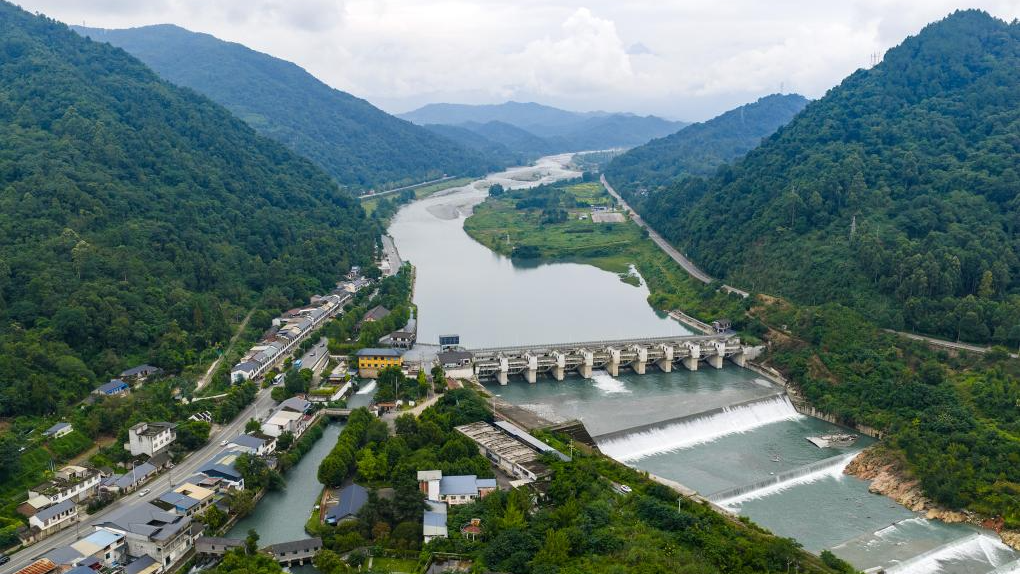
A view of Jianjiangyan Irrigation System in southwest China's Sichuan Province, September 10, 2025. (Photo: Xinhua)
The national water network is a monumental blueprint for the century. Through interconnection, supplementary network development, and enhanced linkage, it stretches across the fertile land, delivering lasting benefits to the people.