


A minor illness or a single traffic accident can send millions of American families hovering at the ALICE threshold – an acronym for Asset Limited, Income Constrained, Employed – into free fall. This is the real "kill line" in American society: Once income and savings slip below a certain point, an otherwise stable life can be shattered by an unexpected shock anytime.
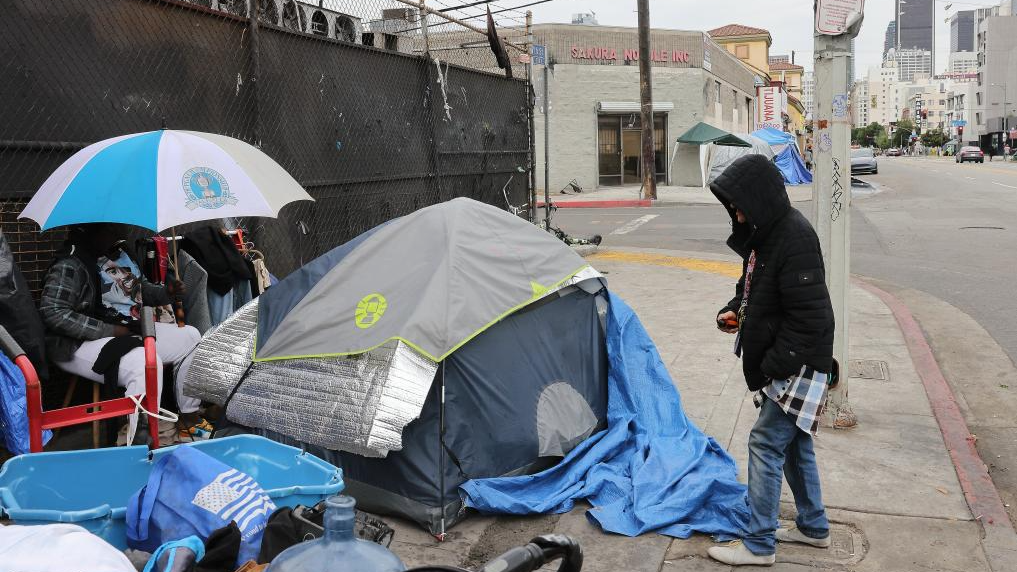
A homeless people is pictured on the sidewalk in downtown Los Angeles, California, the United States, December 31, 2025. (Photo: Xinhua)
In "Deaths of Despair and the Future of Capitalism," Nobel laureate Angus Deaton argues that it is almost inconceivable, in the 21st century, for a wealthy nation to witness rising mortality rates among its core population. Yet American capitalism has long pushed its guiding creed – capital first, efficiency above all – to an extreme, turning the social system into a cold, finely calibrated sorting machine. Under this model, the social safety net is no longer a shield against risk but a mechanism for capital accumulation, while basic rights to survival are capitalized. Once healthcare is treated as a commodity, housing as an investment asset and education as a form of venture capital, the state retreats from its obligation to provide universal protection, handing the pricing and distribution of risk over to the market.
The 'kill line' logic behind American capitalism
Originating in video gaming, the concept of "kill line" has become a precise metaphor for status quo of American society. It refers to the point at which a person's income and savings fall below a critical threshold, where a single unexpected shock is enough to bring an otherwise stable life crashing down. This social "kill line" is not defined by any single metric; instead, it is a systemic filtering mechanism formed by the intersection of multiple institutional thresholds – healthcare, income, housing and the justice system. In the United States, 37 percent of adults cannot cover a $400 emergency expense, 67 percent live paycheck to paycheck and 59 percent are unable to absorb a major unexpected cost.
American capitalism has built the logic of social Darwinism – where the weak are expected to fail and be left behind – into its institutions, creating a well-calibrated system designed not to resolve instability but to manage it. Its core function is to steadily shift deep structural contradictions and failures of public governance onto individuals, redefining systemic breakdown as personal responsibility. At the discourse level, the system reinforces this logic through the myth of "equal opportunity" and the narrative of upward mobility, recasting systemic risk as a competitive race between individuals. At the same time, it sorts vulnerable groups into finely segmented policy categories by race, geography and other markers, thereby fragmenting shared experiences of precarity and obscuring the underlying class conflicts generated by institutional failure.
A central paradox of the U.S. social safety net lies in what is known as the "welfare cliff." Even a marginal increase in income can cause beneficiaries to lose all or most of their benefits almost overnight. In effect, this design penalizes those who attempt to improve their circumstances through work, trapping them in a state where earning even slightly more becomes a risk rather than a reward.
The federal poverty level itself has also drifted far from lived economic reality. In 2026, the threshold was set at just $15,960 in 48 U.S. states. Yet studies suggest that a family of four needs roughly $136,500 a year to cover basic expenses – far above the official poverty benchmark of $31,200. This vast gap leaves millions of households caught between ineligibility and insecurity, effectively invisible to existing policy.
Measured by the ALICE threshold, about 42 percent of U.S. households do not earn enough to meet basic living costs. Their earnings place them just above the official poverty line, yet far below what it takes to pay for housing, food, transportation and healthcare. Too "rich" to qualify for assistance but too insecure to attain real stability, they are left stranded in an invisible middle ground of American society.
Distorted budgets, misallocated resources and the squeezing of public welfare
U.S. budget priorities lay bare a development model that puts capital first. In fiscal year 2026, the White House's proposed budget framework calls for a 13 percent increase in defense spending, pushing it to a record high of $1.01 trillion. By contrast, non-defense spending would be cut by 23 percent, falling to its lowest level since 2017. Funding for the Department of Health and Human Services would be reduced by $33.3 billion, the Department of Education by $12 billion and the Low Income Home Energy Assistance Program by $4 billion.
Even more striking is the so-called One Big Beautiful Bill championed by the Trump administration, which would slash roughly $1 trillion in social spending over the next decade, targeting key programs such as Medicaid and food assistance. This pattern of resource allocation further lead to the highly concentration of wealth to the top. According to estimates by the Congressional Budget Office, the bill would raise annual incomes for the wealthiest U.S. households by an average of $12,000, while forcing the poorest Americans to shoulder an additional $1,600 in costs each year. A Pew Research Center survey shows that 59 percent of Americans believe the bill would harm low-income groups.
The market-driven design of the U.S. healthcare system now consumes 18 percent of GDP – the highest share anywhere in the world – yet delivers some of the weakest outcomes among advanced economies. Around 8 percent of Americans go an entire year without health insurance, while the uninsured rate among Latino adults stands at 24.6 percent. Even for those who are insured, high out-of-pocket costs lead 44 percent of people to forgo needed care.
The education system has been similarly hollowed out by such capitalization. By the third quarter of 2025, total student loan debt in the United States had reached $1.65 trillion, and by the end of 2024, the average federal student loan borrower owed more than $38,000. Higher education, once meant to serve as a key pathway to social mobility, has become a structural debt trap, corroding one of the core channels of generational advancement.
The justice system, meanwhile, imposes an "irreversible line" on the economically vulnerable. A criminal record can exclude people for life, creating systemic barriers to employment and access to professional licenses. At the pretrial stage, defendants who cannot afford high cash bail lose not only their freedom, but often their jobs and family support as well.
Institutional exclusion and social fragmentation under the capital-first logic
U.S. policy-making increasingly favor the wealth under the guise of legality. Corporations, armed with huge campaign contributions and powerful lobbying networks, exert strong influence over laws and regulations, bending the rules to safeguard their own interests. On February 19, 2025, U.S. President Donald Trump issued an executive order expanding the definition of "federal public benefits" to include programs such as early-start initiatives and job training, effectively restricting access for so-called ineligible aliens.
These exclusionary policies do not only target immigrant populations – they are also designed to fragment vulnerable domestic groups. Through finely tuned categories such as race, geography and employment status, the system separates disadvantaged individuals into distinct policy brackets and moral frameworks, preventing them from forming shared recognition of hardship or class identity. Over time, American society has been effectively divided into two nearly isolated groups: on one side, college-educated urban professionals in knowledge-based jobs; on the other, those without a degree, living in declining industrial or rural areas, working unstable, low-wage jobs.
The structural dilemmas of the American development model
The deep cultural logic of American capitalism compounds its structural problems. The Protestant work ethic frames poverty and failure as personal shortcomings or moral failings, providing cultural justification for withholding universal social safety nets. Social Darwinism casts the elimination of the weak as "natural law," a principle reflected across generations of policy in healthcare, housing and welfare, reinforcing the notion that the disadvantaged are responsible for their own misfortune. This cultural logic, combined with economic imperatives, forms a self-reinforcing cycle: Corporations prioritize shareholder returns, boosting stock prices and dividends while focusing on short-term gains over long-term investment or innovation.
Manufacturing jobs that once supported a stable middle class have largely disappeared or been replaced by automation. New jobs are predominantly low-wage, insecure and benefit-free service positions. The federal minimum wage has not increased since July 2009, eroding its real value by roughly 30 percent due to inflation. Meanwhile, among the unemployed, only 29 percent actually receive unemployment insurance. These systemic flaws have produced a vast population of "working poor," chronically vulnerable to economic shocks.
Peeling away the lens of blind admiration, a contradictory picture of the United States comes into focus. On one hand, defense spending continues to swell into trillions; on the other, millions of low-income Americans are losing access to healthcare. Corporations exploit rent-seeking to legally extract wealth, while 42 percent of households fall below basic living standards, left stranded outside the reach of public assistance.
When Wall Street pockets massive profits, Main Street is teetering on the brink of despair and death. The fact that a single $400 emergency can push a family past the "kill line" simply lays bare the inhuman core logic of American capitalism – "capital first, efficiency above all." In the shadows of New York's skyscrapers, those denied medical aid, trapped in cycles of debt and struggling at the edge of the "welfare cliff" confront more than individual tragedy – they are living proof of systemic failure. This system meticulously designs the "kill line," yet offers no protection for the dignity or survival of low-income Americans.