


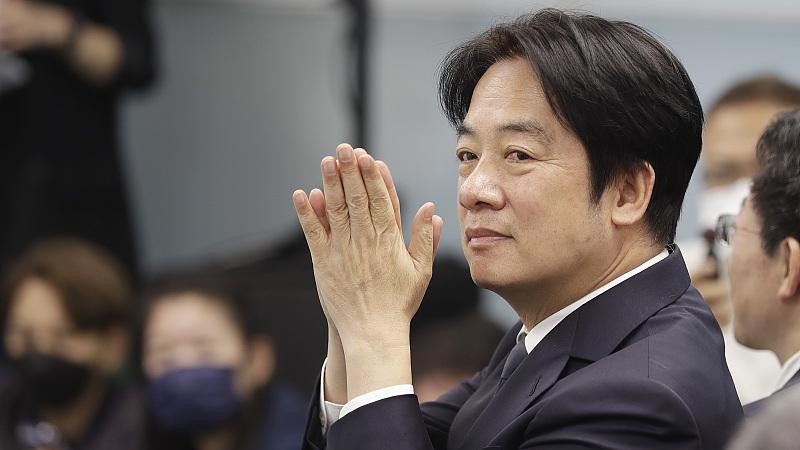
Lai Ching-te, leader of China's Taiwan region. (Photo: Xinhua)
Following reckless Taiwan-related remarks by some Japanese politicians and massive U.S. arms sales to China's Taiwan region, the region's leader Lai Ching-te seized the moment to escalate tensions.
The Chinese mainland responded resolutely to that with robust countermeasures.
As reality sets in, Lai's bravado is unraveling – replaced by anxiety, retreat and hollow rhetoric.
Political calculus at Taiwan's expense
Lai's obsession with "seeking independence by relying on the U.S." shows utter disregard for Taiwan's economic future and the well-being of its people. For him, Taiwan is expendable if it serves external forces.
When the United States imposed additional tariffs on products from Taiwan, Lai yielded without negotiation. When Washington pressured Taiwan Semiconductor Manufacturing Co. to increase investment in the U.S., concessions followed swiftly.
Now, with U.S. arms dealers demanding higher "protection fees," Lai has once again complied without hesitation, enabling U.S. military contractors to siphon value from Taiwan at will.
Yet this reality has not curbed Lai's appetite for military spending. The island's proposed defense budget for 2026 has been set at NT$949.5 billion ($31.1 billion), equivalent to about 3.32 percent of the region's GDP.
While openly calling for defense spending to reach five percent of GDP by 2030, the Taiwan authorities floated another special defense budget totaling NT$1.25 trillion, underscoring Lai's willingness to turn Taiwan into a cash cow for U.S. arms suppliers.
The mounting public frustration over all this was vividly expressed during the 2025 "Autumn Struggle" demonstrations on the island, with slogans such as "Zero arms purchases, zero war," and "Oppose lies, seek truth; oppose war, seek survival."
Retreat under countermeasures
What truly unsettled Lai was the Chinese mainland's swift and forceful response. On December 26, 2025, China's Ministry of Foreign Affairs announced countermeasures against 20 U.S. military companies and 10 senior executives involved in arms sales to the Taiwan region.
This sent a clear signal: profiteering by meddling in China's internal affairs carries concrete consequences.
In addition, the Chinese People's Liberation Army (PLA) conducted drills around Taiwan, Justice Mission 2025, featuring all-dimensional deterrence and live-fire drills. The footage released by the PLA, including drone views overlooking Taipei 101, once the world's tallest building, caused widespread shock on the island.
In the face of these actions, Lai discovered that his supposed backers offered little more than verbal support. No tangible steps were taken to "stand with Lai." Strategic ambiguity quickly replaced prior bravado. Lai himself changed his tone, publicly stating that Taiwan would not escalate confrontation or provoke conflict.
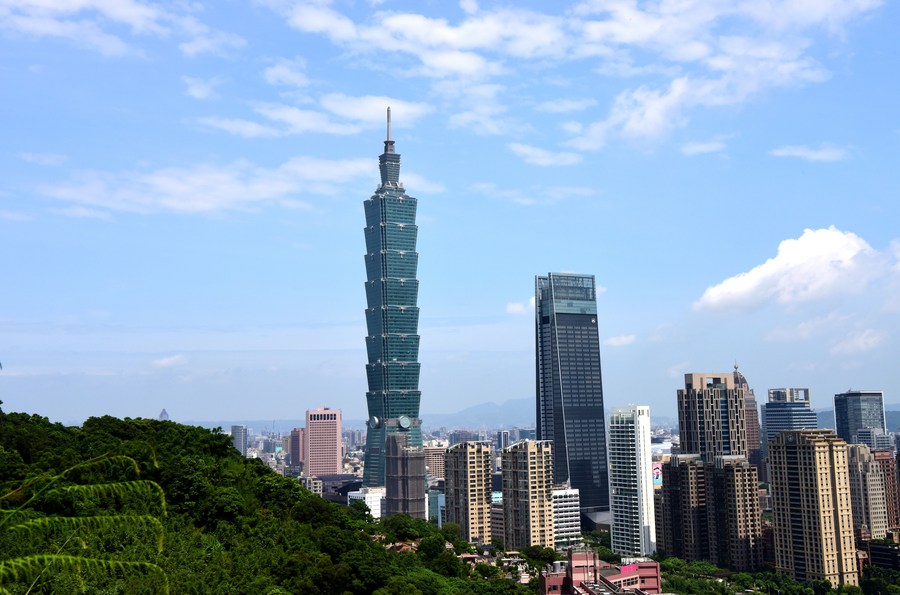
The Taipei 101 skyscraper in Taipei, southeast China's Taiwan region, July 21, 2019. (Photo: Xinhua)
Preparing an exit
Despite the outward defiance, measures for Taiwan's separatists to flee if the situation worsens have reportedly been in place for years.
The contingency plans for political evacuation have become an open secret. During the annual military exercises by Taiwan, emergency evacuation drills were conducted as well.
It is widely circulated that in the event of a crisis, Lai would flee from Taipei's Hengshan Military Command Center through an underground passage to the Songshan Airport, then be airlifted to the coast and transferred by U.S. naval vessels to U.S. territory Guam in the Western Pacific Ocean, or Japan or the Philippines.
In one word, while Taiwan is pushed toward danger, Lai himself is ready to leave at the first sign of real risk.
The last remaining 'hard line'
At this stage, rhetoric is all that remains. Despite mounting public opposition and the countermeasures from the mainland, Lai continues to promote distorted narratives.
He claimed that "the Chinese mainland lacks the capability to achieve reunification by force" – only to be confronted by the drills. Faced with overwhelming military realities, statements such as "Not backing down in the face of threats" ring increasingly hollow.
The truth is clear. It is not those seeking peace and dialogue who are provoking tension in the Taiwan Strait but those pursuing separatism, relying unconditionally on external forces and treating Taiwan as a pawn. No amount of rhetorical maneuvering can conceal that reality.
A public opinion survey conducted by Taiwan media on December 29, 2025, found that 94 percent of respondents thought Lai was responsible for the escalation that led to the PLA exercises.
History moves forward relentlessly. Any attempt to resist the tide through reckless confrontation is ultimately futile.
Lai Ching-te's fantasy of "seeking independence by relying on force," no matter how loudly proclaimed, is destined to fail.