


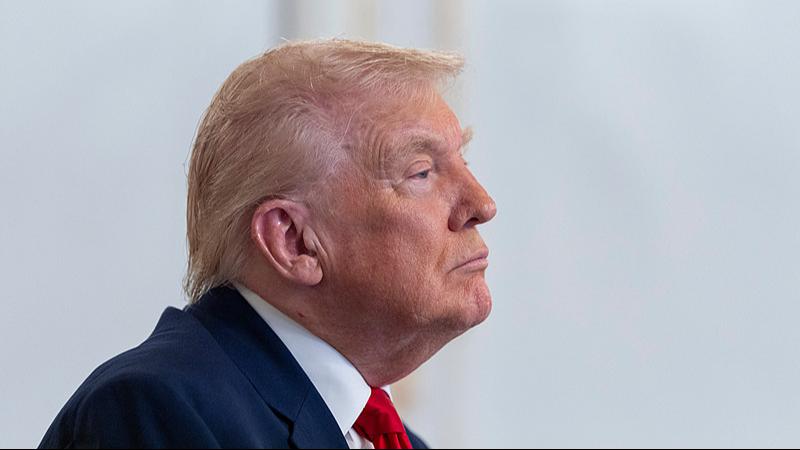
U.S. President Donald Trump speaks to troops via video from his Mar-a-Lago estate on Thanksgiving in Palm Beach, Florida, United States, November 27, 2025. (Photo: CFP)
Editor's note: Imran Khalid, a special commentator on current affairs for CGTN, is a freelance columnist on international affairs. The article reflects the author's opinions and not necessarily the views of CGTN.
On February 6, the digital machinery of the American presidency once again slipped gears. A video released for a short time bypassed decorum to land squarely in the territory of the grotesque.
The 62-second clip, shared on U.S. President Donald Trump's Truth Social account, was ostensibly about the persistent phantom of the 2020 "election fraud." Its more severe problem was the artificial intelligence (AI)-generated imagery it used, depicting former U.S. President Barack Obama and former first lady Michelle Obama as apes.
By noon, the post was gone. The White House blamed a staffer's error, a rare admission of misstep. Earlier, there had been a more characteristic defense of the post as a harmless "King of the Jungle" meme. The president himself later said he had approved the post but missed the offensive finale.
It is a familiar rhythm: provocation, outrage, half-hearted distancing, and finally, a shrug.
To view this incident merely as a lapse in vetting is to ignore the structural transformation of American political life. We are witnessing the refinement of "identity attack" as a primary tool of governance where technology does not just facilitate debate but actively works to hollow it out.
The controversy illustrates how technology has fundamentally reshaped the modes of political attack. In previous eras, a racial slur or a dehumanizing caricature conveyed a degree of intent that carried heavy social costs. Today, the rise of hyper-realistic AI visuals and the "meme-fiction" of discourse provide a convenient layer of plausible deniability.
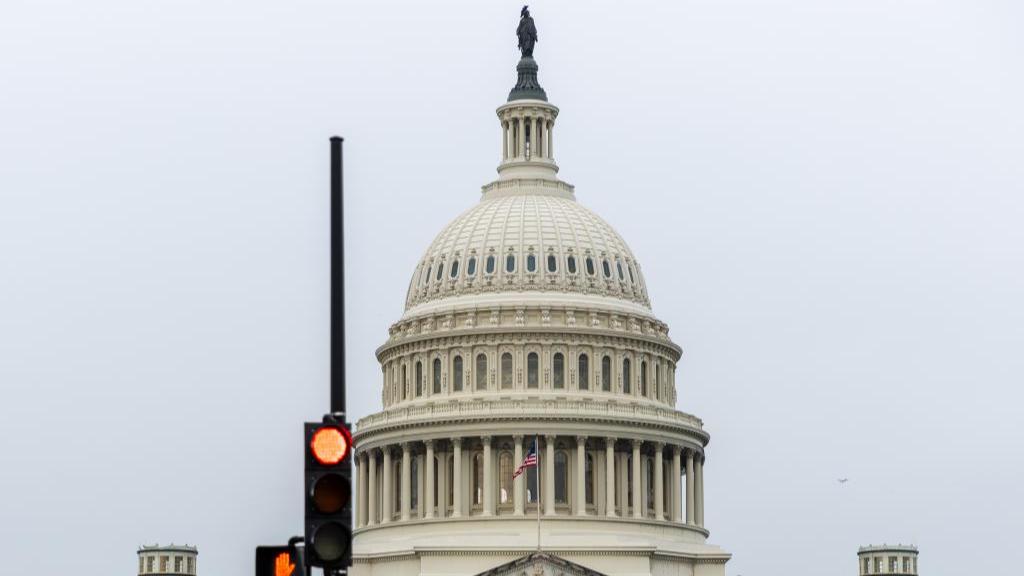
The U.S. Capitol building and traffic lights are seen in Washington D.C., the United States, September 30, 2025. (Photo: Xinhua)
When a video can be generated by an anonymous account and amplified by a head of state within minutes, the boundary between "error" and "offense" vanishes. The digital medium encourages a "post first, explain later" culture that prioritizes emotional impact over factual accuracy. By the time a video is deleted, its work is already done. It has fed the algorithm, energized the base and further siloed an electorate which, as Barack Obama once noted, seems to live on different planets of information.
More troubling than the technology is the intent. The use of simian imagery to target Black Americans is not a new or creative insult; it is a centuries-old trope designed to strip away the humanity of the subject. When this occurs in the context of contemporary identity politics, it transforms the metaphor of "dehumanization" into a physical weapon.
Identity politics, in its most constructive form, seeks to recognize the unique experiences of marginalized groups. In its current, weaponized form, it is used to reduce individuals to caricatures. By portraying the Obamas as animals, the video attempts to remove them from the realm of legitimate political actors.
This is the ultimate goal of the "dehumanization" tactic: To suggest that your opponents are not merely wrong, but subhuman, and therefore ineligible for the rights and respect afforded to citizens.
When this rhetoric emanates from the highest office in the land, it tears at the social fabric. It signals that the rules of civil society are optional and the dignity of one's neighbor is subject to political utility. The "King of the Jungle" defense offered by the White House press secretary was not just a deflection, it was an attempt to normalize the abnormal by framing a racist trope as mere pop-culture playfulness.
Finally, the recurring cycle of apology and clarification reflects a deeper erosion of public trust. In a healthy democracy, a mistake is followed by accountability. In our polarized public sphere, the "staffer error" has become a cliche that no one truly believes, yet everyone is forced to endure.
When Trump says he "didn't see" the part of the video everyone is talking about, he is not asking for forgiveness; he is demonstrating that he is beyond the reach of consequence. This creates a state of permanent exhaustion in the public. When every day brings a new outrage that is subsequently "clarified" without a genuine change in behavior, the very concept of an apology loses its meaning.
What is ultimately lost in this cycle is the possibility of a common ground. Public issues are reduced to "emotional venting," and the space for actual policy debate is crowded out by the need to respond to the latest digital arson. When the political sphere becomes a theater of identity-based attacks, we lose the ability to see each other as fellow citizens with shared stakes in the future.
The video may have been deleted, but the fractures it exposed remain. If we continue to allow technology to amplify our worst instincts and identity to be used as a tool for dehumanization, we will find ourselves in a society where the only thing left to share is our mutual contempt.