


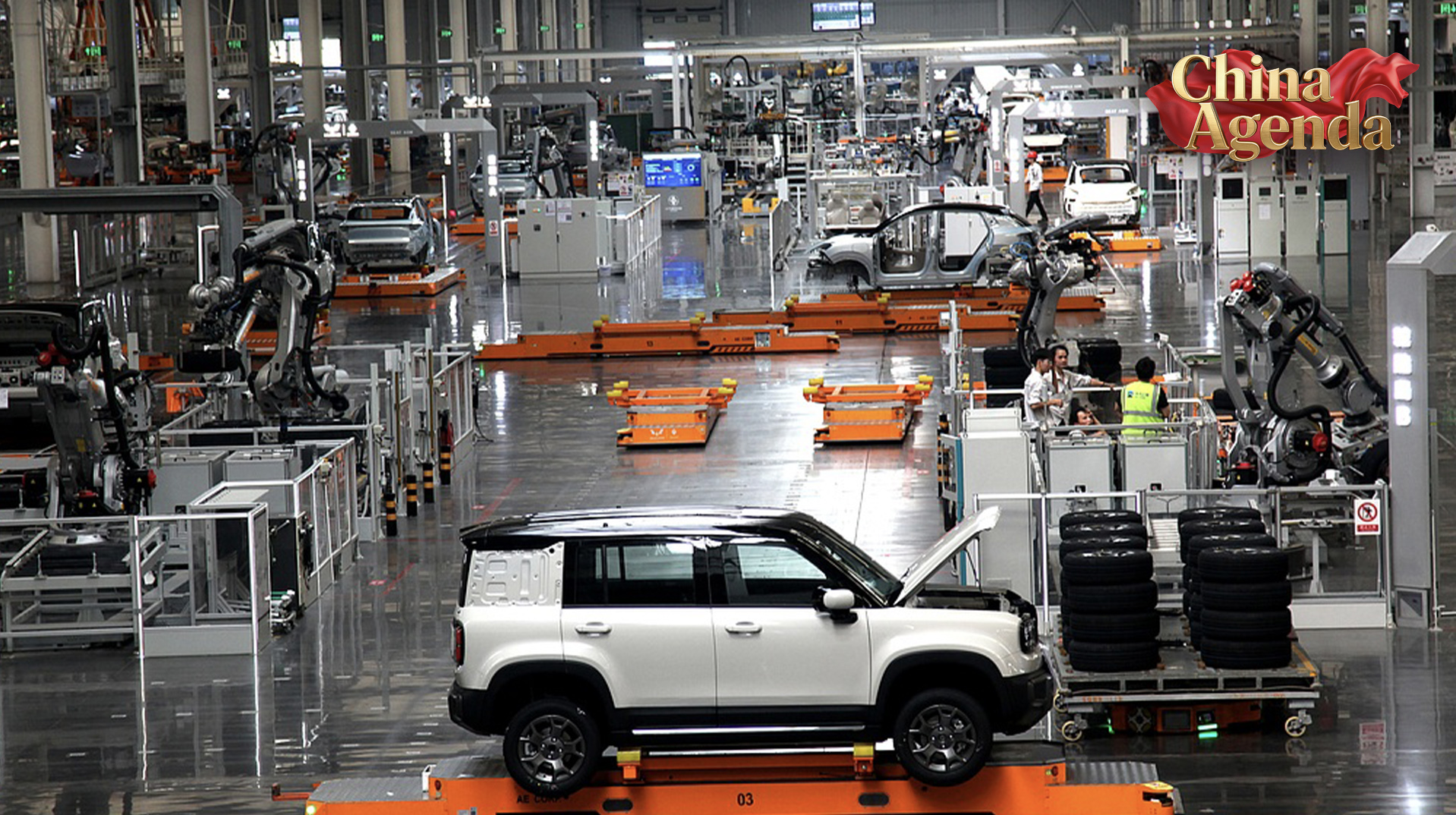
Workers on the production line are manufacturing new energy vehicles in Liuzhou City, south China's Guangxi Zhuang Autonomous Region, September 11, 2025. (Photo: VCG)
As China prepares for its annual Two Sessions, one question is drawing increasing global attention: How resilient is the world's second-largest economy at a time when the international economic order is undergoing profound changes?
China reported 5 percent year-on-year GDP growth in 2025, with total output reaching 140.19 trillion yuan (about $20.13 trillion). Foreign trade expanded to 45.47 trillion yuan, marking the ninth consecutive year of growth.
In a world marked by volatility and fragmentation, the figures inevitably prompt a deeper question: Why has China's economy managed to sustain steady growth? Where does its stability come from? And what underpins its resilience?
The answers lie not only in headline statistics but in the institutional foundations, structural upgrading and innovation-driven transformation that are reshaping the Chinese economy.
Institutional stability: governance as economic support
At the foundation of China's economic resilience is a governance system capable of translating policy direction into practical results.
One important component of China's vast governance structure is its grassroots deputies. The country has more than 2.5 million deputies across five levels of people's congresses. Many serve as bridges between policymakers and market participants, ensuring that regulatory adjustments respond to real economic needs.
In Beijing, for example, feedback from foreign-funded enterprises about unclear regulatory procedures and cumbersome approval processes was gathered by local legislators and later translated into streamlined procedures and bilingual policy guidelines. These changes reduced transaction delays and improved business efficiency.
Policy support has also played a crucial role in sustaining China's economic momentum. For example, in January last year, the country's top economic planner, the National Development and Reform Commission (NDRC), released guidelines for building a unified national market to reduce transaction costs and improve factor mobility nationwide. Meanwhile, China's national lawmakers in April passed the country's first fundamental law dedicated to promoting the private sector, seeking to ensure fair competition, improve financing access and strengthen legal protections for private enterprises.
China's institutional framework reduces uncertainty for businesses and strengthens confidence – a key stabilizer in times of global turbulence.
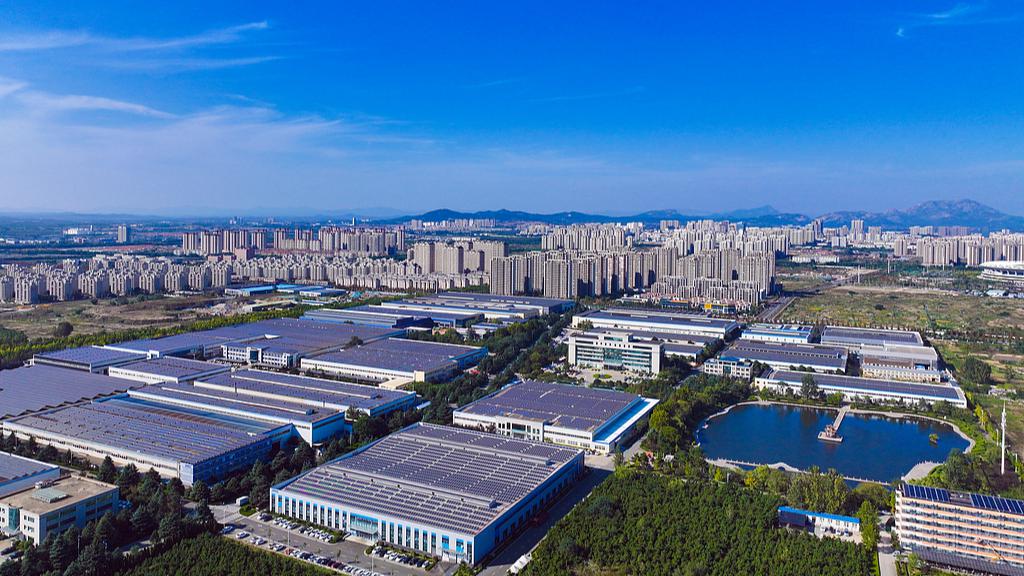
Solar panels neatly arranged on the rooftops of factory buildings in an industrial park, Rizhao City, east China's Shandong Province, October 22, 2025. (Photo: VCG)
Structural upgrading: strengthening the growth engine
Beyond governance, structural transformation has reshaped the drivers of growth.
China's traditional industries are accelerating upgrading, while strategic emerging sectors – including next-generation information technology, high-end equipment manufacturing and new energy vehicles – continue to expand. At the same time, future-oriented industries such as quantum computing, industrial robotics and artificial intelligence are developing rapidly.
Green and low-carbon transformation has become a defining feature of this transition. In 2025, China's new energy vehicle output surpassed 16 million units, maintaining its global lead for the 11th consecutive year. The country has also built the world's largest and most comprehensive renewable energy industrial chain.
According to the NDRC, China's energy consumption per unit of GDP fell 11.6 percent compared with 2020, equivalent to cutting approximately 1.1 billion tonnes of carbon dioxide emissions.
The shift toward greener production not only strengthens competitiveness but also enhances long-term sustainability.
Maris Lauri, the World Bank's chief economist for China, said that green and low-carbon development and innovation-driven growth are reshaping China's economic model while creating opportunities for global technological advancement and green cooperation.
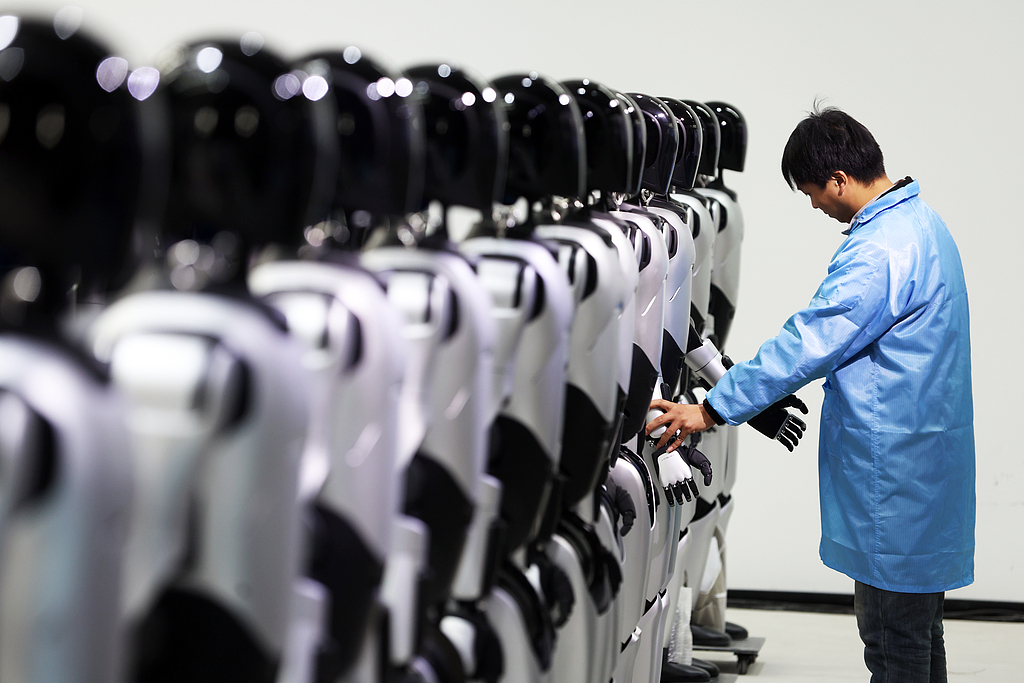
An engineer is adjusting robots in a mass-production factory, east China's Shanghai Municipality, December 8, 2025. (Photo: VCG)
Innovation drive: accelerating new quality productive forces
As structural upgrading reshapes China's growth model, technological innovation provides growing momentum and has emerged as a central pillar of the country's economic resilience.
From the rapid rise of domestic AI models to the integration of large language models across industries, and from industrial robotics breakthroughs to humanoid robots entering real-world applications, innovation is increasingly embedded throughout the industrial chain.
Data from the Ministry of Industry and Information Technology showed that by early 2026, China had more than 6,000 AI enterprises, with the core AI industry exceeding 1.2 trillion yuan in scale, up nearly 30 percent year on year. Domestic open-source large models have recorded over 10 billion downloads globally, signaling that AI development has moved beyond isolated technological competition to ecosystem-wide integration.
Behind this acceleration is a comprehensive policy framework. China has elevated scientific and technological self-reliance to a strategic priority, launched major national research programs and laboratories, positioned enterprises at the center of innovation, strengthened industry–academia collaboration and introduced tax incentives, R&D subsidies and science-finance mechanisms to speed commercialization.
As 2026 marks the beginning of China's new Five-Year Plan period (2026–2030), policymakers have placed the construction of a modern industrial system, the cultivation of new quality productive forces, the expansion of domestic demand and higher-level opening-up at the forefront of the policy agenda. In an era of global uncertainty, China is leveraging its internal stability to buffer external uncertainties.
Fikreyesus Yamhassen, a researcher at the Eritrean Center for Strategic Studies, said China's efforts to cultivate new quality productive forces and upgrade traditional industries through innovation will not only boost its own growth and lay the groundwork for long-term development, but also contribute technological solutions to global challenges such as food security and climate change.