


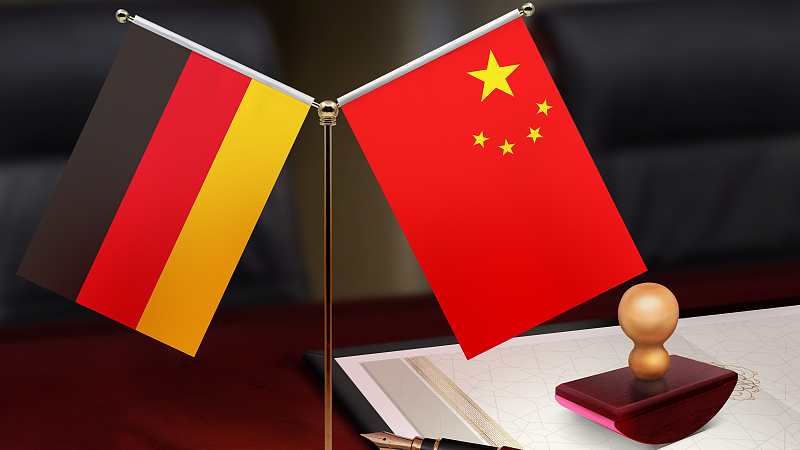
Photo: CFP
German Chancellor Friedrich Merz is paying his first official visit to China on Wednesday. For the world's second- and third-largest economies, the trip presents a good opportunity to enhance mutual understanding, strengthen pragmatic cooperation and jointly contribute more to world peace and prosperity.
At a time when the world is experiencing turbulence and transformation, China and Germany, as major economies and advocates of multilateralism, share the responsibility to uphold the stability of global industrial and supply chains and oppose protectionism and economic coercion.
In a widely noted gesture, Merz recently extended Chinese New Year greetings via social platform X, expressing hope that the Year of the Horse would "bring strength and give new impetus to German-Chinese relations." The message was widely interpreted in Germany as a signal of Berlin's positive expectations for the trip and its intention to reinvigorate economic ties through high-level dialogue.
The composition of the delegation underscores the stakes. Executives from around 30 major companies, including Bayer, Siemens, BMW, Mercedes-Benz and Volkswagen, are expected to accompany the chancellor, once again demonstrating the confidence of the German business community in the Chinese economy and the vitality of bilateral cooperation.
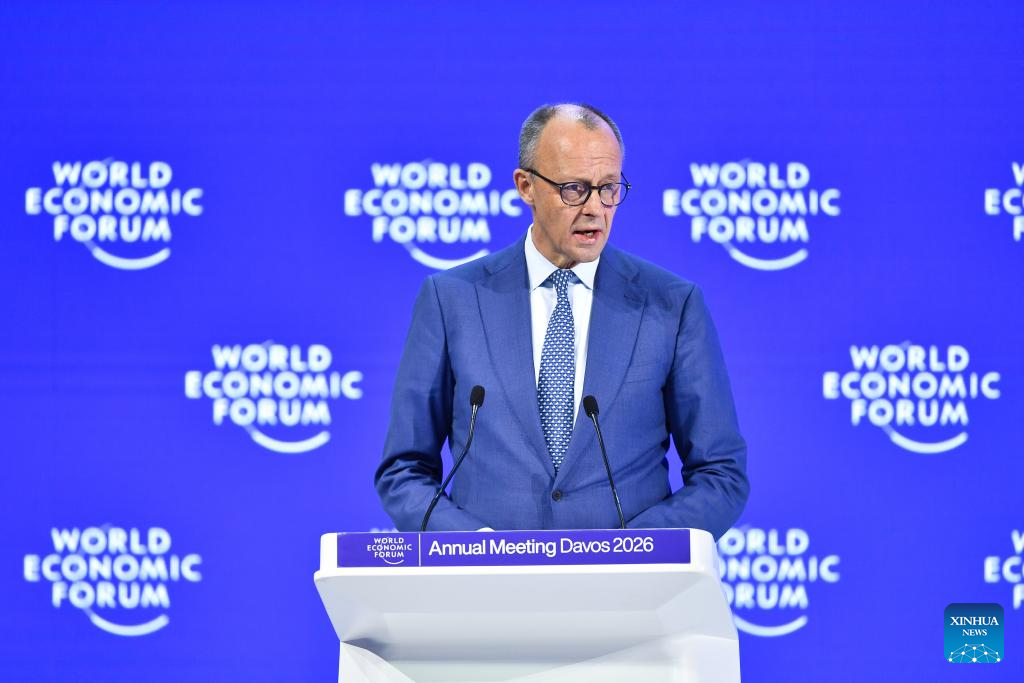
German Chancellor Friedrich Merz speaks at the World Economic Forum (WEF) Annual Meeting 2026 in Davos, Switzerland, January 22, 2026. (Photo: Xinhua)
According to German media Handelsblatt, applications for the trip far exceeded the available seats -- an indication of German industry's determination to deepen its footprint in China and expand investments and partnerships.
The enthusiasm of German businesses is rooted in decades of economic logic. Since the establishment of diplomatic ties in 1972, the two countries have built a dense web of economic links.
Germany has long been China's largest trading partner and source of foreign investment in Europe. Their industrial sectors are deeply integrated, and the foundation of cooperation continues to strengthen. Official data from China's Ministry of Commerce show that bilateral trade between China and Germany has remained above 200 billion U.S. dollars for consecutive years. China has also solidified its position as Germany's largest trading partner for nine of the past 10 years.
Over the past two decades, the China-Germany relationship has matured further. From automotive and machinery to chemicals and advanced materials, German firms have leveraged China not only for its immense scale but also as a hub for innovation. While Germany's automotive giants treat China as a core global market, large companies like BASF and Merck have established R&D and manufacturing clusters, reflecting steadily deepening industrial ties.
The visit comes as debates over "decoupling" and "de-risking" from China continue in Europe and even within Germany. Business sentiment, however, reflects a different calculus rooted in long-term confidence.
A survey by the German Chamber of Commerce in China reveals that 93 percent of German firms intend to maintain or expand their presence in China, more than half plan to increase investment in the next two years, and nearly two-thirds view Chinese partners as indispensable strategic pillars. Meanwhile, innovation gains in China are now feeding back into German headquarters, driving product upgrades on a global scale.
Hard data reinforce this trend. Data from the German Economic Institute show that new German direct investment in China amounted to around 7 billion euros (8.26 billion dollars) in 2025, well above the roughly 4.5 billion euros (5.3 billion dollars) a year earlier. As noted by Juergen Matthes, an expert at the institute, German companies are not only expanding their presence in China but also accelerating the pace of investment.
The broader trajectory of China-Germany relations remains clear. Decades of exchange have closely linked the two economies, making their partnership a case study in the gains of globalization, linking two manufacturing leaders through trade, investment and innovation.
In an era of rising protectionism and unilateralism, closer engagement between Beijing and Berlin carries significance far beyond their borders. It serves as an anchor for global expectations, proving that openness and practical cooperation remain the most viable choice for major economies in an uncertain world.