


Chinese President Xi Jinping met in Beijing on Wednesday with German Chancellor Friedrich Merz, the first foreign leader to pay an official visit to China in the Year of the Horse. President Xi made three propositions on further developing China-Germany relations, providing strategic guidance for deepening bilateral ties. The international community believes that at a time of profound turbulence and transformation in the global landscape, China and Germany have jointly sent a positive signal of upholding openness and cooperation and addressing challenges together, bringing greater stability to a turbulent world.
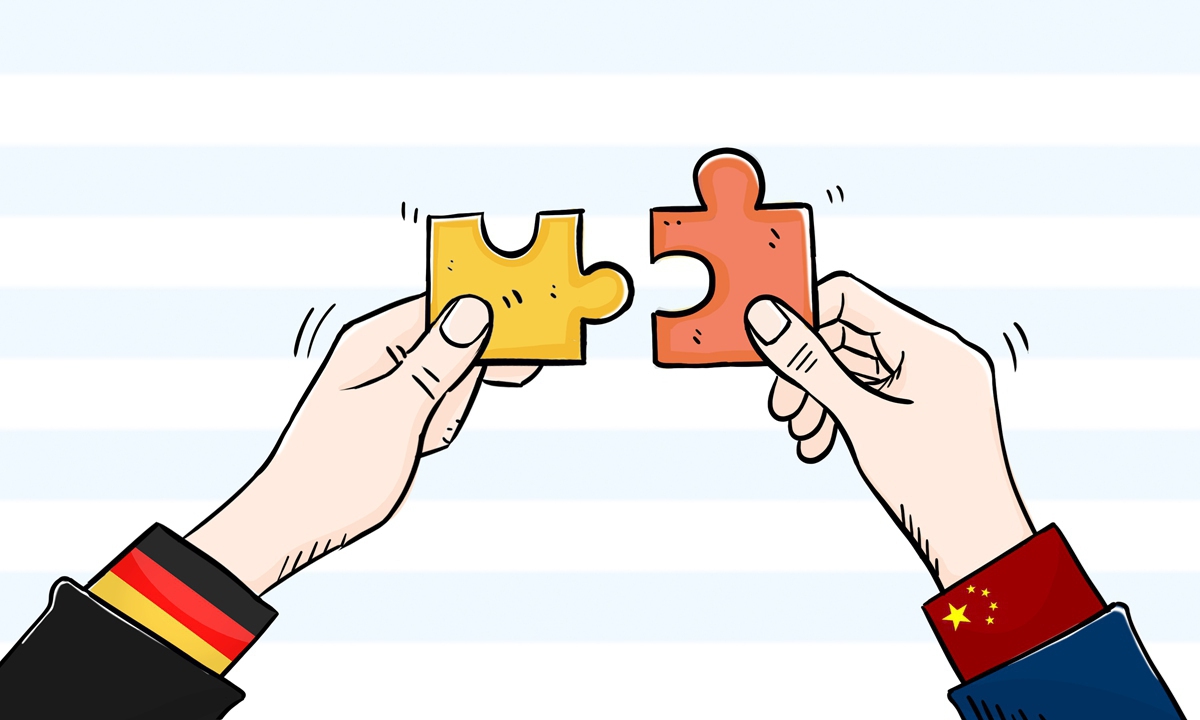
Illustration: Chen Xia/GT
China and Germany are the world's second- and third-largest economies, respectively. Their relationship concerns not only the interests of the two countries but also has significant spillover effects for Europe and the wider world. To ensure that this relationship continues to move in the right direction, strategic guidance from leaders is crucial. In May last year, shortly after Chancellor Merz took office, President Xi had a phone call with him at the latter's request. At the beginning of the Year of the Horse, Chancellor Merz embarked on his first visit to China during his tenure, accompanied by a high-level delegation that included 30 representatives from the German business community. German media described the visit as having been prepared with unprecedented care.
During the meeting, President Xi proposed that China and Germany should be reliable partners that support each other, innovative partners that champion openness and win-win results, and partners that understand each other and share close bonds through cultural and people-to-people exchanges. He also called on both sides to take the lead in safeguarding multilateralism, practicing international rule of law, defending free trade, and advocating for solidarity and coordination. This sets the direction for unlocking the potential of China-Germany relations, ensuring their steady development, and benefiting both countries and the wider world. The two sides issued a joint press statement, agreeing that mutual respect, mutual benefit and win-win results, continued open dialogue, and cooperation in addressing common challenges are the fundamental principles for developing China-Germany relations. Chancellor Merz said that the German side values its relations with China and stands ready to continue to deepen the all-around strategic partnership.
Over the years, China and Germany have pursued development based on their respective national conditions, while adhering to the principles of mutual respect, mutual trust and open cooperation, building a strong record of mutually beneficial cooperation. From the early days of China's reform and opening-up, when German companies helped develop China's automobile industry, to today, when China's green and digital technological innovations are promoting the upgrading of the global automotive industry, the integrated development of the China-Germany automobile sector is a microcosm of mutually beneficial cooperation. In recent years, annual trade between China and Germany has consistently exceeded $200 billion, and two-way investment stock has surpassed $65 billion. Cooperation has entered a new stage of deeper integration and innovation.
During his visit, Chancellor Merz attended a symposium of the China-Germany economic advisory committee, visited companies and localities, and experienced firsthand China's new quality productive forces and the achievements of Chinese modernization. The arrangements were described by German participants as "joining the club of friends of open dialogue." Germany's new development strategies in technology, innovation and digitalization highly resonate with China's objective of intelligent, green and integrated development during the 15th Five-Year Plan (2026-2030) period. There are broad prospects for upgrading cooperation in traditional sectors and enormous potential in emerging sectors. As long as both sides properly handle the relationship between competition and cooperation, they can find pathways to mutually beneficial collaboration and better promote development in both countries and globally.
The current international landscape is undergoing its most profound changes since the end of World War II. The existing international order is under severe strain, and multilateralism faces serious challenges. Against this backdrop, European leaders have visited China in quick succession, forming what some describe as a trend of "looking east." European observers have interpreted this as showing that, in an increasingly turbulent world, many recognize China as a stable anchor. The international community has widely noted that China and Germany have jointly voiced firm support for the status of the United Nations and for multilateralism and free trade, demonstrating the responsibility of major powers to safeguard global stability and prosperity. China has consistently held that Europe is an important pole in a multipolar world and supports Europe's strategic autonomy. The stormier the times, the more China and Europe should uphold the banner of multilateralism, maintain their strategic partnership, adhere to openness, inclusiveness and win-win cooperation, advance China-EU relations to greater heights, and make greater contributions to world peace and development.
China remains committed to the path of peaceful development and has the capacity and confidence to achieve Chinese modernization. It will continue to share development opportunities with Germany and other countries around the world. Looking ahead, as long as China and Germany remain reliable partners that support each other, innovative partners that champion openness and win-win results, and partners that understand each other and share close bonds through cultural and people-to-people exchanges, they will inject fresh momentum into China-EU relations through the stability of China-Germany ties, and add stability, development and cooperation to a turbulent world.