


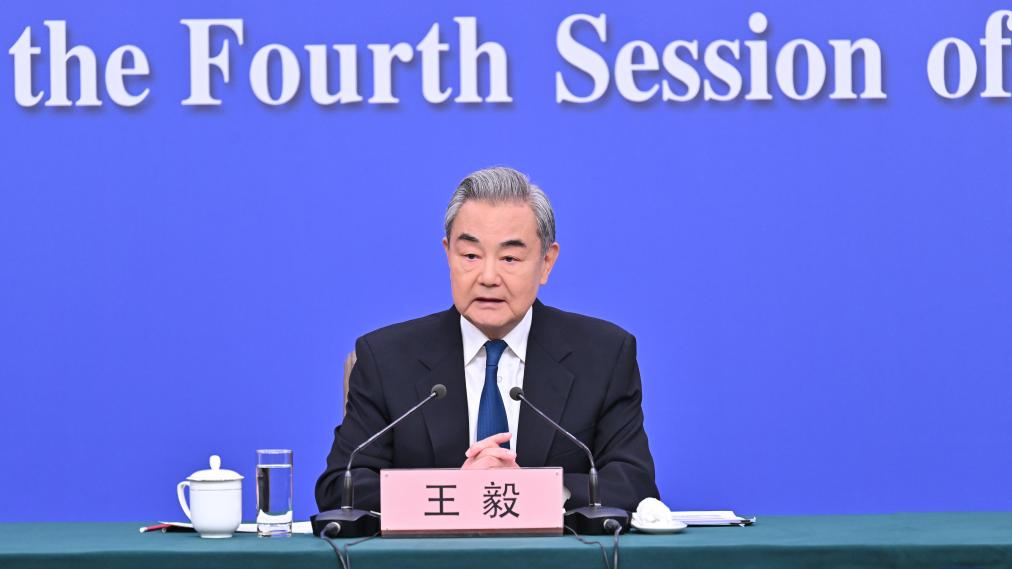
Chinese Foreign Minister Wang Yi, also a member of the Political Bureau of the Communist Party of China Central Committee, attends a press conference on China's foreign policy and external relations on the sidelines of the fourth session of the 14th National People's Congress (NPC) in Beijing, capital of China, March 8, 2026. /Xinhua
Editor's note: Ma Ning is a special commentator on current affairs for CGTN. The article reflects the author's views and not necessarily those of CGTN.
For observers abroad, Chinese Foreign Minister Wang Yi's press conference on Sunday on the sidelines of the fourth session of the 14th National People's Congress was a key moment to gauge the trajectory of Chinese foreign policy at a time of profound global realignment.
Globally, the landscape is fragmented. The Middle East has once again tipped into open strife, transatlantic relations are showing signs of strain, and Washington continues to pursue an aggressively unilateralist agenda.
In this volatile mix, China presents itself as a steadying force. Beijing's diplomatic messages at the two sessions is being interpreted by many as an attempt to project predictability, an offering of "certainty" in uncertain times.
'Certainty' in a shifting world
That certainty, as Wang reiterated at the press conference, stems from standing firm on the right side of history, advocating peaceful development. Whatever the turbulence beyond its borders, China's core orientation has not changed. It remains, in the phrasing of its diplomats, "a builder of world peace, a contributor to global development and a defender of the international order." This is a strategic commitment rooted in national interest.
The most concrete signal of the pull it exerts has been the flurry of foreign leaders' visits to Beijing in the first quarter of 2026. These visits reflect a pragmatic gravitation toward what many now view as the world's most stable growth engine.
With China's economy having crossed the 140 trillion yuan ($20.3 trillion) threshold, attention is now fixed on the forthcoming 15th Five-Year Plan – regarded as not a purely domestic roadmap but a guide to future opportunity.
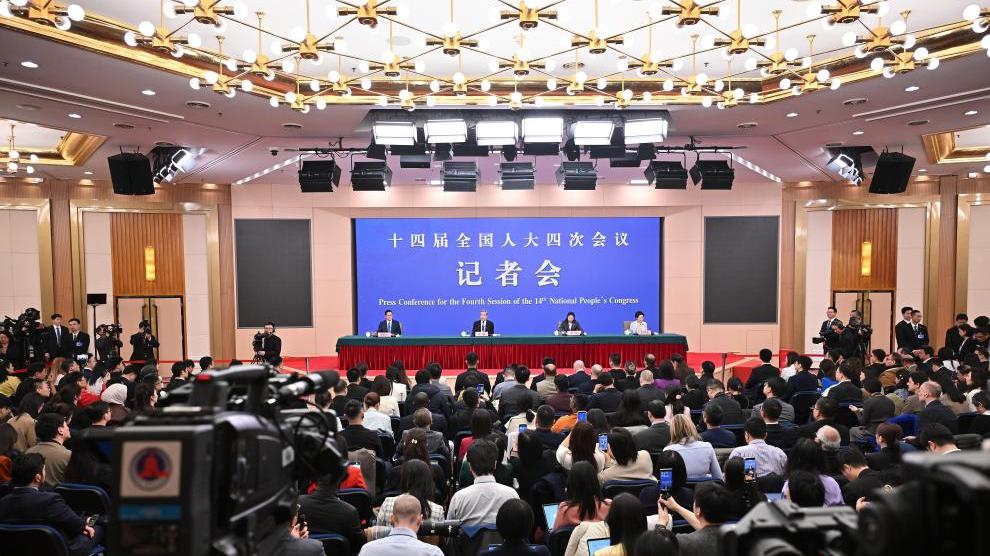
Chinese Foreign Minister Wang Yi’s press conference on China's foreign policy and external relations on the sidelines of the fourth session of the 14th National People's Congress in Beijing, China, March 8, 2026. /Xinhua
Managing major-power friction
"Neither China nor the United States can remodel the other, but we can choose how we want to engage," Wang said at the press conference. The management of China-US relations remains the most delicate variable in the diplomatic equation. After a bruising 2025 marked by punitive tariffs reaching new highs, both sides have signaled a desire to stabilize the relationship. While hardliners in Washington continue to push a confrontational line, there is also a discernible pragmatism creeping in – an openness, on certain issues, to transactional engagement rather than ideological showdown.
For Beijing, this offers room to consolidate a new modus vivendi: one in which Washington engages with it on terms closer to parity. The old "teacher-student" dynamic, as some Chinese strategists describe it, is increasingly untenable. What replaces it remains under negotiation, both in substance and tone.
At the same time, China continues to cast itself as a defender of multilateral frameworks. On issues ranging from climate change to digital governance and pandemic preparedness, it has sought to position itself as a proponent of inclusive cooperation. In the face of "decoupling" narratives and supply chain fragmentation, Beijing's message is consistent: Global problems require global solutions, and no single power should monopolize the rules.
Principles, proximity and the Global South
"The collective rise of the Global South is the distinct hallmark of the great transformation unfolding in the world," Wang said, adding that the Global South should speak up for peace and empower development on the international stage.
Behind the diplomatic signaling lies a structural shift. China's neighborhood strategy is to turn its periphery into a "common home of peace, tranquility, prosperity, beauty and friendship." That reflects a calculated effort to deepen integration – whether through the Regional Comprehensive Economic Partnership, code-of-conduct talks with the Association of Southeast Asian Nations on the South China Sea, or engagement with Central Asia and Southeast Asia.
These are not merely gestures of goodwill. They are experiments in building what Beijing calls "a community with a shared future for humanity" – a concept now being tested regionally before being scaled globally. To that end, China's Global Governance Initiative is increasingly being translated into programs with tangible content.
For much of the global community, this matters. At a time when traditional great-power rivalry offers little but polarization, China is presenting itself as an alternative: one that offers investment, infrastructure, and a commitment to multipolar coexistence. By backing the United Nations' central role in peace and security, Beijing is seeking to demonstrate that its vision of global order is not merely rhetorical.
As the "two sessions" continue, the diplomatic message emanating from Beijing is unmistakable: In a world of growing uncertainty, China offers itself as a point of certainty and confidence. Not through dominance or disruption, but through the promise of stability and the allure of opportunity.
In a fragmented international landscape, many are choosing to hear China's voice. And that voice is likely to carry increasing weight in the multipolar order taking shape.